

Except for low molecular organic gelators, metal-based LMWGs can also be
tuned by anions stimuli. Lee and co-workers reported a metallogel formed by the
bent-shaped bipyridine ligand with dendritic aliphatic appendages 54
(Scheme 2.11) complexed with silver ion through self-assembling process into
supramolecular aggregates. And the secondary structure of a cationic coordination
chain appears to be dependent on the size of the counteranion. With the triflate ion,
these chains are dimeric rather than helical and then the units stack into hexagonally
packed columns, which undergo gelation in aqueous solution. Addition of large
anions such as C 2 F 5 CO 2
− and C 3 F 7 CO 2
− can lead to a gel-to-sol transitions as the
ligand changes from a cisoid to transoid from, which is completely reversible
(Fig. 2.36) [138].
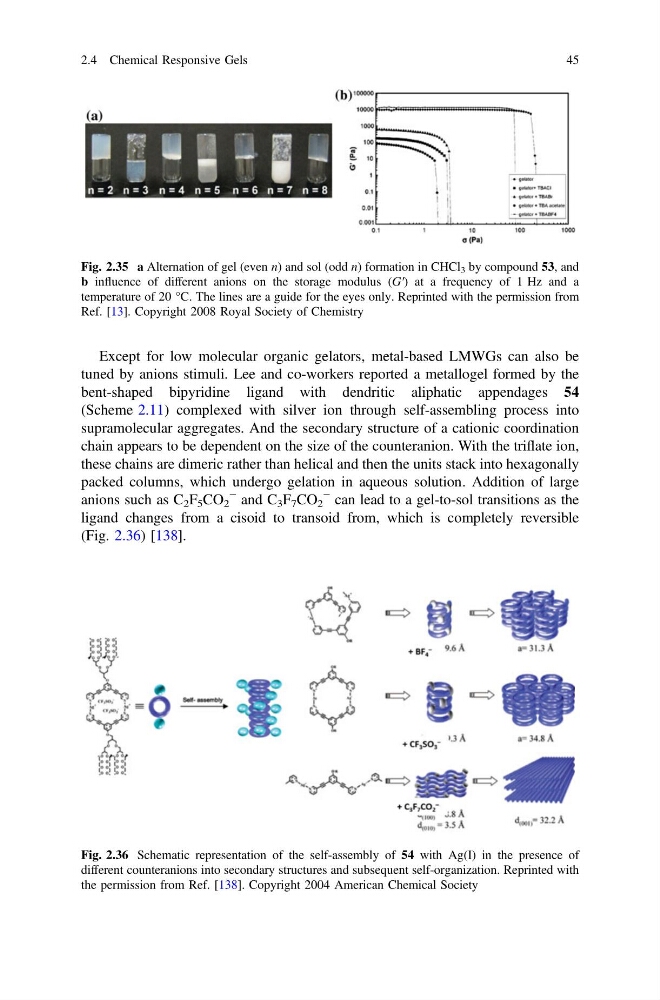
Fig. 2.35 a Alternation of gel (even n) and sol (odd n) formation in CHCl 3 by compound 53, and
b influence of different anions on the storage modulus (G′) at a frequency of 1 Hz and a
temperature of 20 °C. The lines are a guide for the eyes only. Reprinted with the permission from
Ref. [13]. Copyright 2008 Royal Society of Chemistry
Fig. 2.36 Schematic representation of the self-assembly of 54 with Ag(I) in the presence of
different counteranions into secondary structures and subsequent self-organization. Reprinted with
the permission from Ref. [138]. Copyright 2004 American Chemical Society
2.4 Chemical Responsive Gels
45
tuned by anions stimuli. Lee and co-workers reported a metallogel formed by the
bent-shaped bipyridine ligand with dendritic aliphatic appendages 54
(Scheme 2.11) complexed with silver ion through self-assembling process into
supramolecular aggregates. And the secondary structure of a cationic coordination
chain appears to be dependent on the size of the counteranion. With the triflate ion,
these chains are dimeric rather than helical and then the units stack into hexagonally
packed columns, which undergo gelation in aqueous solution. Addition of large
anions such as C 2 F 5 CO 2
− and C 3 F 7 CO 2
− can lead to a gel-to-sol transitions as the
ligand changes from a cisoid to transoid from, which is completely reversible
(Fig. 2.36) [138].
Fig. 2.35 a Alternation of gel (even n) and sol (odd n) formation in CHCl 3 by compound 53, and
b influence of different anions on the storage modulus (G′) at a frequency of 1 Hz and a
temperature of 20 °C. The lines are a guide for the eyes only. Reprinted with the permission from
Ref. [13]. Copyright 2008 Royal Society of Chemistry
Fig. 2.36 Schematic representation of the self-assembly of 54 with Ag(I) in the presence of
different counteranions into secondary structures and subsequent self-organization. Reprinted with
the permission from Ref. [138]. Copyright 2004 American Chemical Society
2.4 Chemical Responsive Gels
45