

From above examples, the gel–sol processes are the results of the dissociation of
intermolecular hydrogen bonds by binding of addition of anions typically the
binding of fluoride. The strong binding of F
− anion origins from the high basicity of
the anion and results in the deprotonation of the hydrogen bonding moiety. Žinić
and co-workers reported an oxalamide-derived anthraquinone gelator 52
(Scheme 2.11), and it can form gels in various solvents with tuning properties by
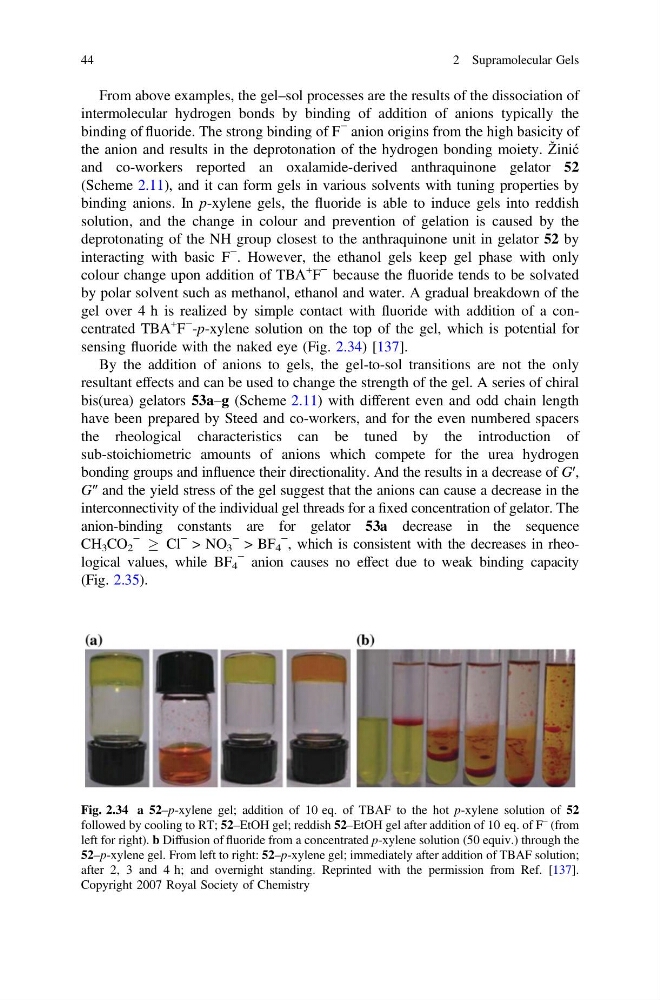
binding anions. In p-xylene gels, the fluoride is able to induce gels into reddish
solution, and the change in colour and prevention of gelation is caused by the
deprotonating of the NH group closest to the anthraquinone unit in gelator 52 by
interacting with basic F
− . However, the ethanol gels keep gel phase with only
colour change upon addition of TBA
+
F
− because the fluoride tends to be solvated
by polar solvent such as methanol, ethanol and water. A gradual breakdown of the
gel over 4 h is realized by simple contact with fluoride with addition of a concentrated TBA
+
F
−
-p-xylene solution on the top of the gel, which is potential for
sensing fluoride with the naked eye (Fig. 2.34) [137].
By the addition of anions to gels, the gel-to-sol transitions are not the only
resultant effects and can be used to change the strength of the gel. A series of chiral
bis(urea) gelators 53a–g (Scheme 2.11) with different even and odd chain length
have been prepared by Steed and co-workers, and for the even numbered spacers
the rheological characteristics can be tuned by the introduction of
sub-stoichiometric amounts of anions which compete for the urea hydrogen
bonding groups and influence their directionality. And the results in a decrease of G′,
G″ and the yield stress of the gel suggest that the anions can cause a decrease in the
interconnectivity of the individual gel threads for a fixed concentration of gelator. The
anion-binding constants are for gelator 53a decrease in the sequence
CH 3 CO 2
−
! Cl
− > NO 3
− > BF 4
−
, which is consistent with the decreases in rheological values, while BF 4
− anion causes no effect due to weak binding capacity
(Fig. 2.35).
Fig. 2.34 a 52–p-xylene gel; addition of 10 eq. of TBAF to the hot p-xylene solution of 52
followed by cooling to RT; 52–EtOH gel; reddish 52–EtOH gel after addition of 10 eq. of F
– (from
left for right). b Diffusion of fluoride from a concentrated p-xylene solution (50 equiv.) through the
52–p-xylene gel. From left to right: 52–p-xylene gel; immediately after addition of TBAF solution;
after 2, 3 and 4 h; and overnight standing. Reprinted with the permission from Ref. [137].
Copyright 2007 Royal Society of Chemistry
44
2 Supramolecular Gels
intermolecular hydrogen bonds by binding of addition of anions typically the
binding of fluoride. The strong binding of F
− anion origins from the high basicity of
the anion and results in the deprotonation of the hydrogen bonding moiety. Žinić
and co-workers reported an oxalamide-derived anthraquinone gelator 52
(Scheme 2.11), and it can form gels in various solvents with tuning properties by
binding anions. In p-xylene gels, the fluoride is able to induce gels into reddish
solution, and the change in colour and prevention of gelation is caused by the
deprotonating of the NH group closest to the anthraquinone unit in gelator 52 by
interacting with basic F
− . However, the ethanol gels keep gel phase with only
colour change upon addition of TBA
+
F
− because the fluoride tends to be solvated
by polar solvent such as methanol, ethanol and water. A gradual breakdown of the
gel over 4 h is realized by simple contact with fluoride with addition of a concentrated TBA
+
F
−
-p-xylene solution on the top of the gel, which is potential for
sensing fluoride with the naked eye (Fig. 2.34) [137].
By the addition of anions to gels, the gel-to-sol transitions are not the only
resultant effects and can be used to change the strength of the gel. A series of chiral
bis(urea) gelators 53a–g (Scheme 2.11) with different even and odd chain length
have been prepared by Steed and co-workers, and for the even numbered spacers
the rheological characteristics can be tuned by the introduction of
sub-stoichiometric amounts of anions which compete for the urea hydrogen
bonding groups and influence their directionality. And the results in a decrease of G′,
G″ and the yield stress of the gel suggest that the anions can cause a decrease in the
interconnectivity of the individual gel threads for a fixed concentration of gelator. The
anion-binding constants are for gelator 53a decrease in the sequence
CH 3 CO 2
−
! Cl
− > NO 3
− > BF 4
−
, which is consistent with the decreases in rheological values, while BF 4
− anion causes no effect due to weak binding capacity
(Fig. 2.35).
Fig. 2.34 a 52–p-xylene gel; addition of 10 eq. of TBAF to the hot p-xylene solution of 52
followed by cooling to RT; 52–EtOH gel; reddish 52–EtOH gel after addition of 10 eq. of F
– (from
left for right). b Diffusion of fluoride from a concentrated p-xylene solution (50 equiv.) through the
52–p-xylene gel. From left to right: 52–p-xylene gel; immediately after addition of TBAF solution;
after 2, 3 and 4 h; and overnight standing. Reprinted with the permission from Ref. [137].
Copyright 2007 Royal Society of Chemistry
44
2 Supramolecular Gels