

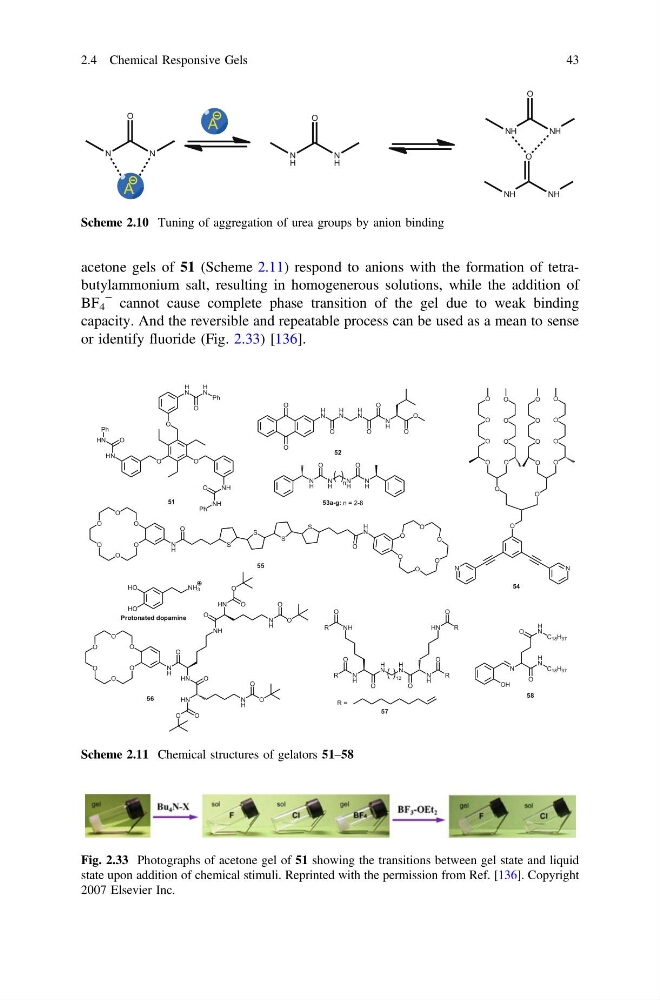
acetone gels of 51 (Scheme 2.11) respond to anions with the formation of tetrabutylammonium salt, resulting in homogenerous solutions, while the addition of
BF 4
− cannot cause complete phase transition of the gel due to weak binding
capacity. And the reversible and repeatable process can be used as a mean to sense
or identify fluoride (Fig. 2.33) [136].
N
N
O
N
H
N
H
O
NH
NH
O
NH
NH
O
A
A
Scheme 2.10 Tuning of aggregation of urea groups by anion binding
O
O
O
H
N
H
N
O
Ph
NH
O
NH
Ph
HN
O
HN
Ph
51
O
O
H
N
H
N
O
H
N
O
N
H
O
O
O
52
N
H
N
H
O
N
H
O
N
H
n
53a-g: n = 2-8
N
N
O
O
O
O
O
O
O
O
O
O
O
O
O
O
O
O
O
O
O
54
N
H
O
S
S
S
S
H
N
O
O
O
O
O
O
O
O
O
O
O
O
O
55
N
H
O
O
O
O
O
O
O
HN
NH
O
HN
O
O
N
H
O
O
O
HN
N
H
O
O
O
O
HO
HO
NH3
Protonated dopamine
56
R
N
H
H
N
H
N
N
H
O
O
O
R
O
NH
O
R
HN
O
R
12
R =
57
OH
N
H
N
O
H
N
O
C18H37
C18H37
58
Scheme 2.11 Chemical structures of gelators 51–58
Fig. 2.33 Photographs of acetone gel of 51 showing the transitions between gel state and liquid
state upon addition of chemical stimuli. Reprinted with the permission from Ref. [136]. Copyright
2007 Elsevier Inc.
2.4 Chemical Responsive Gels
43
BF 4
− cannot cause complete phase transition of the gel due to weak binding
capacity. And the reversible and repeatable process can be used as a mean to sense
or identify fluoride (Fig. 2.33) [136].
N
N
O
N
H
N
H
O
NH
NH
O
NH
NH
O
A
A
Scheme 2.10 Tuning of aggregation of urea groups by anion binding
O
O
O
H
N
H
N
O
Ph
NH
O
NH
Ph
HN
O
HN
Ph
51
O
O
H
N
H
N
O
H
N
O
N
H
O
O
O
52
N
H
N
H
O
N
H
O
N
H
n
53a-g: n = 2-8
N
N
O
O
O
O
O
O
O
O
O
O
O
O
O
O
O
O
O
O
O
54
N
H
O
S
S
S
S
H
N
O
O
O
O
O
O
O
O
O
O
O
O
O
55
N
H
O
O
O
O
O
O
O
HN
NH
O
HN
O
O
N
H
O
O
O
HN
N
H
O
O
O
O
HO
HO
NH3
Protonated dopamine
56
R
N
H
H
N
H
N
N
H
O
O
O
R
O
NH
O
R
HN
O
R
12
R =
57
OH
N
H
N
O
H
N
O
C18H37
C18H37
58
Scheme 2.11 Chemical structures of gelators 51–58
Fig. 2.33 Photographs of acetone gel of 51 showing the transitions between gel state and liquid
state upon addition of chemical stimuli. Reprinted with the permission from Ref. [136]. Copyright
2007 Elsevier Inc.
2.4 Chemical Responsive Gels
43