

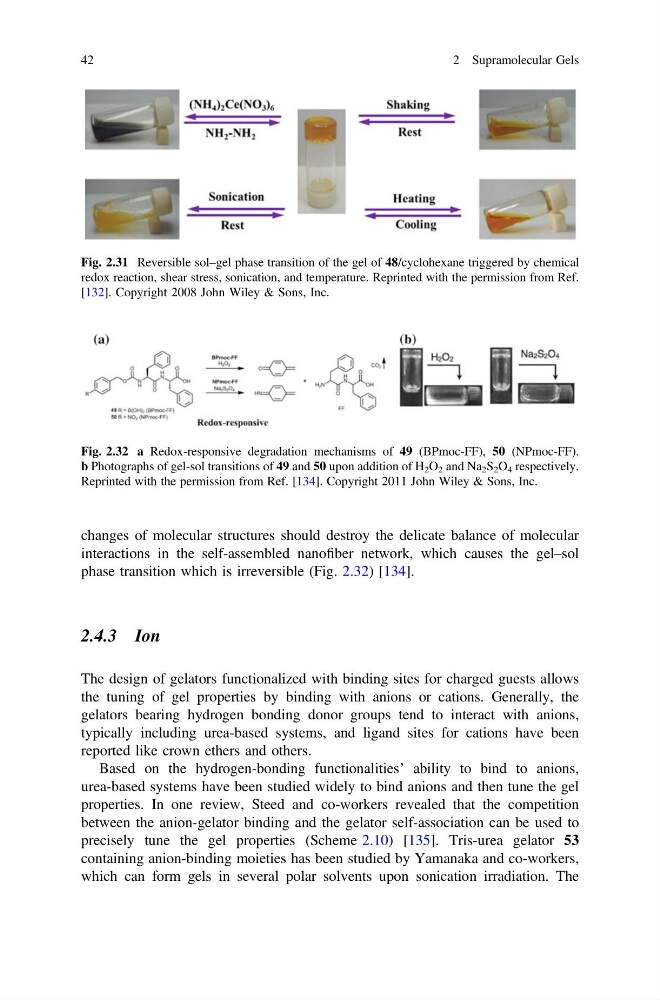
changes of molecular structures should destroy the delicate balance of molecular
interactions in the self-assembled nanofiber network, which causes the gel–sol
phase transition which is irreversible (Fig. 2.32) [134].
2.4.3 Ion
The design of gelators functionalized with binding sites for charged guests allows
the tuning of gel properties by binding with anions or cations. Generally, the
gelators bearing hydrogen bonding donor groups tend to interact with anions,
typically including urea-based systems, and ligand sites for cations have been
reported like crown ethers and others.
Based on the hydrogen-bonding functionalities’ ability to bind to anions,
urea-based systems have been studied widely to bind anions and then tune the gel
properties. In one review, Steed and co-workers revealed that the competition
between the anion-gelator binding and the gelator self-association can be used to
precisely tune the gel properties (Scheme 2.10) [135]. Tris-urea gelator 53
containing anion-binding moieties has been studied by Yamanaka and co-workers,
which can form gels in several polar solvents upon sonication irradiation. The
Fig. 2.31 Reversible sol–gel phase transition of the gel of 48/cyclohexane triggered by chemical
redox reaction, shear stress, sonication, and temperature. Reprinted with the permission from Ref.
[132]. Copyright 2008 John Wiley & Sons, Inc.
Fig. 2.32 a Redox-responsive degradation mechanisms of 49 (BPmoc-FF), 50 (NPmoc-FF).
b Photographs of gel-sol transitions of 49 and 50 upon addition of H 2 O 2 and Na 2 S 2 O 4 respectively.
Reprinted with the permission from Ref. [134]. Copyright 2011 John Wiley & Sons, Inc.
42
2 Supramolecular Gels
interactions in the self-assembled nanofiber network, which causes the gel–sol
phase transition which is irreversible (Fig. 2.32) [134].
2.4.3 Ion
The design of gelators functionalized with binding sites for charged guests allows
the tuning of gel properties by binding with anions or cations. Generally, the
gelators bearing hydrogen bonding donor groups tend to interact with anions,
typically including urea-based systems, and ligand sites for cations have been
reported like crown ethers and others.
Based on the hydrogen-bonding functionalities’ ability to bind to anions,
urea-based systems have been studied widely to bind anions and then tune the gel
properties. In one review, Steed and co-workers revealed that the competition
between the anion-gelator binding and the gelator self-association can be used to
precisely tune the gel properties (Scheme 2.10) [135]. Tris-urea gelator 53
containing anion-binding moieties has been studied by Yamanaka and co-workers,
which can form gels in several polar solvents upon sonication irradiation. The
Fig. 2.31 Reversible sol–gel phase transition of the gel of 48/cyclohexane triggered by chemical
redox reaction, shear stress, sonication, and temperature. Reprinted with the permission from Ref.
[132]. Copyright 2008 John Wiley & Sons, Inc.
Fig. 2.32 a Redox-responsive degradation mechanisms of 49 (BPmoc-FF), 50 (NPmoc-FF).
b Photographs of gel-sol transitions of 49 and 50 upon addition of H 2 O 2 and Na 2 S 2 O 4 respectively.
Reprinted with the permission from Ref. [134]. Copyright 2011 John Wiley & Sons, Inc.
42
2 Supramolecular Gels