

a-position gelator 48 (Scheme 2.9) [133]. The 1,1,2,2-tetrachloroethane gels can be
formed by the self-assembly of p–p stacking and van der Waals forces and show
reversible responsiveness to redox reactions along with gel–sol transitions by addition
of oxidizing and reducing reagents such as FeCl 3 and ascorbic acid, respectively
(Fig. 2.31).
Except for reversible electroactive units, the irreversible redox-active reactions
are also applied for redox-responsive gel systems. Hamachi and co-workers
designed and prepared gelators 49 and 50 containing p-borono phenylmethoxycarbonyl unit (BPmoc-FF) and p-nitro-phenylmethoxycarbonyl unit (NPmoc-FF)
can form stable organogels through the formation of self-assembled nanofibre
networks through van der Waals, p–p, and hydrogen bonding interactions attributed
to the hydrophobic aromatic groups (Fmoc-FF). The introducing moieties are
sensitive to redox agents such as H 2 O 2 and Na 2 S 2 O 4 , which may cause the removal
of a hydrophobic degradation unit from the peptide N-terminal. Accordingly, the
S
S
S
S
S
S
O
O
O
O
N
N
O
O
O
46
Fe
H
N
O
H
N
O
O
47
H
N
N
H
O
O
O
O
S
S
S
H
N
O
N
H
O
4
48
S
S
S
S
S
S
S
N
H
N
H
O
45
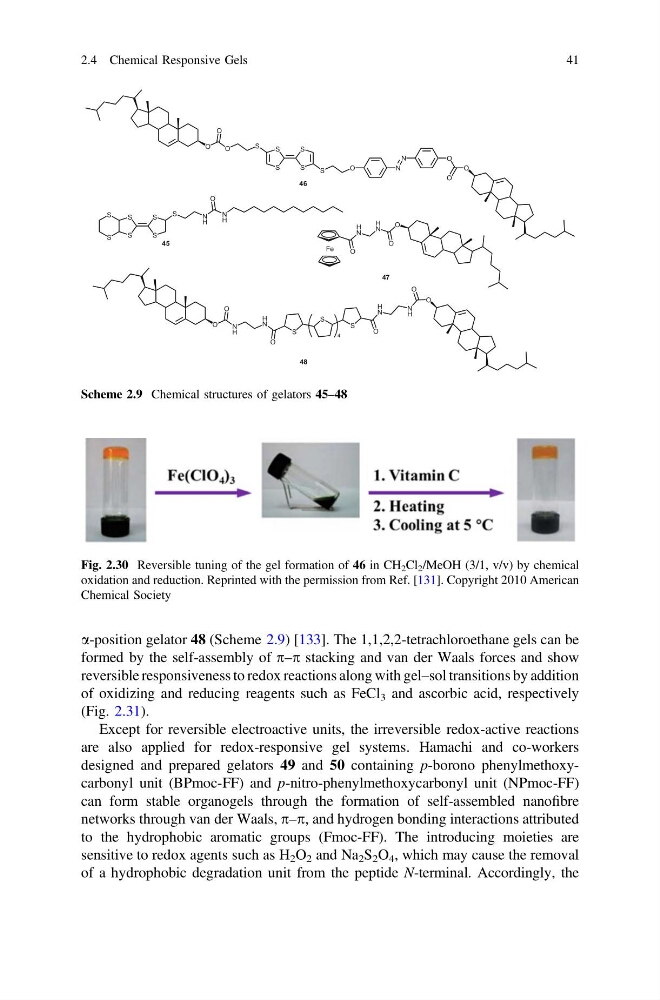
Scheme 2.9 Chemical structures of gelators 45–48
Fig. 2.30 Reversible tuning of the gel formation of 46 in CH 2 Cl 2 /MeOH (3/1, v/v) by chemical
oxidation and reduction. Reprinted with the permission from Ref. [131]. Copyright 2010 American
Chemical Society
2.4 Chemical Responsive Gels
41
formed by the self-assembly of p–p stacking and van der Waals forces and show
reversible responsiveness to redox reactions along with gel–sol transitions by addition
of oxidizing and reducing reagents such as FeCl 3 and ascorbic acid, respectively
(Fig. 2.31).
Except for reversible electroactive units, the irreversible redox-active reactions
are also applied for redox-responsive gel systems. Hamachi and co-workers
designed and prepared gelators 49 and 50 containing p-borono phenylmethoxycarbonyl unit (BPmoc-FF) and p-nitro-phenylmethoxycarbonyl unit (NPmoc-FF)
can form stable organogels through the formation of self-assembled nanofibre
networks through van der Waals, p–p, and hydrogen bonding interactions attributed
to the hydrophobic aromatic groups (Fmoc-FF). The introducing moieties are
sensitive to redox agents such as H 2 O 2 and Na 2 S 2 O 4 , which may cause the removal
of a hydrophobic degradation unit from the peptide N-terminal. Accordingly, the
S
S
S
S
S
S
O
O
O
O
N
N
O
O
O
46
Fe
H
N
O
H
N
O
O
47
H
N
N
H
O
O
O
O
S
S
S
H
N
O
N
H
O
4
48
S
S
S
S
S
S
S
N
H
N
H
O
45
Scheme 2.9 Chemical structures of gelators 45–48
Fig. 2.30 Reversible tuning of the gel formation of 46 in CH 2 Cl 2 /MeOH (3/1, v/v) by chemical
oxidation and reduction. Reprinted with the permission from Ref. [131]. Copyright 2010 American
Chemical Society
2.4 Chemical Responsive Gels
41