

2.4.2 Redox
The transformations in the oxidation of the sensitive centre in the redox-sensitive
gelators exhibit two different changes. One may involve a dramatic modification of
solubility of gelators along with gel–sol transition, and another may product a
change of chemical structure of the gelator either by formation of new covalent
bonds or destruction of sensitive fragments. And the redox-active units mainly
include reversible tetrathiafulvalene (TTF), ferrocene, thiophene and others.
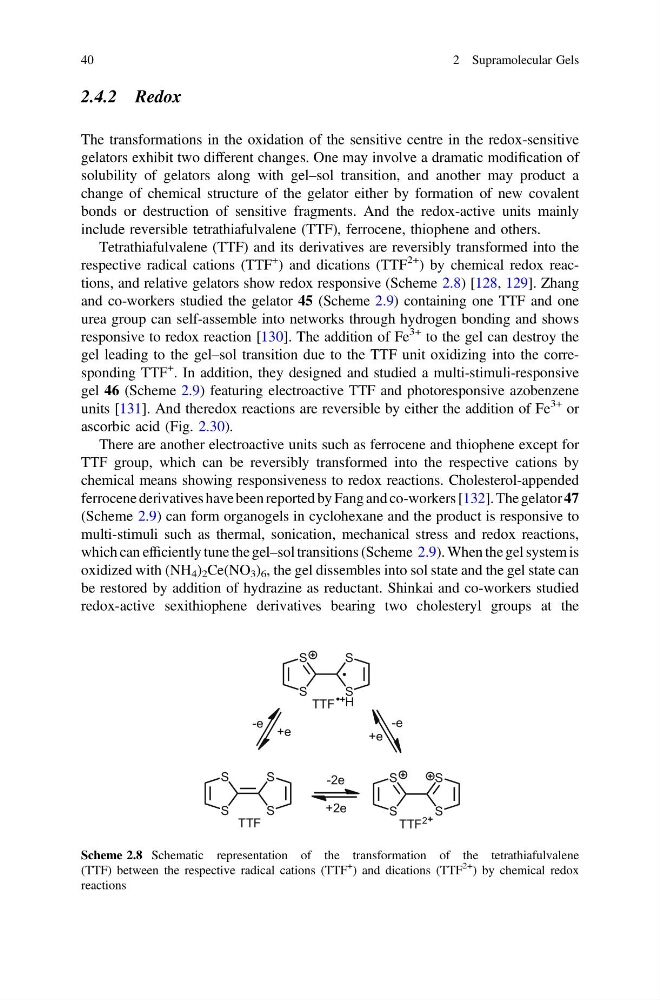
Tetrathiafulvalene (TTF) and its derivatives are reversibly transformed into the
respective radical cations (TTF
+
) and dications (TTF
2+ ) by chemical redox reactions, and relative gelators show redox responsive (Scheme 2.8) [128, 129]. Zhang
and co-workers studied the gelator 45 (Scheme 2.9) containing one TTF and one
urea group can self-assemble into networks through hydrogen bonding and shows
responsive to redox reaction [130]. The addition of Fe
3+ to the gel can destroy the
gel leading to the gel–sol transition due to the TTF unit oxidizing into the corresponding TTF
+
. In addition, they designed and studied a multi-stimuli-responsive
gel 46 (Scheme 2.9) featuring electroactive TTF and photoresponsive azobenzene
units [131]. And theredox reactions are reversible by either the addition of Fe
3+ or
ascorbic acid (Fig. 2.30).
There are another electroactive units such as ferrocene and thiophene except for
TTF group, which can be reversibly transformed into the respective cations by
chemical means showing responsiveness to redox reactions. Cholesterol-appended
ferrocene derivatives have been reported by Fang and co-workers [132]. The gelator 47
(Scheme 2.9) can form organogels in cyclohexane and the product is responsive to
multi-stimuli such as thermal, sonication, mechanical stress and redox reactions,
which can efficiently tune the gel–sol transitions (Scheme 2.9). When the gel system is
oxidized with (NH 4 ) 2 Ce(NO 3 ) 6 , the gel dissembles into sol state and the gel state can
be restored by addition of hydrazine as reductant. Shinkai and co-workers studied
redox-active sexithiophene derivatives bearing two cholesteryl groups at the
S
S
S
H
S
TTF
S
S
S
S
TTF
S
S
S
S
TTF 2
-e
-e
+e
+e
+2e
-2e
Scheme 2.8 Schematic representation of the transformation of the tetrathiafulvalene
(TTF) between the respective radical cations (TTF
+ ) and dications (TTF
2+ ) by chemical redox
reactions
40
2 Supramolecular Gels
The transformations in the oxidation of the sensitive centre in the redox-sensitive
gelators exhibit two different changes. One may involve a dramatic modification of
solubility of gelators along with gel–sol transition, and another may product a
change of chemical structure of the gelator either by formation of new covalent
bonds or destruction of sensitive fragments. And the redox-active units mainly
include reversible tetrathiafulvalene (TTF), ferrocene, thiophene and others.
Tetrathiafulvalene (TTF) and its derivatives are reversibly transformed into the
respective radical cations (TTF
+
) and dications (TTF
2+ ) by chemical redox reactions, and relative gelators show redox responsive (Scheme 2.8) [128, 129]. Zhang
and co-workers studied the gelator 45 (Scheme 2.9) containing one TTF and one
urea group can self-assemble into networks through hydrogen bonding and shows
responsive to redox reaction [130]. The addition of Fe
3+ to the gel can destroy the
gel leading to the gel–sol transition due to the TTF unit oxidizing into the corresponding TTF
+
. In addition, they designed and studied a multi-stimuli-responsive
gel 46 (Scheme 2.9) featuring electroactive TTF and photoresponsive azobenzene
units [131]. And theredox reactions are reversible by either the addition of Fe
3+ or
ascorbic acid (Fig. 2.30).
There are another electroactive units such as ferrocene and thiophene except for
TTF group, which can be reversibly transformed into the respective cations by
chemical means showing responsiveness to redox reactions. Cholesterol-appended
ferrocene derivatives have been reported by Fang and co-workers [132]. The gelator 47
(Scheme 2.9) can form organogels in cyclohexane and the product is responsive to
multi-stimuli such as thermal, sonication, mechanical stress and redox reactions,
which can efficiently tune the gel–sol transitions (Scheme 2.9). When the gel system is
oxidized with (NH 4 ) 2 Ce(NO 3 ) 6 , the gel dissembles into sol state and the gel state can
be restored by addition of hydrazine as reductant. Shinkai and co-workers studied
redox-active sexithiophene derivatives bearing two cholesteryl groups at the
S
S
S
H
S
TTF
S
S
S
S
TTF
S
S
S
S
TTF 2
-e
-e
+e
+e
+2e
-2e
Scheme 2.8 Schematic representation of the transformation of the tetrathiafulvalene
(TTF) between the respective radical cations (TTF
+ ) and dications (TTF
2+ ) by chemical redox
reactions
40
2 Supramolecular Gels