

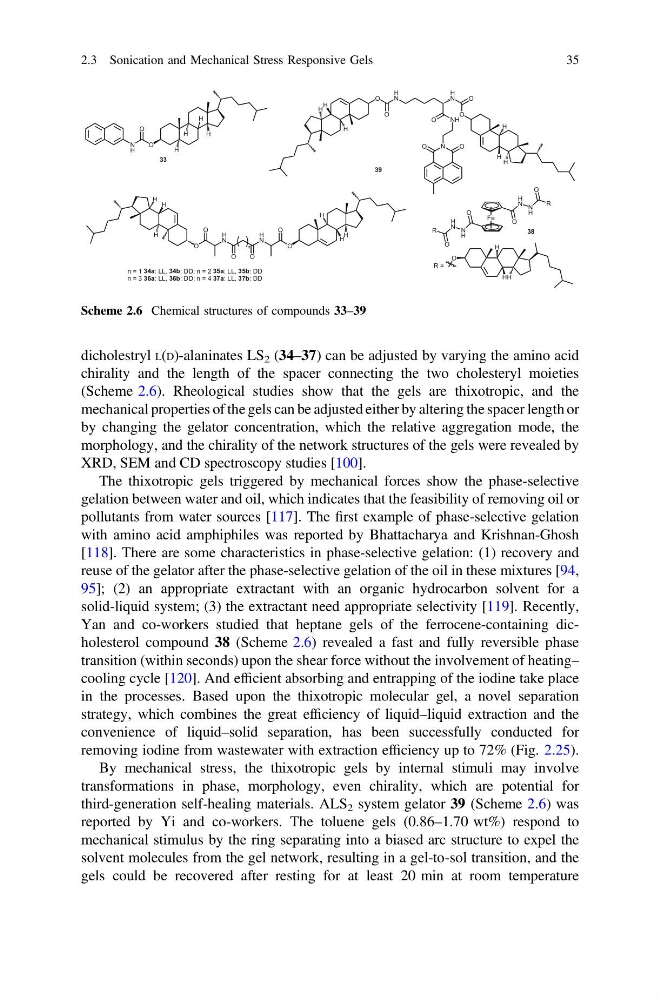
dicholestryl L(D)-alaninates LS 2 (34–37) can be adjusted by varying the amino acid
chirality and the length of the spacer connecting the two cholesteryl moieties
(Scheme 2.6). Rheological studies show that the gels are thixotropic, and the
mechanical properties of the gels can be adjusted either by altering the spacer length or
by changing the gelator concentration, which the relative aggregation mode, the
morphology, and the chirality of the network structures of the gels were revealed by
XRD, SEM and CD spectroscopy studies [100].
The thixotropic gels triggered by mechanical forces show the phase-selective
gelation between water and oil, which indicates that the feasibility of removing oil or
pollutants from water sources [117]. The first example of phase-selective gelation
with amino acid amphiphiles was reported by Bhattacharya and Krishnan-Ghosh
[118]. There are some characteristics in phase-selective gelation: (1) recovery and
reuse of the gelator after the phase-selective gelation of the oil in these mixtures [94,
95]; (2) an appropriate extractant with an organic hydrocarbon solvent for a
solid-liquid system; (3) the extractant need appropriate selectivity [119]. Recently,
Yan and co-workers studied that heptane gels of the ferrocene-containing dicholesterol compound 38 (Scheme 2.6) revealed a fast and fully reversible phase
transition (within seconds) upon the shear force without the involvement of heating–
cooling cycle [120]. And efficient absorbing and entrapping of the iodine take place
in the processes. Based upon the thixotropic molecular gel, a novel separation
strategy, which combines the great efficiency of liquid–liquid extraction and the
convenience of liquid–solid separation, has been successfully conducted for
removing iodine from wastewater with extraction efficiency up to 72% (Fig. 2.25).
By mechanical stress, the thixotropic gels by internal stimuli may involve
transformations in phase, morphology, even chirality, which are potential for
third-generation self-healing materials. ALS 2 system gelator 39 (Scheme 2.6) was
reported by Yi and co-workers. The toluene gels (0.86–1.70 wt%) respond to
mechanical stimulus by the ring separating into a biased arc structure to expel the
solvent molecules from the gel network, resulting in a gel-to-sol transition, and the
gels could be recovered after resting for at least 20 min at room temperature
N
H
O
O
H
H
H
H
33
O
H
N
H
N
O
O
O
O
O
H
H
H
H
H
H
n
n = 1 34a: LL, 34b: DD; n = 2 35a: LL, 35b: DD
n = 3 36a: LL, 36b: DD; n = 4 37a: LL, 37b: DD
Fe
H
N
O
N
H
R
O
N
H
O
H
N
R
O
O
H
HH
R =
38
O
H
N
H
H
H
H
N
NH
O
O
O
N
O
O
H
H H
O
39
Scheme 2.6 Chemical structures of compounds 33–39
2.3 Sonication and Mechanical Stress Responsive Gels
35
chirality and the length of the spacer connecting the two cholesteryl moieties
(Scheme 2.6). Rheological studies show that the gels are thixotropic, and the
mechanical properties of the gels can be adjusted either by altering the spacer length or
by changing the gelator concentration, which the relative aggregation mode, the
morphology, and the chirality of the network structures of the gels were revealed by
XRD, SEM and CD spectroscopy studies [100].
The thixotropic gels triggered by mechanical forces show the phase-selective
gelation between water and oil, which indicates that the feasibility of removing oil or
pollutants from water sources [117]. The first example of phase-selective gelation
with amino acid amphiphiles was reported by Bhattacharya and Krishnan-Ghosh
[118]. There are some characteristics in phase-selective gelation: (1) recovery and
reuse of the gelator after the phase-selective gelation of the oil in these mixtures [94,
95]; (2) an appropriate extractant with an organic hydrocarbon solvent for a
solid-liquid system; (3) the extractant need appropriate selectivity [119]. Recently,
Yan and co-workers studied that heptane gels of the ferrocene-containing dicholesterol compound 38 (Scheme 2.6) revealed a fast and fully reversible phase
transition (within seconds) upon the shear force without the involvement of heating–
cooling cycle [120]. And efficient absorbing and entrapping of the iodine take place
in the processes. Based upon the thixotropic molecular gel, a novel separation
strategy, which combines the great efficiency of liquid–liquid extraction and the
convenience of liquid–solid separation, has been successfully conducted for
removing iodine from wastewater with extraction efficiency up to 72% (Fig. 2.25).
By mechanical stress, the thixotropic gels by internal stimuli may involve
transformations in phase, morphology, even chirality, which are potential for
third-generation self-healing materials. ALS 2 system gelator 39 (Scheme 2.6) was
reported by Yi and co-workers. The toluene gels (0.86–1.70 wt%) respond to
mechanical stimulus by the ring separating into a biased arc structure to expel the
solvent molecules from the gel network, resulting in a gel-to-sol transition, and the
gels could be recovered after resting for at least 20 min at room temperature
N
H
O
O
H
H
H
H
33
O
H
N
H
N
O
O
O
O
O
H
H
H
H
H
H
n
n = 1 34a: LL, 34b: DD; n = 2 35a: LL, 35b: DD
n = 3 36a: LL, 36b: DD; n = 4 37a: LL, 37b: DD
Fe
H
N
O
N
H
R
O
N
H
O
H
N
R
O
O
H
HH
R =
38
O
H
N
H
H
H
H
N
NH
O
O
O
N
O
O
H
H H
O
39
Scheme 2.6 Chemical structures of compounds 33–39
2.3 Sonication and Mechanical Stress Responsive Gels
35