

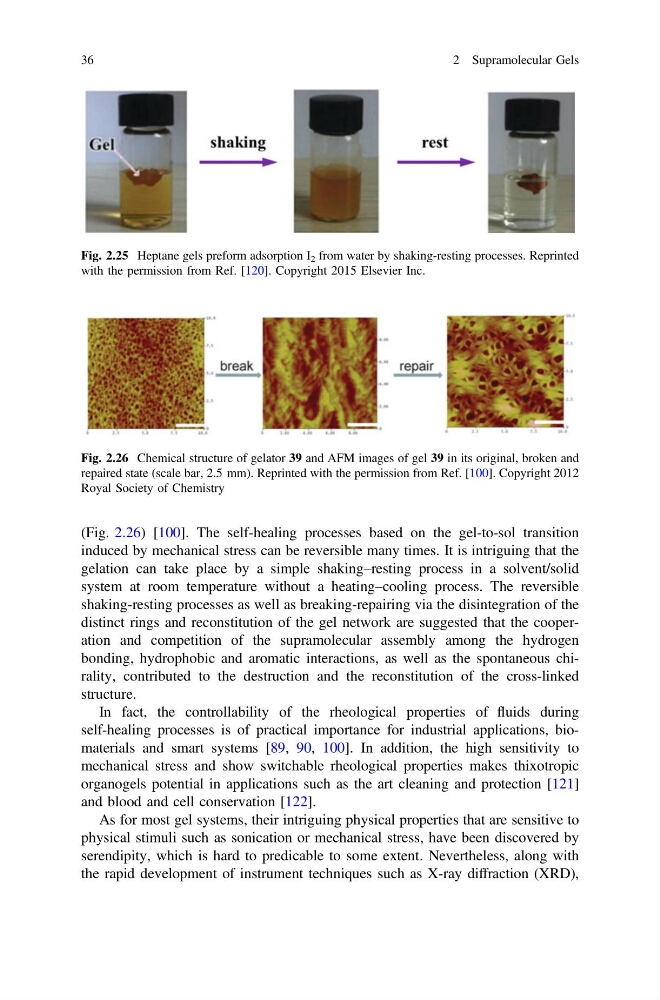
(Fig. 2.26) [100]. The self-healing processes based on the gel-to-sol transition
induced by mechanical stress can be reversible many times. It is intriguing that the
gelation can take place by a simple shaking–resting process in a solvent/solid
system at room temperature without a heating–cooling process. The reversible
shaking-resting processes as well as breaking-repairing via the disintegration of the
distinct rings and reconstitution of the gel network are suggested that the cooperation and competition of the supramolecular assembly among the hydrogen
bonding, hydrophobic and aromatic interactions, as well as the spontaneous chirality, contributed to the destruction and the reconstitution of the cross-linked
structure.
In fact, the controllability of the rheological properties of fluids during
self-healing processes is of practical importance for industrial applications, biomaterials and smart systems [89, 90, 100]. In addition, the high sensitivity to
mechanical stress and show switchable rheological properties makes thixotropic
organogels potential in applications such as the art cleaning and protection [121]
and blood and cell conservation [122].
As for most gel systems, their intriguing physical properties that are sensitive to
physical stimuli such as sonication or mechanical stress, have been discovered by
serendipity, which is hard to predicable to some extent. Nevertheless, along with
the rapid development of instrument techniques such as X-ray diffraction (XRD),
Fig. 2.25 Heptane gels preform adsorption I 2 from water by shaking-resting processes. Reprinted
with the permission from Ref. [120]. Copyright 2015 Elsevier Inc.
Fig. 2.26 Chemical structure of gelator 39 and AFM images of gel 39 in its original, broken and
repaired state (scale bar, 2.5 mm). Reprinted with the permission from Ref. [100]. Copyright 2012
Royal Society of Chemistry
36
2 Supramolecular Gels
induced by mechanical stress can be reversible many times. It is intriguing that the
gelation can take place by a simple shaking–resting process in a solvent/solid
system at room temperature without a heating–cooling process. The reversible
shaking-resting processes as well as breaking-repairing via the disintegration of the
distinct rings and reconstitution of the gel network are suggested that the cooperation and competition of the supramolecular assembly among the hydrogen
bonding, hydrophobic and aromatic interactions, as well as the spontaneous chirality, contributed to the destruction and the reconstitution of the cross-linked
structure.
In fact, the controllability of the rheological properties of fluids during
self-healing processes is of practical importance for industrial applications, biomaterials and smart systems [89, 90, 100]. In addition, the high sensitivity to
mechanical stress and show switchable rheological properties makes thixotropic
organogels potential in applications such as the art cleaning and protection [121]
and blood and cell conservation [122].
As for most gel systems, their intriguing physical properties that are sensitive to
physical stimuli such as sonication or mechanical stress, have been discovered by
serendipity, which is hard to predicable to some extent. Nevertheless, along with
the rapid development of instrument techniques such as X-ray diffraction (XRD),
Fig. 2.25 Heptane gels preform adsorption I 2 from water by shaking-resting processes. Reprinted
with the permission from Ref. [120]. Copyright 2015 Elsevier Inc.
Fig. 2.26 Chemical structure of gelator 39 and AFM images of gel 39 in its original, broken and
repaired state (scale bar, 2.5 mm). Reprinted with the permission from Ref. [100]. Copyright 2012
Royal Society of Chemistry
36
2 Supramolecular Gels