

co-workers studied metallocage hydrogels can selectively bind benzene guest in the
presence of the similarly sized anisole and release the guest molecules by the
addition of competitive agent, such as furan. It is worth noting that the gels with
intrinsic porosity enable to control delivery of multiple reagents with differing
diffusion rates, and exhibit potential applications in catalysis, drug delivery,
chemical purification [81, 82].
Additional investigations by de Jong and co-workers [83] highlight another
advantage of DTE moiety: the generation of two chiral centres upon ring closure in
molecules that are already chiral can result in diastereomeric products with discrepant optical and aggregation properties. The reversible optical transcription of
supramolecular chirality into molecular chirality can be realized by gelator 25. The
dithienylethene molecule 25 exists in two antiparallel interconvertible open forms
with P- and M-helicity, which cyclize in a fully reversible manner upon irradiation
with UV light to form two diastereomers of the ring closed products of 25. The
open form 25 can form gels in non-polar solvents. In toluene gels, the gelator
self-assembles to helical fibres dependent on the supramolecular self-assembly
chirality, consistent with CD and TEM studies. Though there is no stereoselectivity
in the solutions, the selective self-assembly of 25 into the gel state shows nearly
absolute stereocontrol. Both the open and closed forms of 25 exist in two kinds of
chiral gel states, denoted as a and b, leading to a four-state chiroptical
supramolecular switch, achieving a sequence of cycled photochemical reactions
(Fig. 2.17). The optical switching between different supramolecular chiral aggregates and the interplay of molecular and supramolecular chirality in these systems is
attractive for designing molecular memory systems and smart functional materials.
Since the chirality, physical state, molecular configuration of the DTE systems
can be exerted by the permutation of thermal and photonic inputs. The relatively
materials with well defined, long lasting, resistant to fatigue over several cycles can
be exploited in chemical information storage applications. The system state keeps
undisturbed upon the stimulus required for data read-out, which makes DTEs more
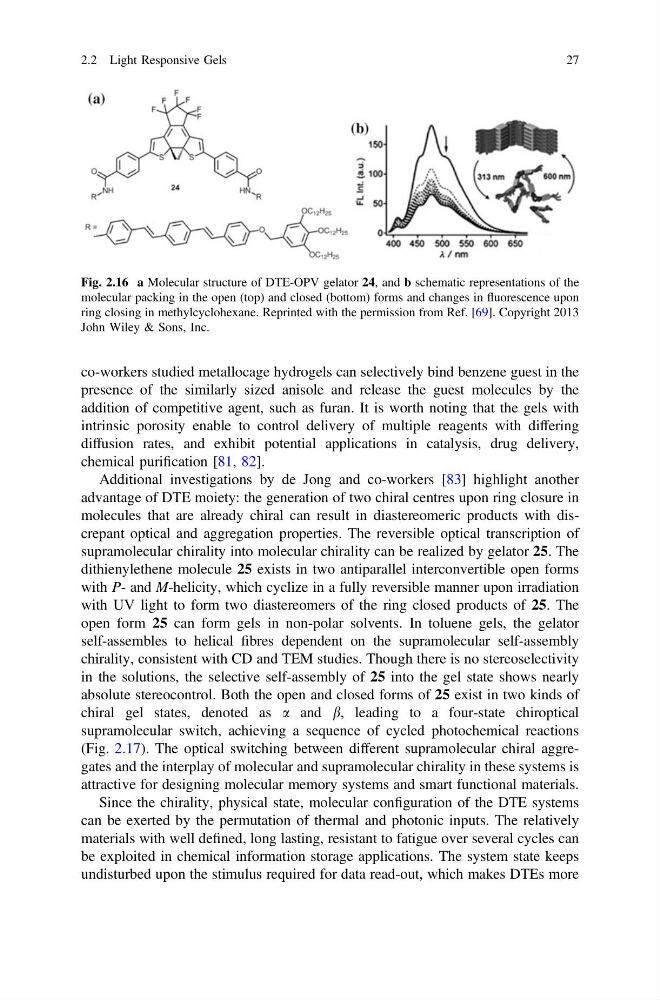
Fig. 2.16 a Molecular structure of DTE-OPV gelator 24, and b schematic representations of the
molecular packing in the open (top) and closed (bottom) forms and changes in fluorescence upon
ring closing in methylcyclohexane. Reprinted with the permission from Ref. [69]. Copyright 2013
John Wiley & Sons, Inc.
2.2 Light Responsive Gels
27
presence of the similarly sized anisole and release the guest molecules by the
addition of competitive agent, such as furan. It is worth noting that the gels with
intrinsic porosity enable to control delivery of multiple reagents with differing
diffusion rates, and exhibit potential applications in catalysis, drug delivery,
chemical purification [81, 82].
Additional investigations by de Jong and co-workers [83] highlight another
advantage of DTE moiety: the generation of two chiral centres upon ring closure in
molecules that are already chiral can result in diastereomeric products with discrepant optical and aggregation properties. The reversible optical transcription of
supramolecular chirality into molecular chirality can be realized by gelator 25. The
dithienylethene molecule 25 exists in two antiparallel interconvertible open forms
with P- and M-helicity, which cyclize in a fully reversible manner upon irradiation
with UV light to form two diastereomers of the ring closed products of 25. The
open form 25 can form gels in non-polar solvents. In toluene gels, the gelator
self-assembles to helical fibres dependent on the supramolecular self-assembly
chirality, consistent with CD and TEM studies. Though there is no stereoselectivity
in the solutions, the selective self-assembly of 25 into the gel state shows nearly
absolute stereocontrol. Both the open and closed forms of 25 exist in two kinds of
chiral gel states, denoted as a and b, leading to a four-state chiroptical
supramolecular switch, achieving a sequence of cycled photochemical reactions
(Fig. 2.17). The optical switching between different supramolecular chiral aggregates and the interplay of molecular and supramolecular chirality in these systems is
attractive for designing molecular memory systems and smart functional materials.
Since the chirality, physical state, molecular configuration of the DTE systems
can be exerted by the permutation of thermal and photonic inputs. The relatively
materials with well defined, long lasting, resistant to fatigue over several cycles can
be exploited in chemical information storage applications. The system state keeps
undisturbed upon the stimulus required for data read-out, which makes DTEs more
Fig. 2.16 a Molecular structure of DTE-OPV gelator 24, and b schematic representations of the
molecular packing in the open (top) and closed (bottom) forms and changes in fluorescence upon
ring closing in methylcyclohexane. Reprinted with the permission from Ref. [69]. Copyright 2013
John Wiley & Sons, Inc.
2.2 Light Responsive Gels
27