

convert to a closed-ring structure, and usually, the ring closure and opening upon
UV and visible light, respectively, is reversible. Of course, the nature of the groups
around the DTE core plays a pivotal role in the reaction cycle and may inhibit the
reaction. Generally, dithio-cyclopentanes and fluorinated derivatives exhibit reliable
and reversible photochemical reactions and are thus popular in the study of
molecular switches in the gel state [80].
The ring closure of a DTE can involve two kinds of the changes in the molecular
conformation properties: reducing the flexibility of the molecule, may favour
gelation due to the lowering the entropic cost of aggregation, while generating two
sp
3 sites, forces the substituents at these sites to be oriented out of the plane of the
molecule. And the ring closure of a DTE system can induce the changes in
aggregates, further influence the self-assembly results. DTE gelator 24 functionalized with fluorescent p-conjugated wings (oligo(para-phenylenevinylene) (OPV))
has been demonstrated by Yagai and co-workers [69]. In methylcyclohexane
solution, the closed-form compound results a non-fluorescence solution, while
produces a highly fluorescence gel by generating the ring opening form under
600 nm light. Molecular modelling results show that the DTE core of photoproduct
can regulate the aggregation by the p–p stacking interactions. However, the closed
isomer forms a disordered structure due to the steric hindrance of methyl groups in
the DTE core with fluorescence quenching through the energy transfer within
aggregates and the intramolecular energy transfer from the p-conjugated moieties to
the diarylethene core (Fig. 2.16).
In most DTE systems, the closed and open forms are both stable enough under
ambient conditions with no significant degradation of the relative responsive
behaviour upon cycles of UV and visible light irradiation. And it is potentially
suited to applications involving the release of an entrapped species. One tactic is to
construct porous metallocage gelator incorporating the DTE core. Foster and
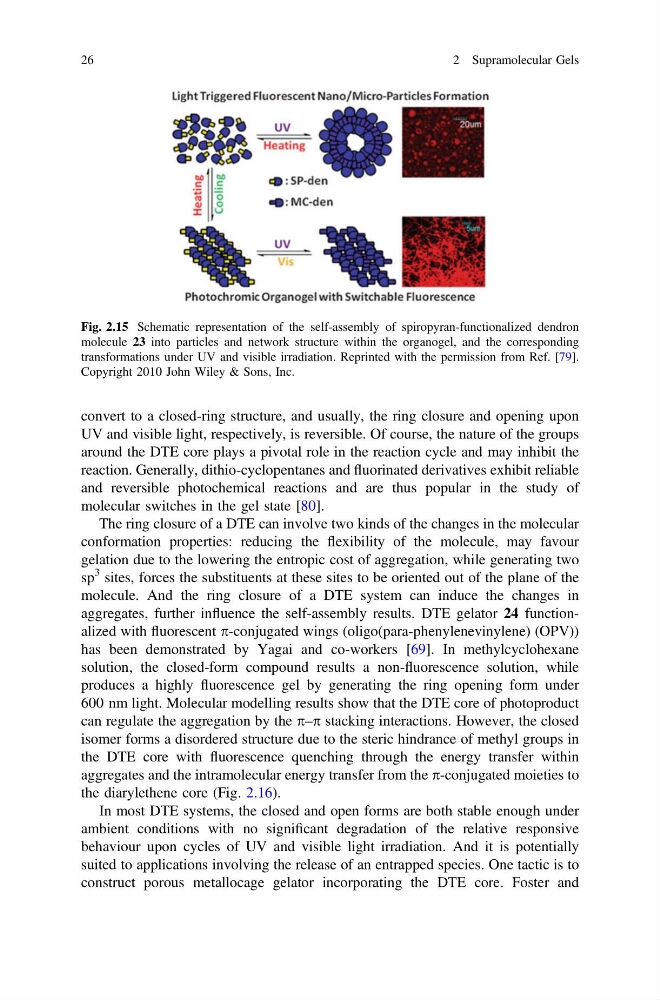
Fig. 2.15 Schematic representation of the self-assembly of spiropyran-functionalized dendron
molecule 23 into particles and network structure within the organogel, and the corresponding
transformations under UV and visible irradiation. Reprinted with the permission from Ref. [79].
Copyright 2010 John Wiley & Sons, Inc.
26
2 Supramolecular Gels
UV and visible light, respectively, is reversible. Of course, the nature of the groups
around the DTE core plays a pivotal role in the reaction cycle and may inhibit the
reaction. Generally, dithio-cyclopentanes and fluorinated derivatives exhibit reliable
and reversible photochemical reactions and are thus popular in the study of
molecular switches in the gel state [80].
The ring closure of a DTE can involve two kinds of the changes in the molecular
conformation properties: reducing the flexibility of the molecule, may favour
gelation due to the lowering the entropic cost of aggregation, while generating two
sp
3 sites, forces the substituents at these sites to be oriented out of the plane of the
molecule. And the ring closure of a DTE system can induce the changes in
aggregates, further influence the self-assembly results. DTE gelator 24 functionalized with fluorescent p-conjugated wings (oligo(para-phenylenevinylene) (OPV))
has been demonstrated by Yagai and co-workers [69]. In methylcyclohexane
solution, the closed-form compound results a non-fluorescence solution, while
produces a highly fluorescence gel by generating the ring opening form under
600 nm light. Molecular modelling results show that the DTE core of photoproduct
can regulate the aggregation by the p–p stacking interactions. However, the closed
isomer forms a disordered structure due to the steric hindrance of methyl groups in
the DTE core with fluorescence quenching through the energy transfer within
aggregates and the intramolecular energy transfer from the p-conjugated moieties to
the diarylethene core (Fig. 2.16).
In most DTE systems, the closed and open forms are both stable enough under
ambient conditions with no significant degradation of the relative responsive
behaviour upon cycles of UV and visible light irradiation. And it is potentially
suited to applications involving the release of an entrapped species. One tactic is to
construct porous metallocage gelator incorporating the DTE core. Foster and
Fig. 2.15 Schematic representation of the self-assembly of spiropyran-functionalized dendron
molecule 23 into particles and network structure within the organogel, and the corresponding
transformations under UV and visible irradiation. Reprinted with the permission from Ref. [79].
Copyright 2010 John Wiley & Sons, Inc.
26
2 Supramolecular Gels