

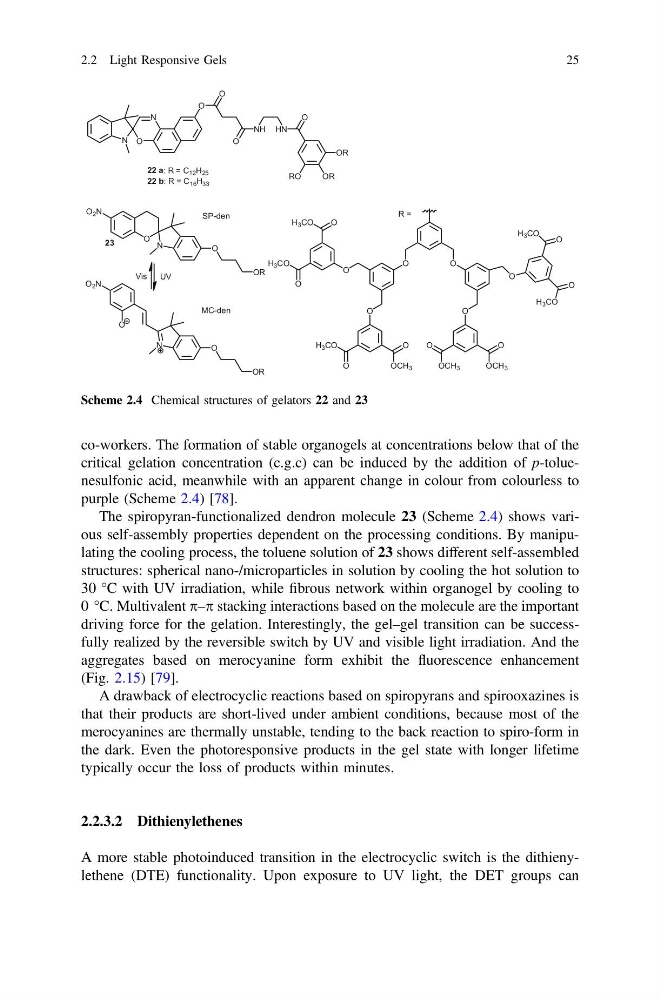
co-workers. The formation of stable organogels at concentrations below that of the
critical gelation concentration (c.g.c) can be induced by the addition of p-toluenesulfonic acid, meanwhile with an apparent change in colour from colourless to
purple (Scheme 2.4) [78].
The spiropyran-functionalized dendron molecule 23 (Scheme 2.4) shows various self-assembly properties dependent on the processing conditions. By manipulating the cooling process, the toluene solution of 23 shows different self-assembled
structures: spherical nano-/microparticles in solution by cooling the hot solution to
30 °C with UV irradiation, while fibrous network within organogel by cooling to
0 °C. Multivalent p–p stacking interactions based on the molecule are the important
driving force for the gelation. Interestingly, the gel–gel transition can be successfully realized by the reversible switch by UV and visible light irradiation. And the
aggregates based on merocyanine form exhibit the fluorescence enhancement
(Fig. 2.15) [79].
A drawback of electrocyclic reactions based on spiropyrans and spirooxazines is
that their products are short-lived under ambient conditions, because most of the
merocyanines are thermally unstable, tending to the back reaction to spiro-form in
the dark. Even the photoresponsive products in the gel state with longer lifetime
typically occur the loss of products within minutes.
2.2.3.2 Dithienylethenes
A more stable photoinduced transition in the electrocyclic switch is the dithienylethene (DTE) functionality. Upon exposure to UV light, the DET groups can
N O
N
O
O
NH
O
HN
O
OR
OR
RO
22 a: R = C 12 H 25
22 b: R = C 16 H 33
O N
O 2 N
O
OR
Vis
UV
O
OR
N
O
O 2 N
SP-den
MC-den
O
O
O
O
O
OCH 3
O
OCH 3
H 3 CO
O
O
H 3 CO
O
O
H 3 CO
O
H 3 CO
O
O
OCH 3
H 3 CO
O
R =
23
Scheme 2.4 Chemical structures of gelators 22 and 23
2.2 Light Responsive Gels
25
critical gelation concentration (c.g.c) can be induced by the addition of p-toluenesulfonic acid, meanwhile with an apparent change in colour from colourless to
purple (Scheme 2.4) [78].
The spiropyran-functionalized dendron molecule 23 (Scheme 2.4) shows various self-assembly properties dependent on the processing conditions. By manipulating the cooling process, the toluene solution of 23 shows different self-assembled
structures: spherical nano-/microparticles in solution by cooling the hot solution to
30 °C with UV irradiation, while fibrous network within organogel by cooling to
0 °C. Multivalent p–p stacking interactions based on the molecule are the important
driving force for the gelation. Interestingly, the gel–gel transition can be successfully realized by the reversible switch by UV and visible light irradiation. And the
aggregates based on merocyanine form exhibit the fluorescence enhancement
(Fig. 2.15) [79].
A drawback of electrocyclic reactions based on spiropyrans and spirooxazines is
that their products are short-lived under ambient conditions, because most of the
merocyanines are thermally unstable, tending to the back reaction to spiro-form in
the dark. Even the photoresponsive products in the gel state with longer lifetime
typically occur the loss of products within minutes.
2.2.3.2 Dithienylethenes
A more stable photoinduced transition in the electrocyclic switch is the dithienylethene (DTE) functionality. Upon exposure to UV light, the DET groups can
N O
N
O
O
NH
O
HN
O
OR
OR
RO
22 a: R = C 12 H 25
22 b: R = C 16 H 33
O N
O 2 N
O
OR
Vis
UV
O
OR
N
O
O 2 N
SP-den
MC-den
O
O
O
O
O
OCH 3
O
OCH 3
H 3 CO
O
O
H 3 CO
O
O
H 3 CO
O
H 3 CO
O
O
OCH 3
H 3 CO
O
R =
23
Scheme 2.4 Chemical structures of gelators 22 and 23
2.2 Light Responsive Gels
25