

self-assembly properties. The most commonly used photoresponsive functionalities
for the light-induced electrocyclic reactions include spiropyrans, spirooxazines,
and dithienylethenes.
2.2.3.1 Spiropyrans and Spirooxazines
The photochromic reaction of spiropyrans and closely related spirooxazines occurs
reversible photochemical cleavage of the C–O bond within a six-membered heterocycle to generate a new double bond and a ketone moiety [47, 52, 74–76]. The
products containing more sp
2 sites tend to adopt a more planar conformation with
increased conjugation and involve the emergence of new optical absorption bands
in the range of around 570–750 nm. Due to their intriguing photochromic properties, spiroheterocyclic compounds have been investigated for the design of optical
memories, switches and displays [74–76].
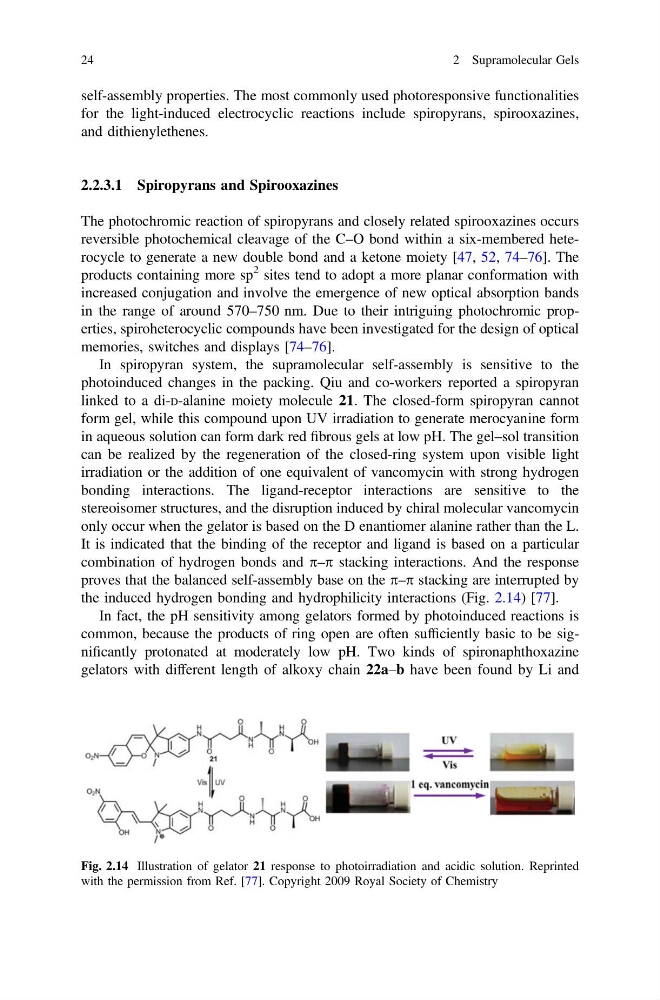
In spiropyran system, the supramolecular self-assembly is sensitive to the
photoinduced changes in the packing. Qiu and co-workers reported a spiropyran
linked to a di-D-alanine moiety molecule 21. The closed-form spiropyran cannot
form gel, while this compound upon UV irradiation to generate merocyanine form
in aqueous solution can form dark red fibrous gels at low pH. The gel–sol transition
can be realized by the regeneration of the closed-ring system upon visible light
irradiation or the addition of one equivalent of vancomycin with strong hydrogen
bonding interactions. The ligand-receptor interactions are sensitive to the
stereoisomer structures, and the disruption induced by chiral molecular vancomycin
only occur when the gelator is based on the D enantiomer alanine rather than the L.
It is indicated that the binding of the receptor and ligand is based on a particular
combination of hydrogen bonds and p–p stacking interactions. And the response
proves that the balanced self-assembly base on the p–p stacking are interrupted by
the induced hydrogen bonding and hydrophilicity interactions (Fig. 2.14) [77].
In fact, the pH sensitivity among gelators formed by photoinduced reactions is
common, because the products of ring open are often sufficiently basic to be significantly protonated at moderately low pH. Two kinds of spironaphthoxazine
gelators with different length of alkoxy chain 22a–b have been found by Li and
Fig. 2.14 Illustration of gelator 21 response to photoirradiation and acidic solution. Reprinted
with the permission from Ref. [77]. Copyright 2009 Royal Society of Chemistry
24
2 Supramolecular Gels
for the light-induced electrocyclic reactions include spiropyrans, spirooxazines,
and dithienylethenes.
2.2.3.1 Spiropyrans and Spirooxazines
The photochromic reaction of spiropyrans and closely related spirooxazines occurs
reversible photochemical cleavage of the C–O bond within a six-membered heterocycle to generate a new double bond and a ketone moiety [47, 52, 74–76]. The
products containing more sp
2 sites tend to adopt a more planar conformation with
increased conjugation and involve the emergence of new optical absorption bands
in the range of around 570–750 nm. Due to their intriguing photochromic properties, spiroheterocyclic compounds have been investigated for the design of optical
memories, switches and displays [74–76].
In spiropyran system, the supramolecular self-assembly is sensitive to the
photoinduced changes in the packing. Qiu and co-workers reported a spiropyran
linked to a di-D-alanine moiety molecule 21. The closed-form spiropyran cannot
form gel, while this compound upon UV irradiation to generate merocyanine form
in aqueous solution can form dark red fibrous gels at low pH. The gel–sol transition
can be realized by the regeneration of the closed-ring system upon visible light
irradiation or the addition of one equivalent of vancomycin with strong hydrogen
bonding interactions. The ligand-receptor interactions are sensitive to the
stereoisomer structures, and the disruption induced by chiral molecular vancomycin
only occur when the gelator is based on the D enantiomer alanine rather than the L.
It is indicated that the binding of the receptor and ligand is based on a particular
combination of hydrogen bonds and p–p stacking interactions. And the response
proves that the balanced self-assembly base on the p–p stacking are interrupted by
the induced hydrogen bonding and hydrophilicity interactions (Fig. 2.14) [77].
In fact, the pH sensitivity among gelators formed by photoinduced reactions is
common, because the products of ring open are often sufficiently basic to be significantly protonated at moderately low pH. Two kinds of spironaphthoxazine
gelators with different length of alkoxy chain 22a–b have been found by Li and
Fig. 2.14 Illustration of gelator 21 response to photoirradiation and acidic solution. Reprinted
with the permission from Ref. [77]. Copyright 2009 Royal Society of Chemistry
24
2 Supramolecular Gels