

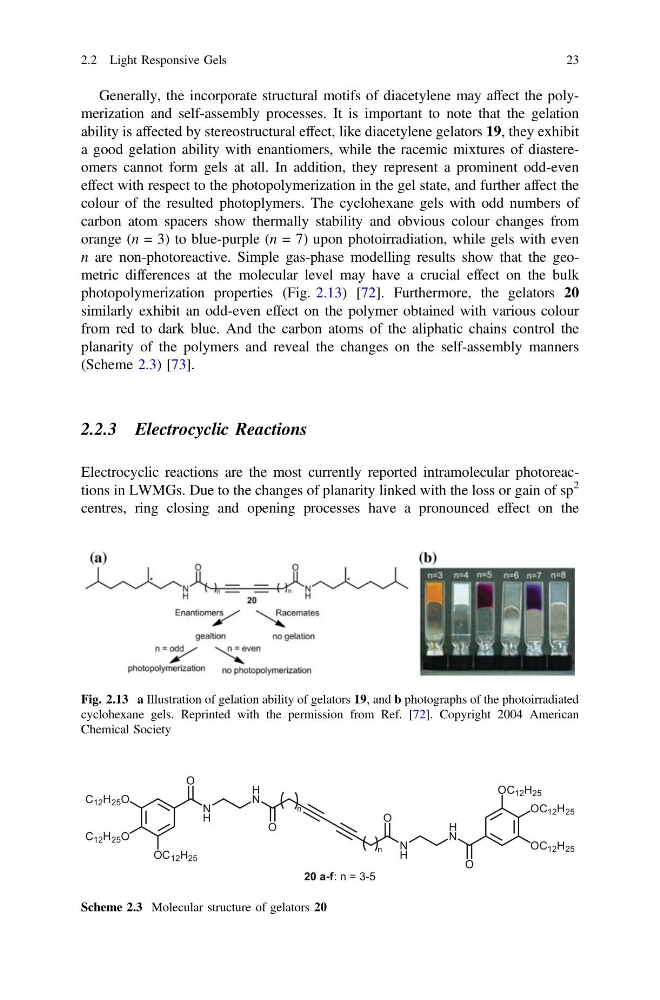
Generally, the incorporate structural motifs of diacetylene may affect the polymerization and self-assembly processes. It is important to note that the gelation
ability is affected by stereostructural effect, like diacetylene gelators 19, they exhibit
a good gelation ability with enantiomers, while the racemic mixtures of diastereomers cannot form gels at all. In addition, they represent a prominent odd-even
effect with respect to the photopolymerization in the gel state, and further affect the
colour of the resulted photoplymers. The cyclohexane gels with odd numbers of
carbon atom spacers show thermally stability and obvious colour changes from
orange (n = 3) to blue-purple (n = 7) upon photoirradiation, while gels with even
n are non-photoreactive. Simple gas-phase modelling results show that the geometric differences at the molecular level may have a crucial effect on the bulk
photopolymerization properties (Fig. 2.13) [72]. Furthermore, the gelators 20
similarly exhibit an odd-even effect on the polymer obtained with various colour
from red to dark blue. And the carbon atoms of the aliphatic chains control the
planarity of the polymers and reveal the changes on the self-assembly manners
(Scheme 2.3) [73].
2.2.3 Electrocyclic Reactions
Electrocyclic reactions are the most currently reported intramolecular photoreactions in LWMGs. Due to the changes of planarity linked with the loss or gain of sp
2
centres, ring closing and opening processes have a pronounced effect on the
N
H
H
N
O
O
O
N
H
H
N
O
OC 12 H 25
C 12 H 25 O
C 12 H 25 O
OC 12 H 25
OC 12 H 25
OC 12 H 25
n
n
20 a-f: n = 3-5
Scheme 2.3 Molecular structure of gelators 20
Fig. 2.13 a Illustration of gelation ability of gelators 19, and b photographs of the photoirradiated
cyclohexane gels. Reprinted with the permission from Ref. [72]. Copyright 2004 American
Chemical Society
2.2 Light Responsive Gels
23
ability is affected by stereostructural effect, like diacetylene gelators 19, they exhibit
a good gelation ability with enantiomers, while the racemic mixtures of diastereomers cannot form gels at all. In addition, they represent a prominent odd-even
effect with respect to the photopolymerization in the gel state, and further affect the
colour of the resulted photoplymers. The cyclohexane gels with odd numbers of
carbon atom spacers show thermally stability and obvious colour changes from
orange (n = 3) to blue-purple (n = 7) upon photoirradiation, while gels with even
n are non-photoreactive. Simple gas-phase modelling results show that the geometric differences at the molecular level may have a crucial effect on the bulk
photopolymerization properties (Fig. 2.13) [72]. Furthermore, the gelators 20
similarly exhibit an odd-even effect on the polymer obtained with various colour
from red to dark blue. And the carbon atoms of the aliphatic chains control the
planarity of the polymers and reveal the changes on the self-assembly manners
(Scheme 2.3) [73].
2.2.3 Electrocyclic Reactions
Electrocyclic reactions are the most currently reported intramolecular photoreactions in LWMGs. Due to the changes of planarity linked with the loss or gain of sp
2
centres, ring closing and opening processes have a pronounced effect on the
N
H
H
N
O
O
O
N
H
H
N
O
OC 12 H 25
C 12 H 25 O
C 12 H 25 O
OC 12 H 25
OC 12 H 25
OC 12 H 25
n
n
20 a-f: n = 3-5
Scheme 2.3 Molecular structure of gelators 20
Fig. 2.13 a Illustration of gelation ability of gelators 19, and b photographs of the photoirradiated
cyclohexane gels. Reprinted with the permission from Ref. [72]. Copyright 2004 American
Chemical Society
2.2 Light Responsive Gels
23