

superior in effective data storage [84, 85]. Xiao and co-workers present the first
example of a fluorescent switch with non-destructive read-out ability in the gel state
[84]. Thus, composition of the system may be determined rapidly, reliably and
non-invasively, without risk of conversion to an alternative state [80, 86].
Another related use for the DTE moieties is as a component of a molecular logic
gate (MLG). MLGs deliver an output signal in the presence of a particular combination of inputs, in accordance with a predefined set of Boolean operations [87].
For example, Xue and co-workers reported a tetrakis(amide) gelator, it is DMSO–
water mixture gel system can be constructed as a XNOR gate based on the output of
fluorescence intensity at 600 nm in the present of the two inputs of proton and
fluoride ions. Due to the gel–sol transitions can afford additional output, a more
complicated gate may be expected. The MLGs based on some combination gates
can deliver multiple output signals due to their response to multiple chemical
stimuli [81]. And the chemical systems are potentially allowed to be modulated
in situ without the invasive devices. Chemically addressable MLGs with repeatable
responses by using of exclusively non-invasive inputs can achieve cycles of wring
and erasing in data storage systems. Selective isomerization of individual photochromes can use absorption and emission properties at different wavelengths as
logic outputs and allow design of simple Boolean logic gates and more complex
logic devices with all-photonic inputs and outputs. A triad FG-DTE molecule 26
consisting of a dithienylethene and two fulgimides developed by Andréasson and
co-workers and constructs effective logic gate. The absorption and fluorescence
signals with relative characteristic pattern are induced by the two molecular
switches dependent on the ring opening and closure (Fig. 2.18). And it can be
configured as AND, XOR, INH, half-adder, half-sub-tractor, multiplexer, demultiplexer, encoder, decoder, keypad lock and logically reversible transfer gate logic
devices, all with a common initial state [88].
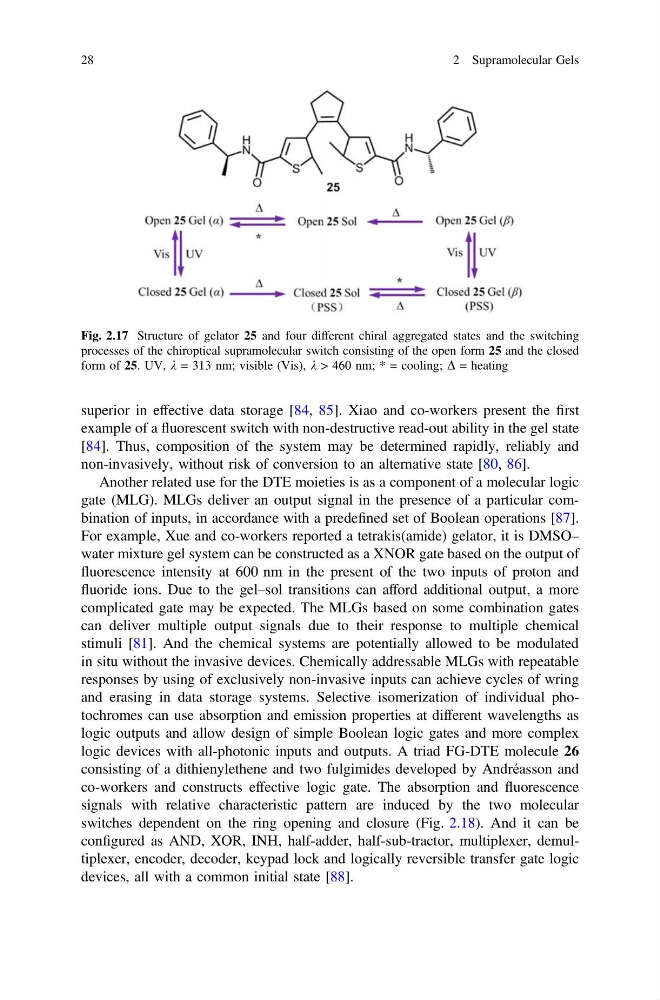
Fig. 2.17 Structure of gelator 25 and four different chiral aggregated states and the switching
processes of the chiroptical supramolecular switch consisting of the open form 25 and the closed
form of 25. UV, k = 313 nm; visible (Vis), k > 460 nm; * = cooling; D = heating
28
2 Supramolecular Gels
example of a fluorescent switch with non-destructive read-out ability in the gel state
[84]. Thus, composition of the system may be determined rapidly, reliably and
non-invasively, without risk of conversion to an alternative state [80, 86].
Another related use for the DTE moieties is as a component of a molecular logic
gate (MLG). MLGs deliver an output signal in the presence of a particular combination of inputs, in accordance with a predefined set of Boolean operations [87].
For example, Xue and co-workers reported a tetrakis(amide) gelator, it is DMSO–
water mixture gel system can be constructed as a XNOR gate based on the output of
fluorescence intensity at 600 nm in the present of the two inputs of proton and
fluoride ions. Due to the gel–sol transitions can afford additional output, a more
complicated gate may be expected. The MLGs based on some combination gates
can deliver multiple output signals due to their response to multiple chemical
stimuli [81]. And the chemical systems are potentially allowed to be modulated
in situ without the invasive devices. Chemically addressable MLGs with repeatable
responses by using of exclusively non-invasive inputs can achieve cycles of wring
and erasing in data storage systems. Selective isomerization of individual photochromes can use absorption and emission properties at different wavelengths as
logic outputs and allow design of simple Boolean logic gates and more complex
logic devices with all-photonic inputs and outputs. A triad FG-DTE molecule 26
consisting of a dithienylethene and two fulgimides developed by Andréasson and
co-workers and constructs effective logic gate. The absorption and fluorescence
signals with relative characteristic pattern are induced by the two molecular
switches dependent on the ring opening and closure (Fig. 2.18). And it can be
configured as AND, XOR, INH, half-adder, half-sub-tractor, multiplexer, demultiplexer, encoder, decoder, keypad lock and logically reversible transfer gate logic
devices, all with a common initial state [88].
Fig. 2.17 Structure of gelator 25 and four different chiral aggregated states and the switching
processes of the chiroptical supramolecular switch consisting of the open form 25 and the closed
form of 25. UV, k = 313 nm; visible (Vis), k > 460 nm; * = cooling; D = heating
28
2 Supramolecular Gels