

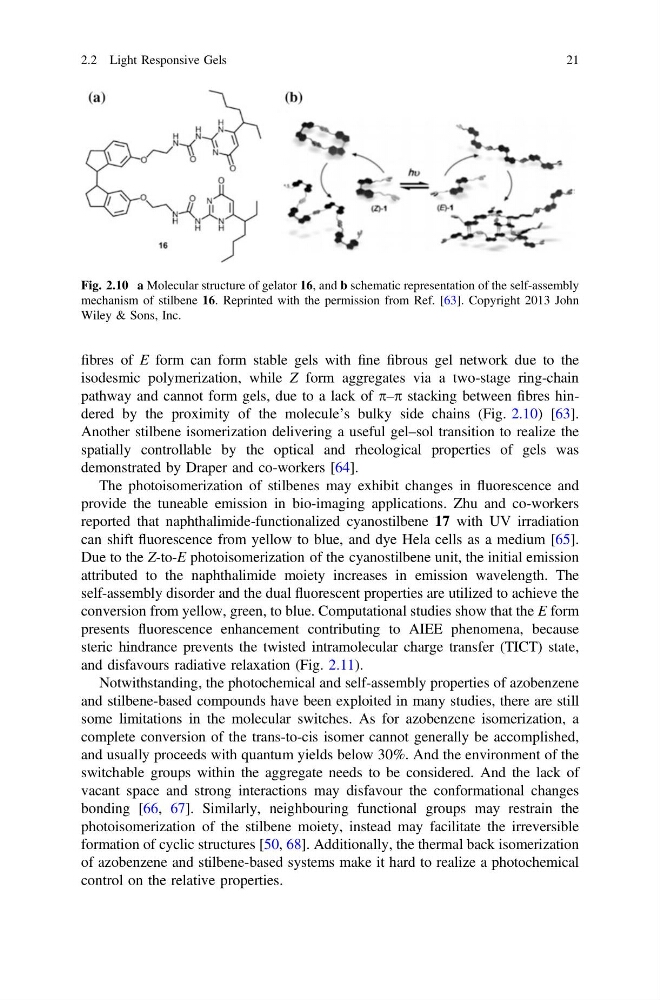
fibres of E form can form stable gels with fine fibrous gel network due to the
isodesmic polymerization, while Z form aggregates via a two-stage ring-chain
pathway and cannot form gels, due to a lack of p–p stacking between fibres hindered by the proximity of the molecule’s bulky side chains (Fig. 2.10) [63].
Another stilbene isomerization delivering a useful gel–sol transition to realize the
spatially controllable by the optical and rheological properties of gels was
demonstrated by Draper and co-workers [64].
The photoisomerization of stilbenes may exhibit changes in fluorescence and
provide the tuneable emission in bio-imaging applications. Zhu and co-workers
reported that naphthalimide-functionalized cyanostilbene 17 with UV irradiation
can shift fluorescence from yellow to blue, and dye Hela cells as a medium [65].
Due to the Z-to-E photoisomerization of the cyanostilbene unit, the initial emission
attributed to the naphthalimide moiety increases in emission wavelength. The
self-assembly disorder and the dual fluorescent properties are utilized to achieve the
conversion from yellow, green, to blue. Computational studies show that the E form
presents fluorescence enhancement contributing to AIEE phenomena, because
steric hindrance prevents the twisted intramolecular charge transfer (TICT) state,
and disfavours radiative relaxation (Fig. 2.11).
Notwithstanding, the photochemical and self-assembly properties of azobenzene
and stilbene-based compounds have been exploited in many studies, there are still
some limitations in the molecular switches. As for azobenzene isomerization, a
complete conversion of the trans-to-cis isomer cannot generally be accomplished,
and usually proceeds with quantum yields below 30%. And the environment of the
switchable groups within the aggregate needs to be considered. And the lack of
vacant space and strong interactions may disfavour the conformational changes
bonding [66, 67]. Similarly, neighbouring functional groups may restrain the
photoisomerization of the stilbene moiety, instead may facilitate the irreversible
formation of cyclic structures [50, 68]. Additionally, the thermal back isomerization
of azobenzene and stilbene-based systems make it hard to realize a photochemical
control on the relative properties.
Fig. 2.10 a Molecular structure of gelator 16, and b schematic representation of the self-assembly
mechanism of stilbene 16. Reprinted with the permission from Ref. [63]. Copyright 2013 John
Wiley & Sons, Inc.
2.2 Light Responsive Gels
21
isodesmic polymerization, while Z form aggregates via a two-stage ring-chain
pathway and cannot form gels, due to a lack of p–p stacking between fibres hindered by the proximity of the molecule’s bulky side chains (Fig. 2.10) [63].
Another stilbene isomerization delivering a useful gel–sol transition to realize the
spatially controllable by the optical and rheological properties of gels was
demonstrated by Draper and co-workers [64].
The photoisomerization of stilbenes may exhibit changes in fluorescence and
provide the tuneable emission in bio-imaging applications. Zhu and co-workers
reported that naphthalimide-functionalized cyanostilbene 17 with UV irradiation
can shift fluorescence from yellow to blue, and dye Hela cells as a medium [65].
Due to the Z-to-E photoisomerization of the cyanostilbene unit, the initial emission
attributed to the naphthalimide moiety increases in emission wavelength. The
self-assembly disorder and the dual fluorescent properties are utilized to achieve the
conversion from yellow, green, to blue. Computational studies show that the E form
presents fluorescence enhancement contributing to AIEE phenomena, because
steric hindrance prevents the twisted intramolecular charge transfer (TICT) state,
and disfavours radiative relaxation (Fig. 2.11).
Notwithstanding, the photochemical and self-assembly properties of azobenzene
and stilbene-based compounds have been exploited in many studies, there are still
some limitations in the molecular switches. As for azobenzene isomerization, a
complete conversion of the trans-to-cis isomer cannot generally be accomplished,
and usually proceeds with quantum yields below 30%. And the environment of the
switchable groups within the aggregate needs to be considered. And the lack of
vacant space and strong interactions may disfavour the conformational changes
bonding [66, 67]. Similarly, neighbouring functional groups may restrain the
photoisomerization of the stilbene moiety, instead may facilitate the irreversible
formation of cyclic structures [50, 68]. Additionally, the thermal back isomerization
of azobenzene and stilbene-based systems make it hard to realize a photochemical
control on the relative properties.
Fig. 2.10 a Molecular structure of gelator 16, and b schematic representation of the self-assembly
mechanism of stilbene 16. Reprinted with the permission from Ref. [63]. Copyright 2013 John
Wiley & Sons, Inc.
2.2 Light Responsive Gels
21