

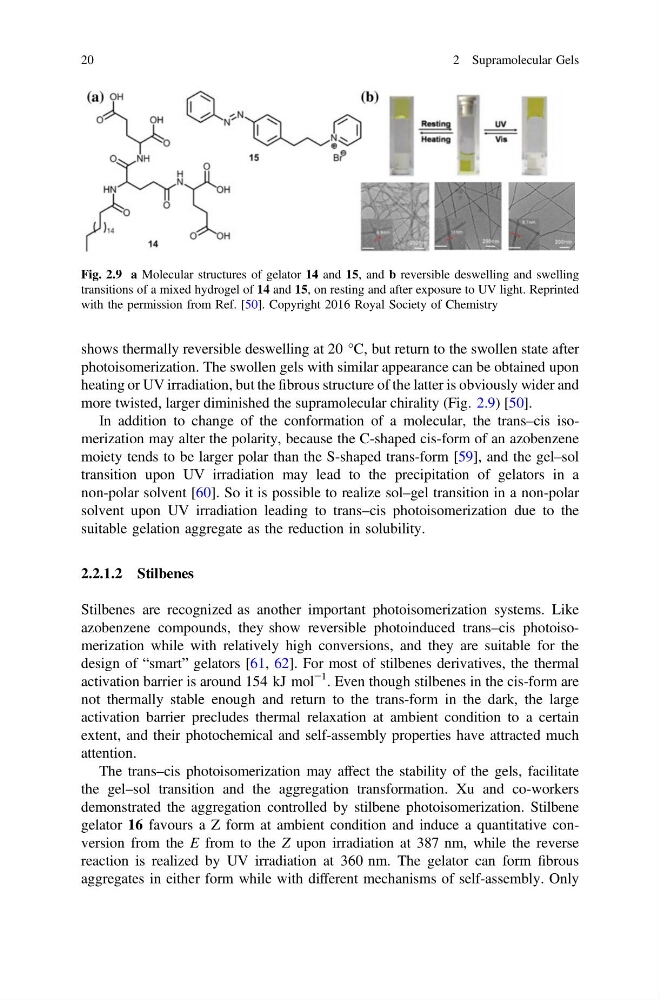
shows thermally reversible deswelling at 20 °C, but return to the swollen state after
photoisomerization. The swollen gels with similar appearance can be obtained upon
heating or UV irradiation, but the fibrous structure of the latter is obviously wider and
more twisted, larger diminished the supramolecular chirality (Fig. 2.9) [50].
In addition to change of the conformation of a molecular, the trans–cis isomerization may alter the polarity, because the C-shaped cis-form of an azobenzene
moiety tends to be larger polar than the S-shaped trans-form [59], and the gel–sol
transition upon UV irradiation may lead to the precipitation of gelators in a
non-polar solvent [60]. So it is possible to realize sol–gel transition in a non-polar
solvent upon UV irradiation leading to trans–cis photoisomerization due to the
suitable gelation aggregate as the reduction in solubility.
2.2.1.2 Stilbenes
Stilbenes are recognized as another important photoisomerization systems. Like
azobenzene compounds, they show reversible photoinduced trans–cis photoisomerization while with relatively high conversions, and they are suitable for the
design of “smart” gelators [61, 62]. For most of stilbenes derivatives, the thermal
activation barrier is around 154 kJ mol
−1 . Even though stilbenes in the cis-form are
not thermally stable enough and return to the trans-form in the dark, the large
activation barrier precludes thermal relaxation at ambient condition to a certain
extent, and their photochemical and self-assembly properties have attracted much
attention.
The trans–cis photoisomerization may affect the stability of the gels, facilitate
the gel–sol transition and the aggregation transformation. Xu and co-workers
demonstrated the aggregation controlled by stilbene photoisomerization. Stilbene
gelator 16 favours a Z form at ambient condition and induce a quantitative conversion from the E from to the Z upon irradiation at 387 nm, while the reverse
reaction is realized by UV irradiation at 360 nm. The gelator can form fibrous
aggregates in either form while with different mechanisms of self-assembly. Only
Fig. 2.9 a Molecular structures of gelator 14 and 15, and b reversible deswelling and swelling
transitions of a mixed hydrogel of 14 and 15, on resting and after exposure to UV light. Reprinted
with the permission from Ref. [50]. Copyright 2016 Royal Society of Chemistry
20
2 Supramolecular Gels
photoisomerization. The swollen gels with similar appearance can be obtained upon
heating or UV irradiation, but the fibrous structure of the latter is obviously wider and
more twisted, larger diminished the supramolecular chirality (Fig. 2.9) [50].
In addition to change of the conformation of a molecular, the trans–cis isomerization may alter the polarity, because the C-shaped cis-form of an azobenzene
moiety tends to be larger polar than the S-shaped trans-form [59], and the gel–sol
transition upon UV irradiation may lead to the precipitation of gelators in a
non-polar solvent [60]. So it is possible to realize sol–gel transition in a non-polar
solvent upon UV irradiation leading to trans–cis photoisomerization due to the
suitable gelation aggregate as the reduction in solubility.
2.2.1.2 Stilbenes
Stilbenes are recognized as another important photoisomerization systems. Like
azobenzene compounds, they show reversible photoinduced trans–cis photoisomerization while with relatively high conversions, and they are suitable for the
design of “smart” gelators [61, 62]. For most of stilbenes derivatives, the thermal
activation barrier is around 154 kJ mol
−1 . Even though stilbenes in the cis-form are
not thermally stable enough and return to the trans-form in the dark, the large
activation barrier precludes thermal relaxation at ambient condition to a certain
extent, and their photochemical and self-assembly properties have attracted much
attention.
The trans–cis photoisomerization may affect the stability of the gels, facilitate
the gel–sol transition and the aggregation transformation. Xu and co-workers
demonstrated the aggregation controlled by stilbene photoisomerization. Stilbene
gelator 16 favours a Z form at ambient condition and induce a quantitative conversion from the E from to the Z upon irradiation at 387 nm, while the reverse
reaction is realized by UV irradiation at 360 nm. The gelator can form fibrous
aggregates in either form while with different mechanisms of self-assembly. Only
Fig. 2.9 a Molecular structures of gelator 14 and 15, and b reversible deswelling and swelling
transitions of a mixed hydrogel of 14 and 15, on resting and after exposure to UV light. Reprinted
with the permission from Ref. [50]. Copyright 2016 Royal Society of Chemistry
20
2 Supramolecular Gels