

of S–S bonding within the gel network, the MoS x chalcogel can adsorb Hg vapour
chemically by forming S–Hg–S bonds [32]. This Hg adsorption property has
potential applications in eliminating mercury contamination emitted from coal
burning. Another significant advantage of the MoS x chalcogel is the ability to
adsorb I 2 vapour. This is related to the polarization of the inner Mo–S surface of the
chalcogel. The I 2 vapour is claimed to be mainly adsorbed via physical interactions.
The choice of preparation methods plays an important role in determining the
structures of the resulting chalcogels and gel formation routes. Examples include
the preparation of antimony sulphide (SbS) chalcogels using four different methods
[33]. As shown in Fig. 6.10, the four synthetic methods include the hydrolysis of
SbS 3
3− salts, the metathesis reaction between SbS 3
3− and Sb 3
+
, the reaction between
Na 2 S and Sb 2 S 3 followed by hydrolysis and the reaction between KOH and Sb 2 S 3
followed by hydrolysis. All of these reaction routes lead to the formation of
SbS-based chalcogels with difference in gelation time. More specifically, the
gelation processes for SbS-I, SbS-III and SbS-IV are completed within a few hours
while this for SbS-II requires 1 week. The prominent advantage of the SbS-based
chalcogels lies in their high surface areas (nearly 1700 m
2 g
−1 ) as detected by N 2
gas sorption experiments.
In addition to the diverse synthetic routes, chalcogels have attracted extensive
research interest mainly because of their remarkable and highly tunable functional
properties. These properties include the aforementioned I 2 and Hg vapour adsorption [32], electrocatalytic and photocatalytic activity for hydrogen production
[34, 35], selective removal of heavy metal elements [30] and hydrodesulphurization
(HDS) catalysis [36]. In this section, several exemplary literatures investigating the
properties of chalcogels are summarized and discussed.
Spongy chalcogels containing Ni–Mo–S, Co–Mo–S and Co–Ni–Mo–S have
been prepared by metathesis reactions (Fig. 6.11) [36]. In these reactions, (MoS 4 )
2−
is used as precursors, and Co
2+ and Ni
2+ containing salts are used as linking agents.
At room temperature, gel-phase materials can be obtained by mixing the solutions
containing the precursors and linking agents followed by a 96 h ageing process.
The gels prepared using the reactions (1), (2) and (3) were named as
chalcogel-Ni-1, chalcogel-Co-1 and chalcogel-NiCo-1, respectively.
The photographs in Fig. 6.12a show the images of some of the wet gels and
aerogels prepared by CO 2 supercritical drying. In comparison, the chalcogels
undergo no significant loss in volume showing stable connection between the
secondary particles. The secondary particles are formed by the aggregation of
primary particles produced by the reactions between (MoS 4 )
2− and Co
2+ /Ni
2+ ions.
Through hydrodesulphurization (HDS) processes, organosulphur compounds are
removed from fossil fuels [37]. The catalytic activity of the chalcogels in the HDS
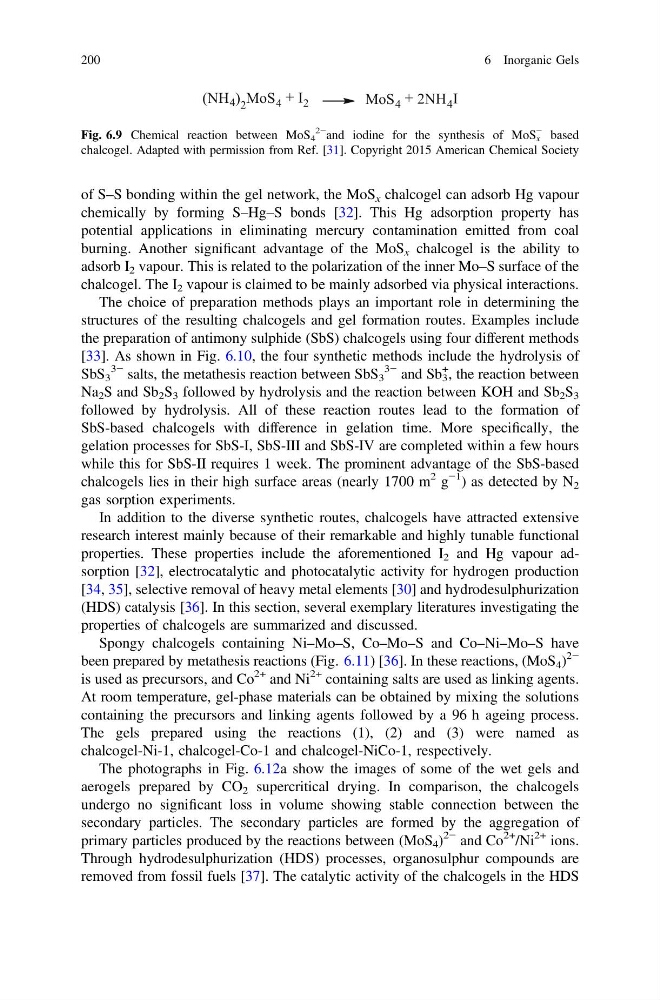
(NH 4 ) 2 MoS 4 + I 2
MoS 4 + 2NH 4 I
Fig. 6.9 Chemical reaction between MoS 4
2−
and iodine for the synthesis of MoS x
− based
chalcogel. Adapted with permission from Ref. [31]. Copyright 2015 American Chemical Society
200
6 Inorganic Gels
chemically by forming S–Hg–S bonds [32]. This Hg adsorption property has
potential applications in eliminating mercury contamination emitted from coal
burning. Another significant advantage of the MoS x chalcogel is the ability to
adsorb I 2 vapour. This is related to the polarization of the inner Mo–S surface of the
chalcogel. The I 2 vapour is claimed to be mainly adsorbed via physical interactions.
The choice of preparation methods plays an important role in determining the
structures of the resulting chalcogels and gel formation routes. Examples include
the preparation of antimony sulphide (SbS) chalcogels using four different methods
[33]. As shown in Fig. 6.10, the four synthetic methods include the hydrolysis of
SbS 3
3− salts, the metathesis reaction between SbS 3
3− and Sb 3
+
, the reaction between
Na 2 S and Sb 2 S 3 followed by hydrolysis and the reaction between KOH and Sb 2 S 3
followed by hydrolysis. All of these reaction routes lead to the formation of
SbS-based chalcogels with difference in gelation time. More specifically, the
gelation processes for SbS-I, SbS-III and SbS-IV are completed within a few hours
while this for SbS-II requires 1 week. The prominent advantage of the SbS-based
chalcogels lies in their high surface areas (nearly 1700 m
2 g
−1 ) as detected by N 2
gas sorption experiments.
In addition to the diverse synthetic routes, chalcogels have attracted extensive
research interest mainly because of their remarkable and highly tunable functional
properties. These properties include the aforementioned I 2 and Hg vapour adsorption [32], electrocatalytic and photocatalytic activity for hydrogen production
[34, 35], selective removal of heavy metal elements [30] and hydrodesulphurization
(HDS) catalysis [36]. In this section, several exemplary literatures investigating the
properties of chalcogels are summarized and discussed.
Spongy chalcogels containing Ni–Mo–S, Co–Mo–S and Co–Ni–Mo–S have
been prepared by metathesis reactions (Fig. 6.11) [36]. In these reactions, (MoS 4 )
2−
is used as precursors, and Co
2+ and Ni
2+ containing salts are used as linking agents.
At room temperature, gel-phase materials can be obtained by mixing the solutions
containing the precursors and linking agents followed by a 96 h ageing process.
The gels prepared using the reactions (1), (2) and (3) were named as
chalcogel-Ni-1, chalcogel-Co-1 and chalcogel-NiCo-1, respectively.
The photographs in Fig. 6.12a show the images of some of the wet gels and
aerogels prepared by CO 2 supercritical drying. In comparison, the chalcogels
undergo no significant loss in volume showing stable connection between the
secondary particles. The secondary particles are formed by the aggregation of
primary particles produced by the reactions between (MoS 4 )
2− and Co
2+ /Ni
2+ ions.
Through hydrodesulphurization (HDS) processes, organosulphur compounds are
removed from fossil fuels [37]. The catalytic activity of the chalcogels in the HDS
(NH 4 ) 2 MoS 4 + I 2
MoS 4 + 2NH 4 I
Fig. 6.9 Chemical reaction between MoS 4
2−
and iodine for the synthesis of MoS x
− based
chalcogel. Adapted with permission from Ref. [31]. Copyright 2015 American Chemical Society
200
6 Inorganic Gels