

process can be presented by the plots in Fig. 6.12b. Compared with the thiophene
HDS activity of the commonly employed sulphide Co–Mo/Al 2 O 3 catalyst at 643 K,
the chalcogel-Co-1 exhibits double catalytic performance as well as long-term
stability (>48 h). This result demonstrates that the non-platinum chalcogel has
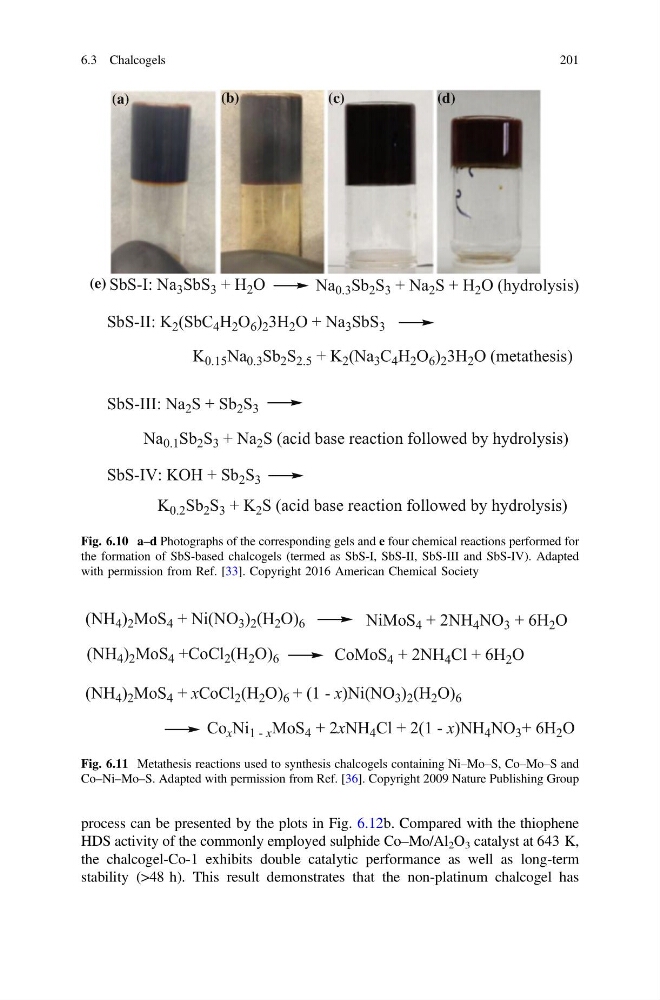
SbS-I: Na 3 SbS 3 + H 2 O
Na 0.3 Sb 2 S 3 + Na 2 S + H 2 O (hydrolysis)
SbS-II: K 2 (SbC 4 H 2 O 6 ) 2 3H 2 O + Na 3 SbS 3
K 0.15 Na 0.3 Sb 2 S 2.5 + K 2 (Na 3 C 4 H 2 O 6 ) 2 3H 2 O (metathesis)
SbS-III: Na 2 S + Sb 2 S 3
Na 0.1 Sb 2 S 3 + Na 2 S (acid base reaction followed by hydrolysis)
SbS-IV: KOH + Sb 2 S 3
K 0.2 Sb 2 S 3 + K 2 S (acid base reaction followed by hydrolysis)
(a)
(b)
(c)
(d)
(e)
Fig. 6.10 a–d Photographs of the corresponding gels and e four chemical reactions performed for
the formation of SbS-based chalcogels (termed as SbS-I, SbS-II, SbS-III and SbS-IV). Adapted
with permission from Ref. [33]. Copyright 2016 American Chemical Society
(NH 4 ) 2 MoS 4 + Ni(NO 3 ) 2 (H 2 O) 6
NiMoS 4 + 2NH 4 NO 3 + 6H 2 O
CoMoS 4 + 2NH 4 Cl + 6H 2 O
(NH 4 ) 2 MoS 4 +CoCl 2 (H 2 O) 6
Co x Ni 1 - x MoS 4 + 2xNH 4 Cl + 2(1 - x)NH 4 NO 3 + 6H 2 O
(NH 4 ) 2 MoS 4 + xCoCl 2 (H 2 O) 6 + (1 - x)Ni(NO 3 ) 2 (H 2 O) 6
Fig. 6.11 Metathesis reactions used to synthesis chalcogels containing Ni–Mo–S, Co–Mo–S and
Co–Ni–Mo–S. Adapted with permission from Ref. [36]. Copyright 2009 Nature Publishing Group
6.3 Chalcogels
201
HDS activity of the commonly employed sulphide Co–Mo/Al 2 O 3 catalyst at 643 K,
the chalcogel-Co-1 exhibits double catalytic performance as well as long-term
stability (>48 h). This result demonstrates that the non-platinum chalcogel has
SbS-I: Na 3 SbS 3 + H 2 O
Na 0.3 Sb 2 S 3 + Na 2 S + H 2 O (hydrolysis)
SbS-II: K 2 (SbC 4 H 2 O 6 ) 2 3H 2 O + Na 3 SbS 3
K 0.15 Na 0.3 Sb 2 S 2.5 + K 2 (Na 3 C 4 H 2 O 6 ) 2 3H 2 O (metathesis)
SbS-III: Na 2 S + Sb 2 S 3
Na 0.1 Sb 2 S 3 + Na 2 S (acid base reaction followed by hydrolysis)
SbS-IV: KOH + Sb 2 S 3
K 0.2 Sb 2 S 3 + K 2 S (acid base reaction followed by hydrolysis)
(a)
(b)
(c)
(d)
(e)
Fig. 6.10 a–d Photographs of the corresponding gels and e four chemical reactions performed for
the formation of SbS-based chalcogels (termed as SbS-I, SbS-II, SbS-III and SbS-IV). Adapted
with permission from Ref. [33]. Copyright 2016 American Chemical Society
(NH 4 ) 2 MoS 4 + Ni(NO 3 ) 2 (H 2 O) 6
NiMoS 4 + 2NH 4 NO 3 + 6H 2 O
CoMoS 4 + 2NH 4 Cl + 6H 2 O
(NH 4 ) 2 MoS 4 +CoCl 2 (H 2 O) 6
Co x Ni 1 - x MoS 4 + 2xNH 4 Cl + 2(1 - x)NH 4 NO 3 + 6H 2 O
(NH 4 ) 2 MoS 4 + xCoCl 2 (H 2 O) 6 + (1 - x)Ni(NO 3 ) 2 (H 2 O) 6
Fig. 6.11 Metathesis reactions used to synthesis chalcogels containing Ni–Mo–S, Co–Mo–S and
Co–Ni–Mo–S. Adapted with permission from Ref. [36]. Copyright 2009 Nature Publishing Group
6.3 Chalcogels
201