

6.3 Chalcogels
Apart from inorganic gels made from oxides, Kanatzidis and co-workers have
developed the application of sulphide and selenide clusters in gel formation [30].
The porous gel networks are stabilized by the interactions between these clusters
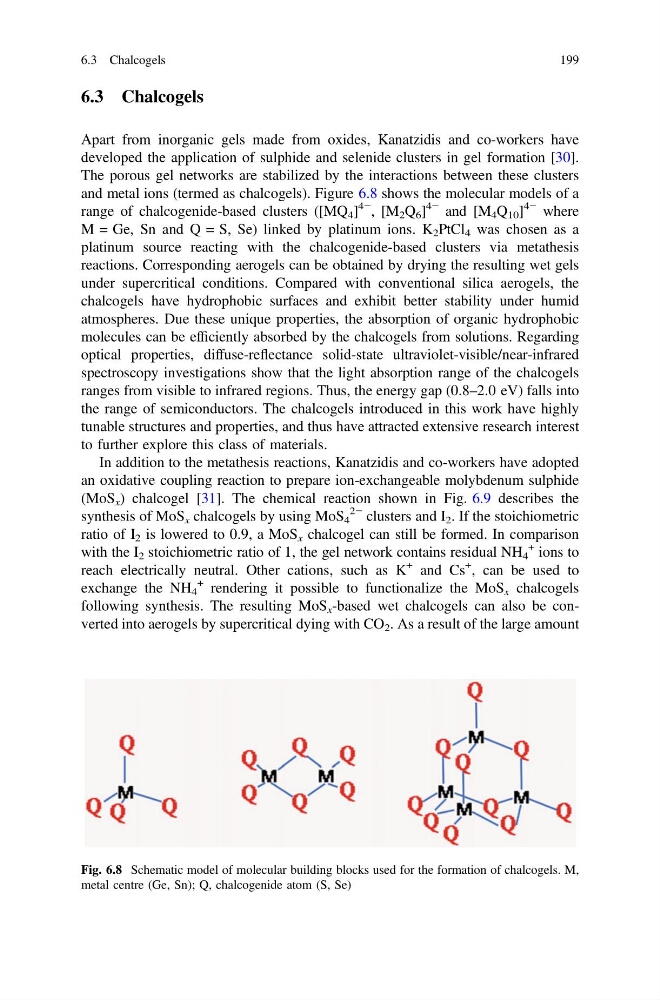
and metal ions (termed as chalcogels). Figure 6.8 shows the molecular models of a
range of chalcogenide-based clusters ([MQ 4 ]
4− , [M 2 Q 6 ]
4− and [M 4 Q 10 ]
4− where
M = Ge, Sn and Q = S, Se) linked by platinum ions. K 2 PtCl 4 was chosen as a
platinum source reacting with the chalcogenide-based clusters via metathesis
reactions. Corresponding aerogels can be obtained by drying the resulting wet gels
under supercritical conditions. Compared with conventional silica aerogels, the
chalcogels have hydrophobic surfaces and exhibit better stability under humid
atmospheres. Due these unique properties, the absorption of organic hydrophobic
molecules can be efficiently absorbed by the chalcogels from solutions. Regarding
optical properties, diffuse-reflectance solid-state ultraviolet-visible/near-infrared
spectroscopy investigations show that the light absorption range of the chalcogels
ranges from visible to infrared regions. Thus, the energy gap (0.8–2.0 eV) falls into
the range of semiconductors. The chalcogels introduced in this work have highly
tunable structures and properties, and thus have attracted extensive research interest
to further explore this class of materials.
In addition to the metathesis reactions, Kanatzidis and co-workers have adopted
an oxidative coupling reaction to prepare ion-exchangeable molybdenum sulphide
(MoS x ) chalcogel [31]. The chemical reaction shown in Fig. 6.9 describes the
synthesis of MoS x chalcogels by using MoS 4
2− clusters and I 2 . If the stoichiometric
ratio of I 2 is lowered to 0.9, a MoS x chalcogel can still be formed. In comparison
with the I 2 stoichiometric ratio of 1, the gel network contains residual NH 4
+ ions to
reach electrically neutral. Other cations, such as K
+ and Cs
+ , can be used to
exchange the NH 4
+ rendering it possible to functionalize the MoS x chalcogels
following synthesis. The resulting MoS x -based wet chalcogels can also be converted into aerogels by supercritical dying with CO 2 . As a result of the large amount
Fig. 6.8 Schematic model of molecular building blocks used for the formation of chalcogels. M,
metal centre (Ge, Sn); Q, chalcogenide atom (S, Se)
6.3 Chalcogels
199
Apart from inorganic gels made from oxides, Kanatzidis and co-workers have
developed the application of sulphide and selenide clusters in gel formation [30].
The porous gel networks are stabilized by the interactions between these clusters
and metal ions (termed as chalcogels). Figure 6.8 shows the molecular models of a
range of chalcogenide-based clusters ([MQ 4 ]
4− , [M 2 Q 6 ]
4− and [M 4 Q 10 ]
4− where
M = Ge, Sn and Q = S, Se) linked by platinum ions. K 2 PtCl 4 was chosen as a
platinum source reacting with the chalcogenide-based clusters via metathesis
reactions. Corresponding aerogels can be obtained by drying the resulting wet gels
under supercritical conditions. Compared with conventional silica aerogels, the
chalcogels have hydrophobic surfaces and exhibit better stability under humid
atmospheres. Due these unique properties, the absorption of organic hydrophobic
molecules can be efficiently absorbed by the chalcogels from solutions. Regarding
optical properties, diffuse-reflectance solid-state ultraviolet-visible/near-infrared
spectroscopy investigations show that the light absorption range of the chalcogels
ranges from visible to infrared regions. Thus, the energy gap (0.8–2.0 eV) falls into
the range of semiconductors. The chalcogels introduced in this work have highly
tunable structures and properties, and thus have attracted extensive research interest
to further explore this class of materials.
In addition to the metathesis reactions, Kanatzidis and co-workers have adopted
an oxidative coupling reaction to prepare ion-exchangeable molybdenum sulphide
(MoS x ) chalcogel [31]. The chemical reaction shown in Fig. 6.9 describes the
synthesis of MoS x chalcogels by using MoS 4
2− clusters and I 2 . If the stoichiometric
ratio of I 2 is lowered to 0.9, a MoS x chalcogel can still be formed. In comparison
with the I 2 stoichiometric ratio of 1, the gel network contains residual NH 4
+ ions to
reach electrically neutral. Other cations, such as K
+ and Cs
+ , can be used to
exchange the NH 4
+ rendering it possible to functionalize the MoS x chalcogels
following synthesis. The resulting MoS x -based wet chalcogels can also be converted into aerogels by supercritical dying with CO 2 . As a result of the large amount
Fig. 6.8 Schematic model of molecular building blocks used for the formation of chalcogels. M,
metal centre (Ge, Sn); Q, chalcogenide atom (S, Se)
6.3 Chalcogels
199