

composites. Figure 6.6b shows the photography of a three-point flexural bending
method to test the strength of the di-ISO cross-linked silica aerogel with a density of
0.447 g cm
−3 . Results from the mechanical test prove that a load of around 15 kg is
required to break the monolith sample.
Colloidal silicon dioxide produced in a flame (called as fumed silica) is a widely
investigated inorganic particle species for silica-based gel formation. The SEM
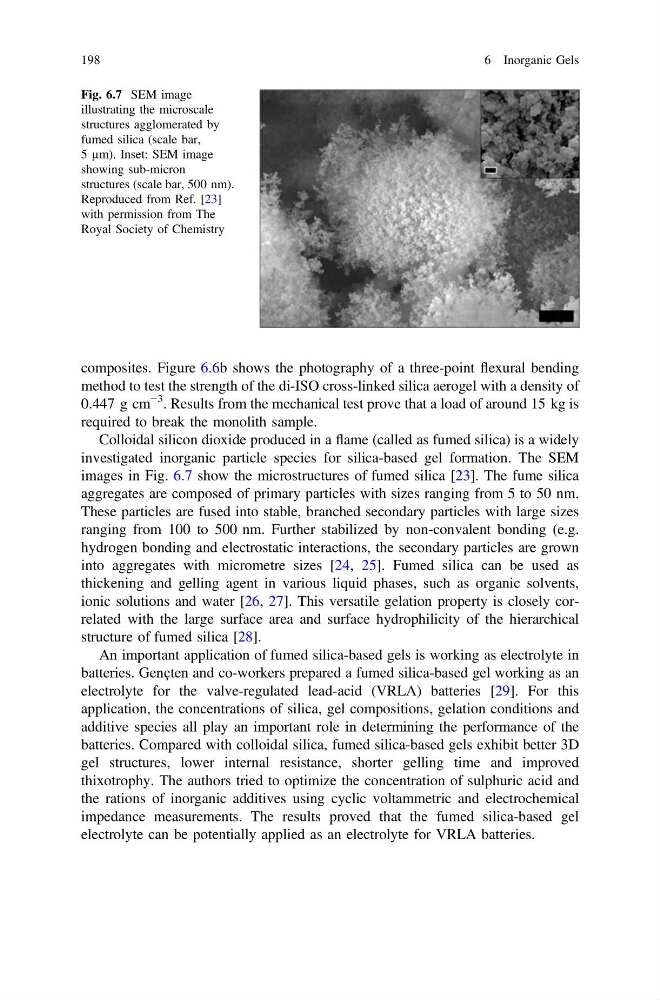
images in Fig. 6.7 show the microstructures of fumed silica [23]. The fume silica
aggregates are composed of primary particles with sizes ranging from 5 to 50 nm.
These particles are fused into stable, branched secondary particles with large sizes
ranging from 100 to 500 nm. Further stabilized by non-convalent bonding (e.g.
hydrogen bonding and electrostatic interactions, the secondary particles are grown
into aggregates with micrometre sizes [24, 25]. Fumed silica can be used as
thickening and gelling agent in various liquid phases, such as organic solvents,
ionic solutions and water [26, 27]. This versatile gelation property is closely correlated with the large surface area and surface hydrophilicity of the hierarchical
structure of fumed silica [28].
An important application of fumed silica-based gels is working as electrolyte in
batteries. Gençten and co-workers prepared a fumed silica-based gel working as an
electrolyte for the valve-regulated lead-acid (VRLA) batteries [29]. For this
application, the concentrations of silica, gel compositions, gelation conditions and
additive species all play an important role in determining the performance of the
batteries. Compared with colloidal silica, fumed silica-based gels exhibit better 3D
gel structures, lower internal resistance, shorter gelling time and improved
thixotrophy. The authors tried to optimize the concentration of sulphuric acid and
the rations of inorganic additives using cyclic voltammetric and electrochemical
impedance measurements. The results proved that the fumed silica-based gel
electrolyte can be potentially applied as an electrolyte for VRLA batteries.
Fig. 6.7 SEM image
illustrating the microscale
structures agglomerated by
fumed silica (scale bar,
5 µm). Inset: SEM image
showing sub-micron
structures (scale bar, 500 nm).
Reproduced from Ref. [23]
with permission from The
Royal Society of Chemistry
198
6 Inorganic Gels
method to test the strength of the di-ISO cross-linked silica aerogel with a density of
0.447 g cm
−3 . Results from the mechanical test prove that a load of around 15 kg is
required to break the monolith sample.
Colloidal silicon dioxide produced in a flame (called as fumed silica) is a widely
investigated inorganic particle species for silica-based gel formation. The SEM
images in Fig. 6.7 show the microstructures of fumed silica [23]. The fume silica
aggregates are composed of primary particles with sizes ranging from 5 to 50 nm.
These particles are fused into stable, branched secondary particles with large sizes
ranging from 100 to 500 nm. Further stabilized by non-convalent bonding (e.g.
hydrogen bonding and electrostatic interactions, the secondary particles are grown
into aggregates with micrometre sizes [24, 25]. Fumed silica can be used as
thickening and gelling agent in various liquid phases, such as organic solvents,
ionic solutions and water [26, 27]. This versatile gelation property is closely correlated with the large surface area and surface hydrophilicity of the hierarchical
structure of fumed silica [28].
An important application of fumed silica-based gels is working as electrolyte in
batteries. Gençten and co-workers prepared a fumed silica-based gel working as an
electrolyte for the valve-regulated lead-acid (VRLA) batteries [29]. For this
application, the concentrations of silica, gel compositions, gelation conditions and
additive species all play an important role in determining the performance of the
batteries. Compared with colloidal silica, fumed silica-based gels exhibit better 3D
gel structures, lower internal resistance, shorter gelling time and improved
thixotrophy. The authors tried to optimize the concentration of sulphuric acid and
the rations of inorganic additives using cyclic voltammetric and electrochemical
impedance measurements. The results proved that the fumed silica-based gel
electrolyte can be potentially applied as an electrolyte for VRLA batteries.
Fig. 6.7 SEM image
illustrating the microscale
structures agglomerated by
fumed silica (scale bar,
5 µm). Inset: SEM image
showing sub-micron
structures (scale bar, 500 nm).
Reproduced from Ref. [23]
with permission from The
Royal Society of Chemistry
198
6 Inorganic Gels