

6.2 Silica-Based Gels
In early times, SiO 2 were made from the chemical reaction between sodium
metasilicate Na 2 SiO 3 and an acid (see reaction 6.1) [6, 11].
Na 2 SiO 3 þ 2HCl þ ðx À 1ÞH 2 O ! SiO 2 H 2 O
ð
Þ x þ 2NaCl
ð6:1Þ
In order to obtain pure SiO 2 , dialysis processes are often performed to remove
NaCl following the reaction. Kistler first used this reaction to synthesize water
glass-based aerogels by supercritical drying [11]. As a cheap method, this reaction
was once modified by BASF to produce commercial silica-based aerogels [12]. The
main disadvantage of the reaction lies in the use of water as a solvent which reduces
the flexibility for the adjustment of the hydrolysis and condensation rates [6].
The preparation of silica gels often starts with the formation of a solution by
dispersing nanoparticles in a suitable liquid, followed by interconnection of the
particles. The most commonly used silica source is silicon alkoxide molecules,
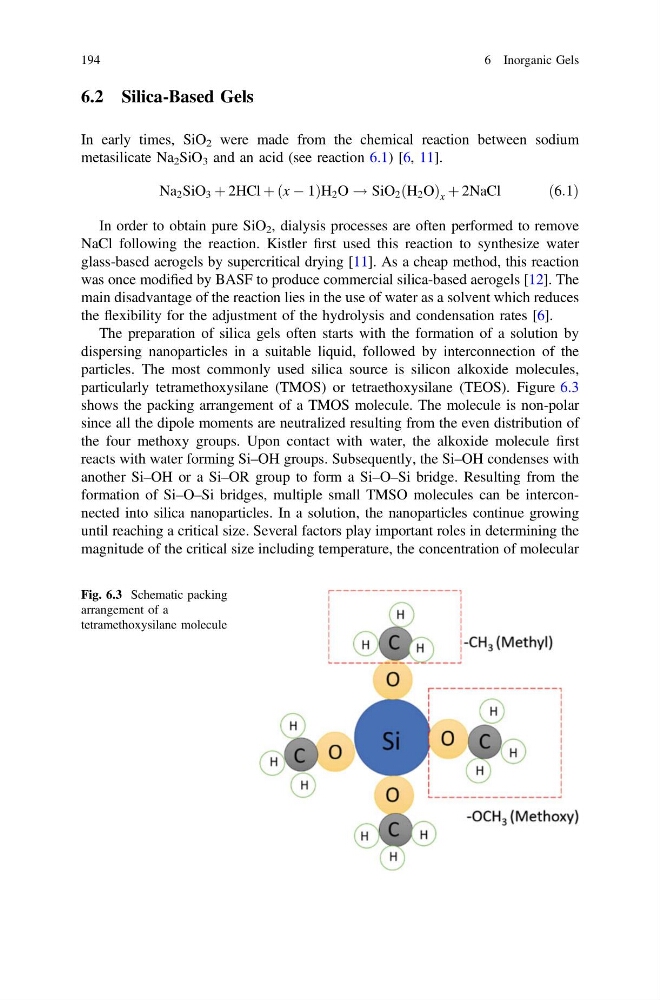
particularly tetramethoxysilane (TMOS) or tetraethoxysilane (TEOS). Figure 6.3
shows the packing arrangement of a TMOS molecule. The molecule is non-polar
since all the dipole moments are neutralized resulting from the even distribution of
the four methoxy groups. Upon contact with water, the alkoxide molecule first
reacts with water forming Si–OH groups. Subsequently, the Si–OH condenses with
another Si–OH or a Si–OR group to form a Si–O–Si bridge. Resulting from the
formation of Si–O–Si bridges, multiple small TMSO molecules can be interconnected into silica nanoparticles. In a solution, the nanoparticles continue growing
until reaching a critical size. Several factors play important roles in determining the
magnitude of the critical size including temperature, the concentration of molecular
Fig. 6.3 Schematic packing
arrangement of a
tetramethoxysilane molecule
194
6 Inorganic Gels
In early times, SiO 2 were made from the chemical reaction between sodium
metasilicate Na 2 SiO 3 and an acid (see reaction 6.1) [6, 11].
Na 2 SiO 3 þ 2HCl þ ðx À 1ÞH 2 O ! SiO 2 H 2 O
ð
Þ x þ 2NaCl
ð6:1Þ
In order to obtain pure SiO 2 , dialysis processes are often performed to remove
NaCl following the reaction. Kistler first used this reaction to synthesize water
glass-based aerogels by supercritical drying [11]. As a cheap method, this reaction
was once modified by BASF to produce commercial silica-based aerogels [12]. The
main disadvantage of the reaction lies in the use of water as a solvent which reduces
the flexibility for the adjustment of the hydrolysis and condensation rates [6].
The preparation of silica gels often starts with the formation of a solution by
dispersing nanoparticles in a suitable liquid, followed by interconnection of the
particles. The most commonly used silica source is silicon alkoxide molecules,
particularly tetramethoxysilane (TMOS) or tetraethoxysilane (TEOS). Figure 6.3
shows the packing arrangement of a TMOS molecule. The molecule is non-polar
since all the dipole moments are neutralized resulting from the even distribution of
the four methoxy groups. Upon contact with water, the alkoxide molecule first
reacts with water forming Si–OH groups. Subsequently, the Si–OH condenses with
another Si–OH or a Si–OR group to form a Si–O–Si bridge. Resulting from the
formation of Si–O–Si bridges, multiple small TMSO molecules can be interconnected into silica nanoparticles. In a solution, the nanoparticles continue growing
until reaching a critical size. Several factors play important roles in determining the
magnitude of the critical size including temperature, the concentration of molecular
Fig. 6.3 Schematic packing
arrangement of a
tetramethoxysilane molecule
194
6 Inorganic Gels