

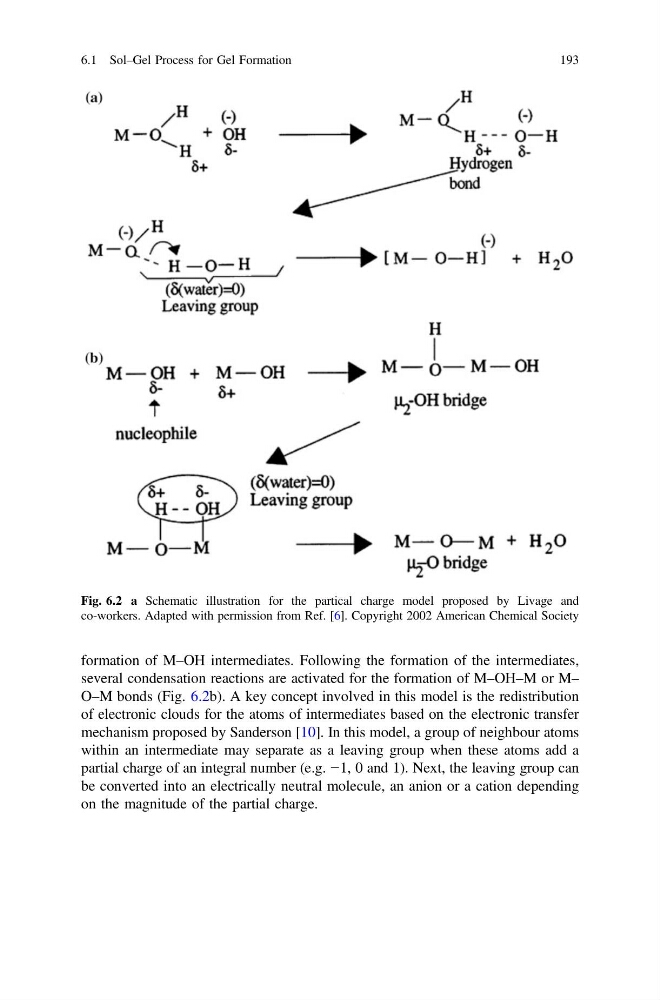
formation of M–OH intermediates. Following the formation of the intermediates,
several condensation reactions are activated for the formation of M–OH–M or M–
O–M bonds (Fig. 6.2b). A key concept involved in this model is the redistribution
of electronic clouds for the atoms of intermediates based on the electronic transfer
mechanism proposed by Sanderson [10]. In this model, a group of neighbour atoms
within an intermediate may separate as a leaving group when these atoms add a
partial charge of an integral number (e.g. −1, 0 and 1). Next, the leaving group can
be converted into an electrically neutral molecule, an anion or a cation depending
on the magnitude of the partial charge.
Fig. 6.2 a Schematic illustration for the partical charge model proposed by Livage and
co-workers. Adapted with permission from Ref. [6]. Copyright 2002 American Chemical Society
6.1 Sol–Gel Process for Gel Formation
193
several condensation reactions are activated for the formation of M–OH–M or M–
O–M bonds (Fig. 6.2b). A key concept involved in this model is the redistribution
of electronic clouds for the atoms of intermediates based on the electronic transfer
mechanism proposed by Sanderson [10]. In this model, a group of neighbour atoms
within an intermediate may separate as a leaving group when these atoms add a
partial charge of an integral number (e.g. −1, 0 and 1). Next, the leaving group can
be converted into an electrically neutral molecule, an anion or a cation depending
on the magnitude of the partial charge.
Fig. 6.2 a Schematic illustration for the partical charge model proposed by Livage and
co-workers. Adapted with permission from Ref. [6]. Copyright 2002 American Chemical Society
6.1 Sol–Gel Process for Gel Formation
193