

Conventional wet gels encapsulating liquids can be converted into other gel
forms through dying. Examples include xerogel formed after the shrinkage of
original gel networks by drying under ambient pressure and aerogels which
maintain gel networks by drying under supercritical conditions. Despite abundant
existence of organic gels, inorganic gels have already evolved into an inseparable
research branch of gel materials [6–8].
6.1 Sol–Gel Process for Gel Formation
Inorganic gels are often formed via the hydrolysis and condensation of oxides, in
the form of solid colloidal particles. The colloid species that can undergo such sol–
gel processes include silica and other metal oxides (e.g. Al 2 O 3 , TiO 2 and ZrO 2 ).
The formation of inorganic gels involves the linking of silicon of metallic atoms,
similar to cross-linking between gelators via self-assembly or polymerization for
polymer gels.
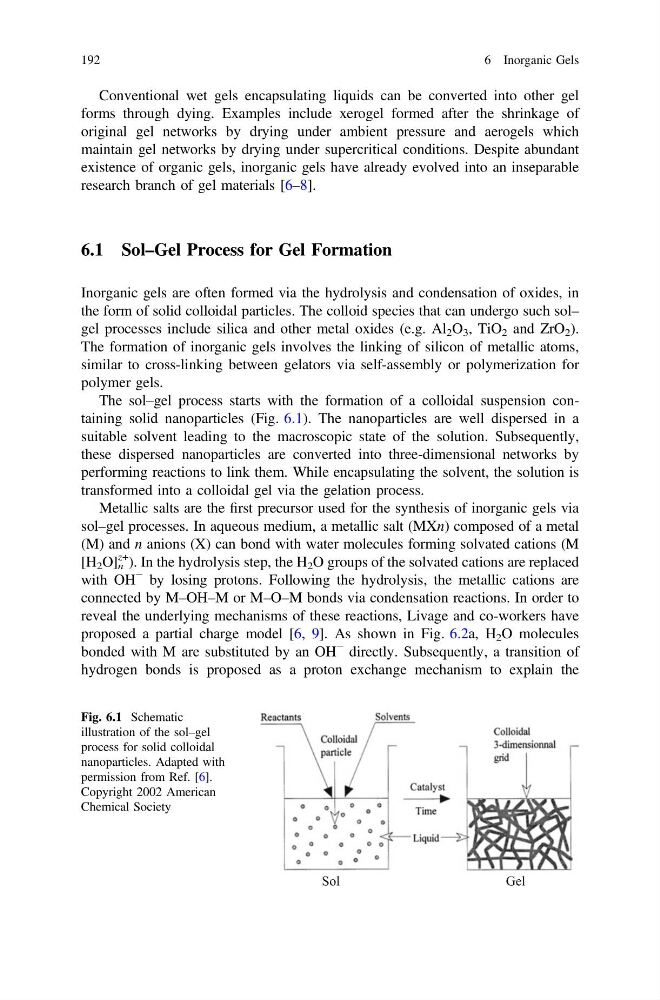
The sol–gel process starts with the formation of a colloidal suspension containing solid nanoparticles (Fig. 6.1). The nanoparticles are well dispersed in a
suitable solvent leading to the macroscopic state of the solution. Subsequently,
these dispersed nanoparticles are converted into three-dimensional networks by
performing reactions to link them. While encapsulating the solvent, the solution is
transformed into a colloidal gel via the gelation process.
Metallic salts are the first precursor used for the synthesis of inorganic gels via
sol–gel processes. In aqueous medium, a metallic salt (MXn) composed of a metal
(M) and n anions (X) can bond with water molecules forming solvated cations (M
[H 2 O] n
z+
). In the hydrolysis step, the H 2 O groups of the solvated cations are replaced
with OH
− by losing protons. Following the hydrolysis, the metallic cations are
connected by M–OH–M or M–O–M bonds via condensation reactions. In order to
reveal the underlying mechanisms of these reactions, Livage and co-workers have
proposed a partial charge model [6, 9]. As shown in Fig. 6.2a, H 2 O molecules
bonded with M are substituted by an OH
− directly. Subsequently, a transition of
hydrogen bonds is proposed as a proton exchange mechanism to explain the
Sol
Gel
Fig. 6.1 Schematic
illustration of the sol–gel
process for solid colloidal
nanoparticles. Adapted with
permission from Ref. [6].
Copyright 2002 American
Chemical Society
192
6 Inorganic Gels
forms through dying. Examples include xerogel formed after the shrinkage of
original gel networks by drying under ambient pressure and aerogels which
maintain gel networks by drying under supercritical conditions. Despite abundant
existence of organic gels, inorganic gels have already evolved into an inseparable
research branch of gel materials [6–8].
6.1 Sol–Gel Process for Gel Formation
Inorganic gels are often formed via the hydrolysis and condensation of oxides, in
the form of solid colloidal particles. The colloid species that can undergo such sol–
gel processes include silica and other metal oxides (e.g. Al 2 O 3 , TiO 2 and ZrO 2 ).
The formation of inorganic gels involves the linking of silicon of metallic atoms,
similar to cross-linking between gelators via self-assembly or polymerization for
polymer gels.
The sol–gel process starts with the formation of a colloidal suspension containing solid nanoparticles (Fig. 6.1). The nanoparticles are well dispersed in a
suitable solvent leading to the macroscopic state of the solution. Subsequently,
these dispersed nanoparticles are converted into three-dimensional networks by
performing reactions to link them. While encapsulating the solvent, the solution is
transformed into a colloidal gel via the gelation process.
Metallic salts are the first precursor used for the synthesis of inorganic gels via
sol–gel processes. In aqueous medium, a metallic salt (MXn) composed of a metal
(M) and n anions (X) can bond with water molecules forming solvated cations (M
[H 2 O] n
z+
). In the hydrolysis step, the H 2 O groups of the solvated cations are replaced
with OH
− by losing protons. Following the hydrolysis, the metallic cations are
connected by M–OH–M or M–O–M bonds via condensation reactions. In order to
reveal the underlying mechanisms of these reactions, Livage and co-workers have
proposed a partial charge model [6, 9]. As shown in Fig. 6.2a, H 2 O molecules
bonded with M are substituted by an OH
− directly. Subsequently, a transition of
hydrogen bonds is proposed as a proton exchange mechanism to explain the
Sol
Gel
Fig. 6.1 Schematic
illustration of the sol–gel
process for solid colloidal
nanoparticles. Adapted with
permission from Ref. [6].
Copyright 2002 American
Chemical Society
192
6 Inorganic Gels