

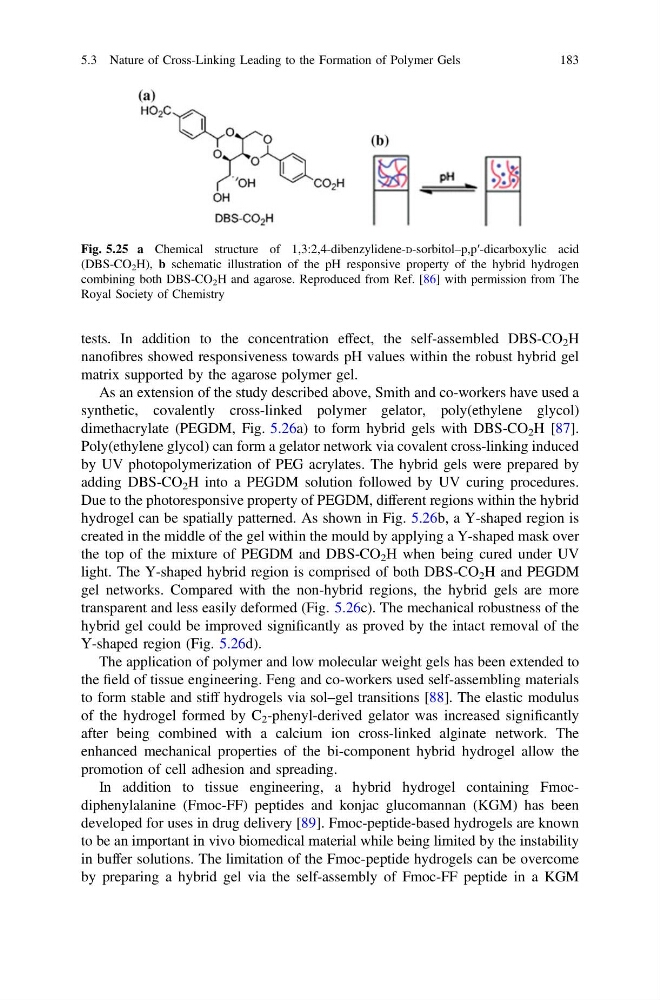
tests. In addition to the concentration effect, the self-assembled DBS-CO 2 H
nanofibres showed responsiveness towards pH values within the robust hybrid gel
matrix supported by the agarose polymer gel.
As an extension of the study described above, Smith and co-workers have used a
synthetic, covalently cross-linked polymer gelator, poly(ethylene glycol)
dimethacrylate (PEGDM, Fig. 5.26a) to form hybrid gels with DBS-CO 2 H [87].
Poly(ethylene glycol) can form a gelator network via covalent cross-linking induced
by UV photopolymerization of PEG acrylates. The hybrid gels were prepared by
adding DBS-CO 2 H into a PEGDM solution followed by UV curing procedures.
Due to the photoresponsive property of PEGDM, different regions within the hybrid
hydrogel can be spatially patterned. As shown in Fig. 5.26b, a Y-shaped region is
created in the middle of the gel within the mould by applying a Y-shaped mask over
the top of the mixture of PEGDM and DBS-CO 2 H when being cured under UV
light. The Y-shaped hybrid region is comprised of both DBS-CO 2 H and PEGDM
gel networks. Compared with the non-hybrid regions, the hybrid gels are more
transparent and less easily deformed (Fig. 5.26c). The mechanical robustness of the
hybrid gel could be improved significantly as proved by the intact removal of the
Y-shaped region (Fig. 5.26d).
The application of polymer and low molecular weight gels has been extended to
the field of tissue engineering. Feng and co-workers used self-assembling materials
to form stable and stiff hydrogels via sol–gel transitions [88]. The elastic modulus
of the hydrogel formed by C 2 -phenyl-derived gelator was increased significantly
after being combined with a calcium ion cross-linked alginate network. The
enhanced mechanical properties of the bi-component hybrid hydrogel allow the
promotion of cell adhesion and spreading.
In addition to tissue engineering, a hybrid hydrogel containing Fmocdiphenylalanine (Fmoc-FF) peptides and konjac glucomannan (KGM) has been
developed for uses in drug delivery [89]. Fmoc-peptide-based hydrogels are known
to be an important in vivo biomedical material while being limited by the instability
in buffer solutions. The limitation of the Fmoc-peptide hydrogels can be overcome
by preparing a hybrid gel via the self-assembly of Fmoc-FF peptide in a KGM
Fig. 5.25 a Chemical structure of 1,3:2,4-dibenzylidene-D-sorbitol–p,p′-dicarboxylic acid
(DBS-CO 2 H), b schematic illustration of the pH responsive property of the hybrid hydrogen
combining both DBS-CO 2 H and agarose. Reproduced from Ref. [86] with permission from The
Royal Society of Chemistry
5.3 Nature of Cross-Linking Leading to the Formation of Polymer Gels
183
nanofibres showed responsiveness towards pH values within the robust hybrid gel
matrix supported by the agarose polymer gel.
As an extension of the study described above, Smith and co-workers have used a
synthetic, covalently cross-linked polymer gelator, poly(ethylene glycol)
dimethacrylate (PEGDM, Fig. 5.26a) to form hybrid gels with DBS-CO 2 H [87].
Poly(ethylene glycol) can form a gelator network via covalent cross-linking induced
by UV photopolymerization of PEG acrylates. The hybrid gels were prepared by
adding DBS-CO 2 H into a PEGDM solution followed by UV curing procedures.
Due to the photoresponsive property of PEGDM, different regions within the hybrid
hydrogel can be spatially patterned. As shown in Fig. 5.26b, a Y-shaped region is
created in the middle of the gel within the mould by applying a Y-shaped mask over
the top of the mixture of PEGDM and DBS-CO 2 H when being cured under UV
light. The Y-shaped hybrid region is comprised of both DBS-CO 2 H and PEGDM
gel networks. Compared with the non-hybrid regions, the hybrid gels are more
transparent and less easily deformed (Fig. 5.26c). The mechanical robustness of the
hybrid gel could be improved significantly as proved by the intact removal of the
Y-shaped region (Fig. 5.26d).
The application of polymer and low molecular weight gels has been extended to
the field of tissue engineering. Feng and co-workers used self-assembling materials
to form stable and stiff hydrogels via sol–gel transitions [88]. The elastic modulus
of the hydrogel formed by C 2 -phenyl-derived gelator was increased significantly
after being combined with a calcium ion cross-linked alginate network. The
enhanced mechanical properties of the bi-component hybrid hydrogel allow the
promotion of cell adhesion and spreading.
In addition to tissue engineering, a hybrid hydrogel containing Fmocdiphenylalanine (Fmoc-FF) peptides and konjac glucomannan (KGM) has been
developed for uses in drug delivery [89]. Fmoc-peptide-based hydrogels are known
to be an important in vivo biomedical material while being limited by the instability
in buffer solutions. The limitation of the Fmoc-peptide hydrogels can be overcome
by preparing a hybrid gel via the self-assembly of Fmoc-FF peptide in a KGM
Fig. 5.25 a Chemical structure of 1,3:2,4-dibenzylidene-D-sorbitol–p,p′-dicarboxylic acid
(DBS-CO 2 H), b schematic illustration of the pH responsive property of the hybrid hydrogen
combining both DBS-CO 2 H and agarose. Reproduced from Ref. [86] with permission from The
Royal Society of Chemistry
5.3 Nature of Cross-Linking Leading to the Formation of Polymer Gels
183