

solution. The drug release performance of the hybrid gel was characterized thoroughly including its pH responsibility, overall integrity and crystallization processes. Measurements were conducted to study the in vitro docetaxel release from
the hybrid gel. The experimental results proved that the release rate was mainly
associated with the concentration of KGM, ageing time and the concentration of
b-mannanase added into the gel system. A fine control over these parameters can
lead to a sustained docetaxel release from the peptide–polysaccharide hybrid
hydrogel.
The formation of hybrid gels has been proven as an effective approach to
developing novel materials where the properties of low molecular weight and
polymer gelators are combined in a single structure. The properties of the two types
of gel networks are not only combined simply, but also, in some cases, are entirely
new. The properties of either of the components may be surpassed by those of the
resulting hybrid gel materials. A large amount of further work is required to fully
understand the growth mechanism of the hybrid molecular networks and gel
materials with potential high-tech applications.
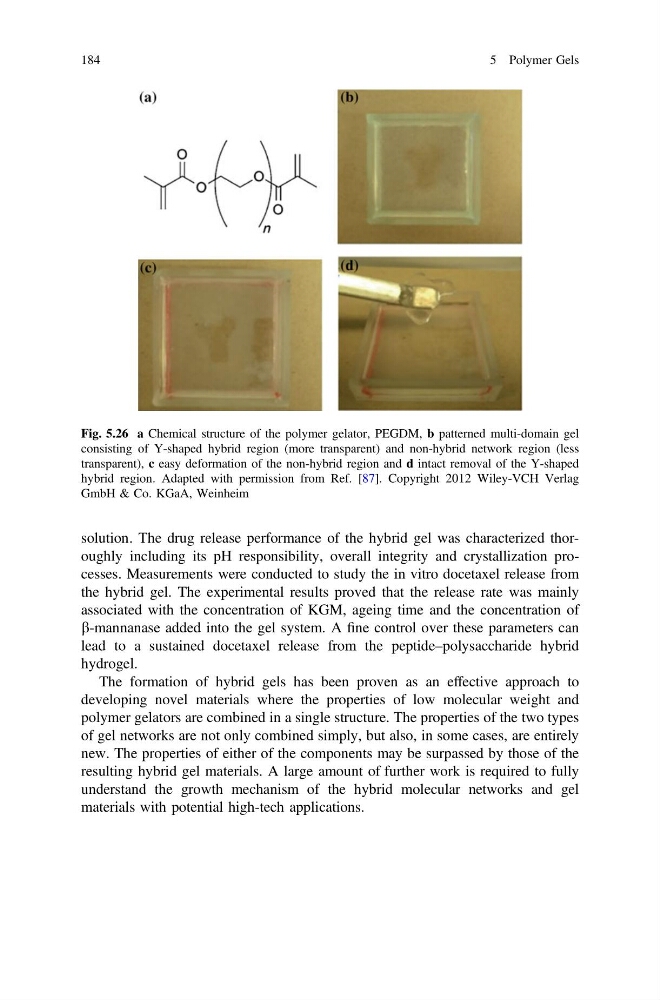
Fig. 5.26 a Chemical structure of the polymer gelator, PEGDM, b patterned multi-domain gel
consisting of Y-shaped hybrid region (more transparent) and non-hybrid network region (less
transparent), c easy deformation of the non-hybrid region and d intact removal of the Y-shaped
hybrid region. Adapted with permission from Ref. [87]. Copyright 2012 Wiley-VCH Verlag
GmbH & Co. KGaA, Weinheim
184
5 Polymer Gels
the hybrid gel. The experimental results proved that the release rate was mainly
associated with the concentration of KGM, ageing time and the concentration of
b-mannanase added into the gel system. A fine control over these parameters can
lead to a sustained docetaxel release from the peptide–polysaccharide hybrid
hydrogel.
The formation of hybrid gels has been proven as an effective approach to
developing novel materials where the properties of low molecular weight and
polymer gelators are combined in a single structure. The properties of the two types
of gel networks are not only combined simply, but also, in some cases, are entirely
new. The properties of either of the components may be surpassed by those of the
resulting hybrid gel materials. A large amount of further work is required to fully
understand the growth mechanism of the hybrid molecular networks and gel
materials with potential high-tech applications.
Fig. 5.26 a Chemical structure of the polymer gelator, PEGDM, b patterned multi-domain gel
consisting of Y-shaped hybrid region (more transparent) and non-hybrid network region (less
transparent), c easy deformation of the non-hybrid region and d intact removal of the Y-shaped
hybrid region. Adapted with permission from Ref. [87]. Copyright 2012 Wiley-VCH Verlag
GmbH & Co. KGaA, Weinheim
184
5 Polymer Gels