

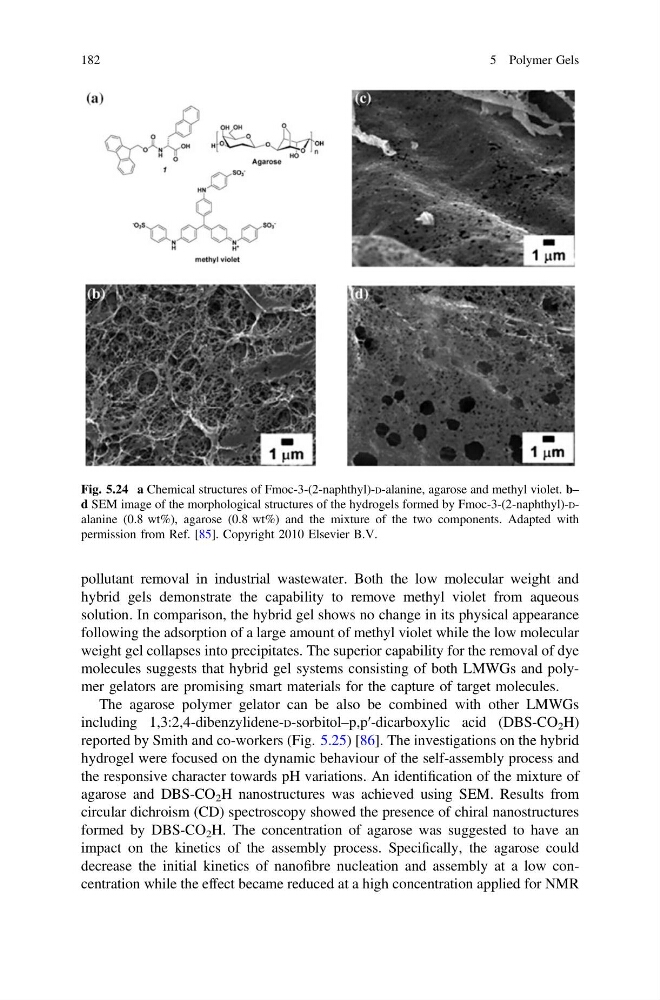
pollutant removal in industrial wastewater. Both the low molecular weight and
hybrid gels demonstrate the capability to remove methyl violet from aqueous
solution. In comparison, the hybrid gel shows no change in its physical appearance
following the adsorption of a large amount of methyl violet while the low molecular
weight gel collapses into precipitates. The superior capability for the removal of dye
molecules suggests that hybrid gel systems consisting of both LMWGs and polymer gelators are promising smart materials for the capture of target molecules.
The agarose polymer gelator can be also be combined with other LMWGs
including 1,3:2,4-dibenzylidene-D-sorbitol–p,p′-dicarboxylic acid (DBS-CO 2 H)
reported by Smith and co-workers (Fig. 5.25) [86]. The investigations on the hybrid
hydrogel were focused on the dynamic behaviour of the self-assembly process and
the responsive character towards pH variations. An identification of the mixture of
agarose and DBS-CO 2 H nanostructures was achieved using SEM. Results from
circular dichroism (CD) spectroscopy showed the presence of chiral nanostructures
formed by DBS-CO 2 H. The concentration of agarose was suggested to have an
impact on the kinetics of the assembly process. Specifically, the agarose could
decrease the initial kinetics of nanofibre nucleation and assembly at a low concentration while the effect became reduced at a high concentration applied for NMR
Fig. 5.24 a Chemical structures of Fmoc-3-(2-naphthyl)-D-alanine, agarose and methyl violet. b–
d SEM image of the morphological structures of the hydrogels formed by Fmoc-3-(2-naphthyl)-Dalanine (0.8 wt%), agarose (0.8 wt%) and the mixture of the two components. Adapted with
permission from Ref. [85]. Copyright 2010 Elsevier B.V.
182
5 Polymer Gels
hybrid gels demonstrate the capability to remove methyl violet from aqueous
solution. In comparison, the hybrid gel shows no change in its physical appearance
following the adsorption of a large amount of methyl violet while the low molecular
weight gel collapses into precipitates. The superior capability for the removal of dye
molecules suggests that hybrid gel systems consisting of both LMWGs and polymer gelators are promising smart materials for the capture of target molecules.
The agarose polymer gelator can be also be combined with other LMWGs
including 1,3:2,4-dibenzylidene-D-sorbitol–p,p′-dicarboxylic acid (DBS-CO 2 H)
reported by Smith and co-workers (Fig. 5.25) [86]. The investigations on the hybrid
hydrogel were focused on the dynamic behaviour of the self-assembly process and
the responsive character towards pH variations. An identification of the mixture of
agarose and DBS-CO 2 H nanostructures was achieved using SEM. Results from
circular dichroism (CD) spectroscopy showed the presence of chiral nanostructures
formed by DBS-CO 2 H. The concentration of agarose was suggested to have an
impact on the kinetics of the assembly process. Specifically, the agarose could
decrease the initial kinetics of nanofibre nucleation and assembly at a low concentration while the effect became reduced at a high concentration applied for NMR
Fig. 5.24 a Chemical structures of Fmoc-3-(2-naphthyl)-D-alanine, agarose and methyl violet. b–
d SEM image of the morphological structures of the hydrogels formed by Fmoc-3-(2-naphthyl)-Dalanine (0.8 wt%), agarose (0.8 wt%) and the mixture of the two components. Adapted with
permission from Ref. [85]. Copyright 2010 Elsevier B.V.
182
5 Polymer Gels