

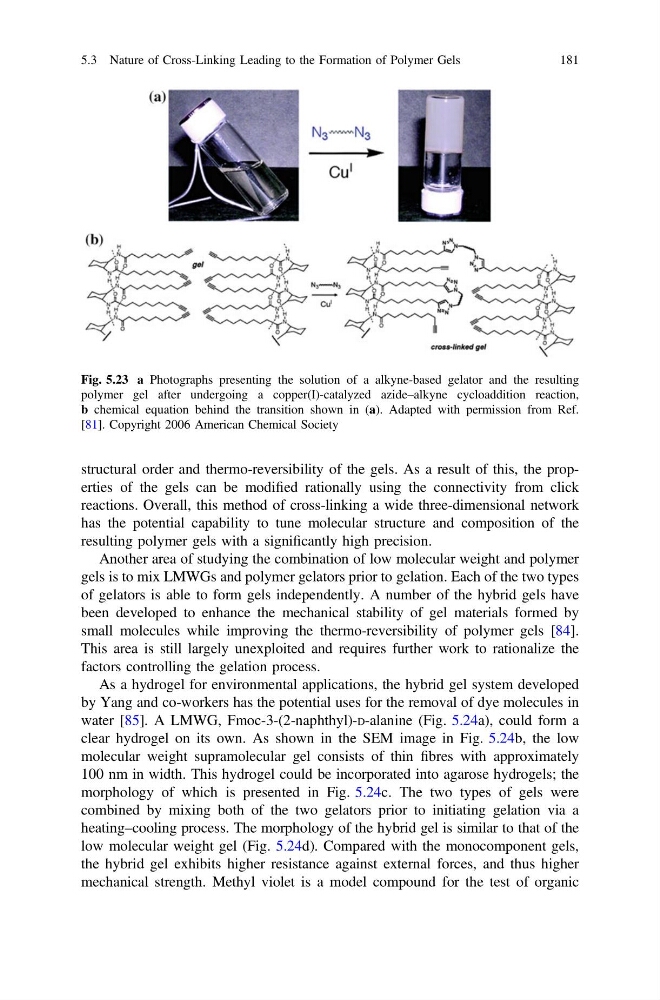
structural order and thermo-reversibility of the gels. As a result of this, the properties of the gels can be modified rationally using the connectivity from click
reactions. Overall, this method of cross-linking a wide three-dimensional network
has the potential capability to tune molecular structure and composition of the
resulting polymer gels with a significantly high precision.
Another area of studying the combination of low molecular weight and polymer
gels is to mix LMWGs and polymer gelators prior to gelation. Each of the two types
of gelators is able to form gels independently. A number of the hybrid gels have
been developed to enhance the mechanical stability of gel materials formed by
small molecules while improving the thermo-reversibility of polymer gels [84].
This area is still largely unexploited and requires further work to rationalize the
factors controlling the gelation process.
As a hydrogel for environmental applications, the hybrid gel system developed
by Yang and co-workers has the potential uses for the removal of dye molecules in
water [85]. A LMWG, Fmoc-3-(2-naphthyl)-D-alanine (Fig. 5.24a), could form a
clear hydrogel on its own. As shown in the SEM image in Fig. 5.24b, the low
molecular weight supramolecular gel consists of thin fibres with approximately
100 nm in width. This hydrogel could be incorporated into agarose hydrogels; the
morphology of which is presented in Fig. 5.24c. The two types of gels were
combined by mixing both of the two gelators prior to initiating gelation via a
heating–cooling process. The morphology of the hybrid gel is similar to that of the
low molecular weight gel (Fig. 5.24d). Compared with the monocomponent gels,
the hybrid gel exhibits higher resistance against external forces, and thus higher
mechanical strength. Methyl violet is a model compound for the test of organic
Fig. 5.23 a Photographs presenting the solution of a alkyne-based gelator and the resulting
polymer gel after undergoing a copper(I)-catalyzed azide–alkyne cycloaddition reaction,
b chemical equation behind the transition shown in (a). Adapted with permission from Ref.
[81]. Copyright 2006 American Chemical Society
5.3 Nature of Cross-Linking Leading to the Formation of Polymer Gels
181
reactions. Overall, this method of cross-linking a wide three-dimensional network
has the potential capability to tune molecular structure and composition of the
resulting polymer gels with a significantly high precision.
Another area of studying the combination of low molecular weight and polymer
gels is to mix LMWGs and polymer gelators prior to gelation. Each of the two types
of gelators is able to form gels independently. A number of the hybrid gels have
been developed to enhance the mechanical stability of gel materials formed by
small molecules while improving the thermo-reversibility of polymer gels [84].
This area is still largely unexploited and requires further work to rationalize the
factors controlling the gelation process.
As a hydrogel for environmental applications, the hybrid gel system developed
by Yang and co-workers has the potential uses for the removal of dye molecules in
water [85]. A LMWG, Fmoc-3-(2-naphthyl)-D-alanine (Fig. 5.24a), could form a
clear hydrogel on its own. As shown in the SEM image in Fig. 5.24b, the low
molecular weight supramolecular gel consists of thin fibres with approximately
100 nm in width. This hydrogel could be incorporated into agarose hydrogels; the
morphology of which is presented in Fig. 5.24c. The two types of gels were
combined by mixing both of the two gelators prior to initiating gelation via a
heating–cooling process. The morphology of the hybrid gel is similar to that of the
low molecular weight gel (Fig. 5.24d). Compared with the monocomponent gels,
the hybrid gel exhibits higher resistance against external forces, and thus higher
mechanical strength. Methyl violet is a model compound for the test of organic
Fig. 5.23 a Photographs presenting the solution of a alkyne-based gelator and the resulting
polymer gel after undergoing a copper(I)-catalyzed azide–alkyne cycloaddition reaction,
b chemical equation behind the transition shown in (a). Adapted with permission from Ref.
[81]. Copyright 2006 American Chemical Society
5.3 Nature of Cross-Linking Leading to the Formation of Polymer Gels
181