

of the UV polymerization was inferred to be associated with the distance between the
diacetylene units within the fibres of the gel. The packing arrangement of the
molecular network was suggested to allow the diacetylene units be placed within the
critical distance required for polymerization. After undergoing a heating process at
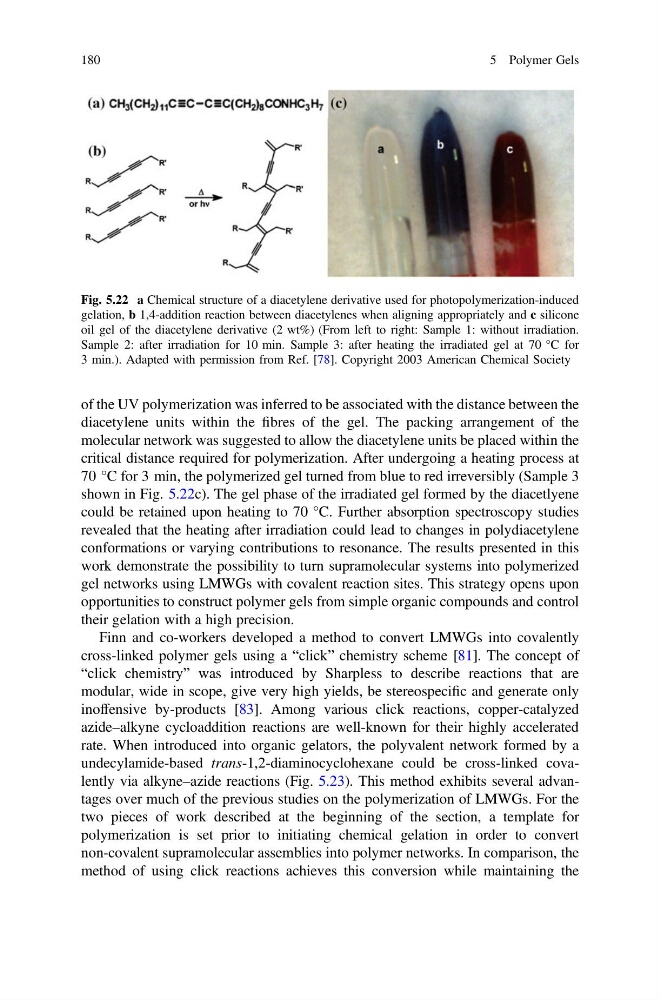
70 °C for 3 min, the polymerized gel turned from blue to red irreversibly (Sample 3
shown in Fig. 5.22c). The gel phase of the irradiated gel formed by the diacetlyene
could be retained upon heating to 70 °C. Further absorption spectroscopy studies
revealed that the heating after irradiation could lead to changes in polydiacetylene
conformations or varying contributions to resonance. The results presented in this
work demonstrate the possibility to turn supramolecular systems into polymerized
gel networks using LMWGs with covalent reaction sites. This strategy opens upon
opportunities to construct polymer gels from simple organic compounds and control
their gelation with a high precision.
Finn and co-workers developed a method to convert LMWGs into covalently
cross-linked polymer gels using a “click” chemistry scheme [81]. The concept of
“click chemistry” was introduced by Sharpless to describe reactions that are
modular, wide in scope, give very high yields, be stereospecific and generate only
inoffensive by-products [83]. Among various click reactions, copper-catalyzed
azide–alkyne cycloaddition reactions are well-known for their highly accelerated
rate. When introduced into organic gelators, the polyvalent network formed by a
undecylamide-based trans-1,2-diaminocyclohexane could be cross-linked covalently via alkyne–azide reactions (Fig. 5.23). This method exhibits several advantages over much of the previous studies on the polymerization of LMWGs. For the
two pieces of work described at the beginning of the section, a template for
polymerization is set prior to initiating chemical gelation in order to convert
non-covalent supramolecular assemblies into polymer networks. In comparison, the
method of using click reactions achieves this conversion while maintaining the
Fig. 5.22 a Chemical structure of a diacetylene derivative used for photopolymerization-induced
gelation, b 1,4-addition reaction between diacetylenes when aligning appropriately and c silicone
oil gel of the diacetylene derivative (2 wt%) (From left to right: Sample 1: without irradiation.
Sample 2: after irradiation for 10 min. Sample 3: after heating the irradiated gel at 70 °C for
3 min.). Adapted with permission from Ref. [78]. Copyright 2003 American Chemical Society
180
5 Polymer Gels
diacetylene units within the fibres of the gel. The packing arrangement of the
molecular network was suggested to allow the diacetylene units be placed within the
critical distance required for polymerization. After undergoing a heating process at
70 °C for 3 min, the polymerized gel turned from blue to red irreversibly (Sample 3
shown in Fig. 5.22c). The gel phase of the irradiated gel formed by the diacetlyene
could be retained upon heating to 70 °C. Further absorption spectroscopy studies
revealed that the heating after irradiation could lead to changes in polydiacetylene
conformations or varying contributions to resonance. The results presented in this
work demonstrate the possibility to turn supramolecular systems into polymerized
gel networks using LMWGs with covalent reaction sites. This strategy opens upon
opportunities to construct polymer gels from simple organic compounds and control
their gelation with a high precision.
Finn and co-workers developed a method to convert LMWGs into covalently
cross-linked polymer gels using a “click” chemistry scheme [81]. The concept of
“click chemistry” was introduced by Sharpless to describe reactions that are
modular, wide in scope, give very high yields, be stereospecific and generate only
inoffensive by-products [83]. Among various click reactions, copper-catalyzed
azide–alkyne cycloaddition reactions are well-known for their highly accelerated
rate. When introduced into organic gelators, the polyvalent network formed by a
undecylamide-based trans-1,2-diaminocyclohexane could be cross-linked covalently via alkyne–azide reactions (Fig. 5.23). This method exhibits several advantages over much of the previous studies on the polymerization of LMWGs. For the
two pieces of work described at the beginning of the section, a template for
polymerization is set prior to initiating chemical gelation in order to convert
non-covalent supramolecular assemblies into polymer networks. In comparison, the
method of using click reactions achieves this conversion while maintaining the
Fig. 5.22 a Chemical structure of a diacetylene derivative used for photopolymerization-induced
gelation, b 1,4-addition reaction between diacetylenes when aligning appropriately and c silicone
oil gel of the diacetylene derivative (2 wt%) (From left to right: Sample 1: without irradiation.
Sample 2: after irradiation for 10 min. Sample 3: after heating the irradiated gel at 70 °C for
3 min.). Adapted with permission from Ref. [78]. Copyright 2003 American Chemical Society
180
5 Polymer Gels