

Interestingly, the cross-linked polymer gel in DMF shows self-healing property
under ambient conditions (in air at room temperature). Moreover, the self-healing
property of the polymer is not influenced by the freshness of the surfaces since the
dynamic cross-linking reaction is tolerant of humidity and air.
Polymer gels based on the dynamic covalent cross-linking of trithiocarbonate
(TTC) units have been developed [73, 74]. Dynamic exchange reactions of TTC
units can be triggered via homolysis of C–S bonds either by UV irradiation or by
radical generators including a thermal initiator or a copper(I) catalyst.
Matyjaszewski and co-workers have reported the re-organization of poly(methyl
methacrylate) (PMMA) gels containing trithiocarbonate (TTC) units along the main
polymer chains in the presence of radicals [73]. Reshuffling of the cross-linked
network yields a remarkable change in the degree of swelling (up to 300%
increase). Moreover, the gel is proposed to undergo reprocessing and/or
self-repairing as indicated by the fusion of the gels from discrete pieces into a
single one. The radical reshuffling of the TTC units is triggered when the
cross-linked polymers are swollen in either a good solvent or a non-solvent medium
and then exposed to UV light [74]. The degree of swelling and network size in
toluene increases in the presence of good solvents, whereas they decrease in
non-solvents. The swelling degree in toluene prior to the UV irradiation is 650%;
after exposing to UV light in THF, the value increases with the reaction time and
reaches up to 1440% after 60 min. However, the degree of swelling in methanol
decreases from 650% (before UV) to 500% after UV irradiation after 60 min.
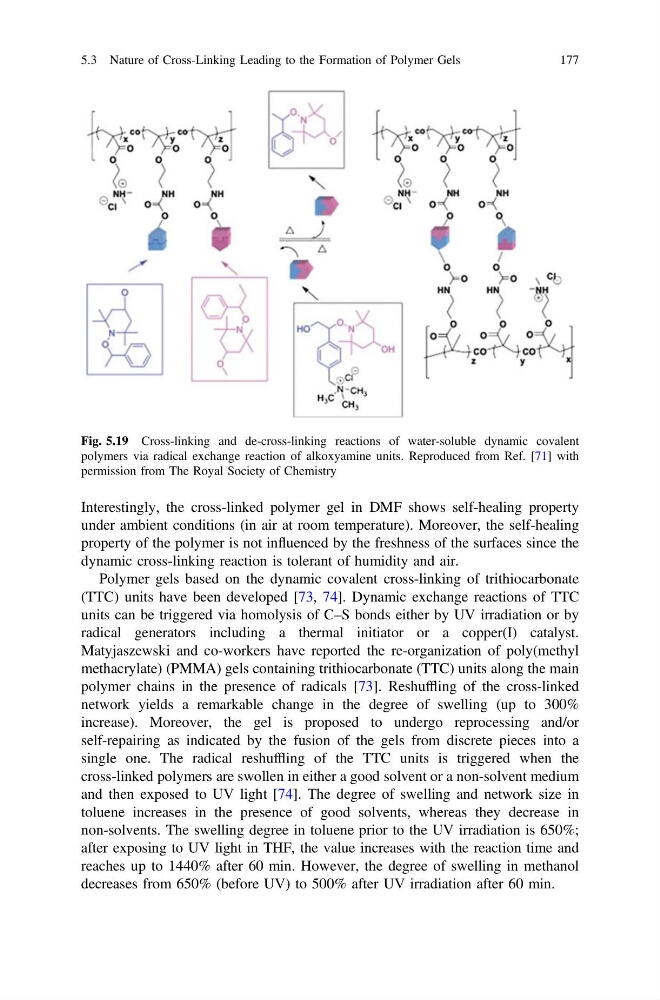
Fig. 5.19 Cross-linking and de-cross-linking reactions of water-soluble dynamic covalent
polymers via radical exchange reaction of alkoxyamine units. Reproduced from Ref. [71] with
permission from The Royal Society of Chemistry
5.3 Nature of Cross-Linking Leading to the Formation of Polymer Gels
177
under ambient conditions (in air at room temperature). Moreover, the self-healing
property of the polymer is not influenced by the freshness of the surfaces since the
dynamic cross-linking reaction is tolerant of humidity and air.
Polymer gels based on the dynamic covalent cross-linking of trithiocarbonate
(TTC) units have been developed [73, 74]. Dynamic exchange reactions of TTC
units can be triggered via homolysis of C–S bonds either by UV irradiation or by
radical generators including a thermal initiator or a copper(I) catalyst.
Matyjaszewski and co-workers have reported the re-organization of poly(methyl
methacrylate) (PMMA) gels containing trithiocarbonate (TTC) units along the main
polymer chains in the presence of radicals [73]. Reshuffling of the cross-linked
network yields a remarkable change in the degree of swelling (up to 300%
increase). Moreover, the gel is proposed to undergo reprocessing and/or
self-repairing as indicated by the fusion of the gels from discrete pieces into a
single one. The radical reshuffling of the TTC units is triggered when the
cross-linked polymers are swollen in either a good solvent or a non-solvent medium
and then exposed to UV light [74]. The degree of swelling and network size in
toluene increases in the presence of good solvents, whereas they decrease in
non-solvents. The swelling degree in toluene prior to the UV irradiation is 650%;
after exposing to UV light in THF, the value increases with the reaction time and
reaches up to 1440% after 60 min. However, the degree of swelling in methanol
decreases from 650% (before UV) to 500% after UV irradiation after 60 min.
Fig. 5.19 Cross-linking and de-cross-linking reactions of water-soluble dynamic covalent
polymers via radical exchange reaction of alkoxyamine units. Reproduced from Ref. [71] with
permission from The Royal Society of Chemistry
5.3 Nature of Cross-Linking Leading to the Formation of Polymer Gels
177