

5.3.4 Hybrid Polymer and Low Molecular Weight Gels
An emerging area of studying gel materials is the combination of polymers and
LMWGs [75]. One strategy to bridge the gap between polymer and low molecular
weight gels is to polymerize low molecular weight gelators (LMWGs) directly. The
first reported work on the polymerization of LMWGs following self-assembly was
conducted by Feringa and co-workers [76]. The motivation of this work was to
enhance the mechanical stability of organogels formed by the self-assembly of small
organic compounds. As shown in Fig. 5.21a, a methacrylate derivative of trans1,2-bis(3-methylureido)cyclohexane (MUC) was designed as a LMWG. Upon cooling down to room temperature, MUC molecules were observed to form optically
transparent gels. A variety of organic solvents were tested to be effective for the
gelation of MUC including tetralin, benzene, 1,2-dichloroethane, butyl acetate and
cyclohexane. As illustrated in Fig. 5.21b, the supramolecular MUC gels driven by
hydrogen bonding consists of interdigitated straight thin fibres with diameters
reaching down to 50 nm. Subsequently, a photoinitiator, 2,2-dimethoxy2-phenylacetophenone was added into the gelation system. When irradiated with a
200 W high-pressure Hg lamp, a fully photopolymerized MUC gel was confirmed
O
O
OH
HO
O
O
O
HO
OH
O
O
O
OH
HO
O
O
O
OH
HO
O
RT
+
DABBF
(a)
(b)
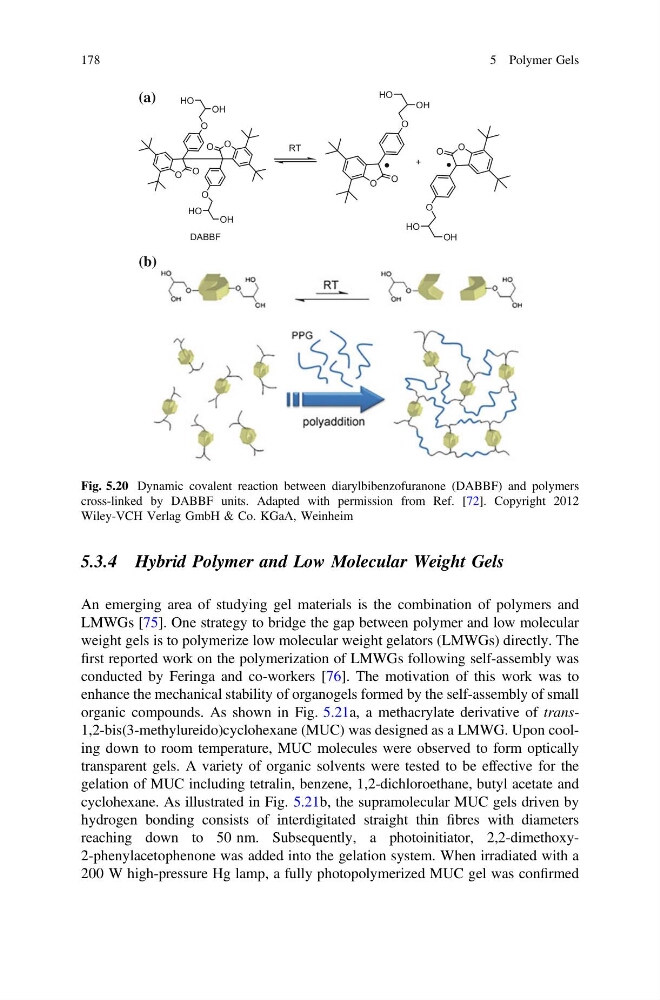
Fig. 5.20 Dynamic covalent reaction between diarylbibenzofuranone (DABBF) and polymers
cross-linked by DABBF units. Adapted with permission from Ref. [72]. Copyright 2012
Wiley-VCH Verlag GmbH & Co. KGaA, Weinheim
178
5 Polymer Gels
An emerging area of studying gel materials is the combination of polymers and
LMWGs [75]. One strategy to bridge the gap between polymer and low molecular
weight gels is to polymerize low molecular weight gelators (LMWGs) directly. The
first reported work on the polymerization of LMWGs following self-assembly was
conducted by Feringa and co-workers [76]. The motivation of this work was to
enhance the mechanical stability of organogels formed by the self-assembly of small
organic compounds. As shown in Fig. 5.21a, a methacrylate derivative of trans1,2-bis(3-methylureido)cyclohexane (MUC) was designed as a LMWG. Upon cooling down to room temperature, MUC molecules were observed to form optically
transparent gels. A variety of organic solvents were tested to be effective for the
gelation of MUC including tetralin, benzene, 1,2-dichloroethane, butyl acetate and
cyclohexane. As illustrated in Fig. 5.21b, the supramolecular MUC gels driven by
hydrogen bonding consists of interdigitated straight thin fibres with diameters
reaching down to 50 nm. Subsequently, a photoinitiator, 2,2-dimethoxy2-phenylacetophenone was added into the gelation system. When irradiated with a
200 W high-pressure Hg lamp, a fully photopolymerized MUC gel was confirmed
O
O
OH
HO
O
O
O
HO
OH
O
O
O
OH
HO
O
O
O
OH
HO
O
RT
+
DABBF
(a)
(b)
Fig. 5.20 Dynamic covalent reaction between diarylbibenzofuranone (DABBF) and polymers
cross-linked by DABBF units. Adapted with permission from Ref. [72]. Copyright 2012
Wiley-VCH Verlag GmbH & Co. KGaA, Weinheim
178
5 Polymer Gels