

Based on the thermal equilibrium of Diels–Alder reaction, a
polyoxazoline-based gel was designed by Saegusa and co-workers (Fig. 5.18) [69].
The gelation is attributed to the Diels–Alder reaction between furan-modified poly
(N-acetylethyleneimine) (PAEI) and maleimide-modified PAEI in MeOH. The reversible interconversion between the polyoxazoline gel and the linear polymer
precursor solution can be manipulated by changing the heating temperature.
A thermally reversible transition from the polymer gel into the solution state can be
achieved upon heating the molecular system.
Based on Diels–Alder reaction, a controlled release system of poly(ethylene)
glycol (PEG) hydrogel has been developed by Bowman and co-workers [70]. The
hydrogel is constructed via thiol-Michael addition reactions between multifunctional maleimide and thiol PEG macromers. The reaction is performed in an
off-stoichiometric ratio to create excess unreacted maleimide tethering sites in the
polymer network. Due to the existence of excess unreacted maleimide groups,
several molecular species, such as small pharmaceutical molecules and peptides,
can be covalently tethered to the network via Diels–Alder reactions. Subsequently,
the molecules attached to the hydrogel networks can be released by shifting the
(a)
(b)
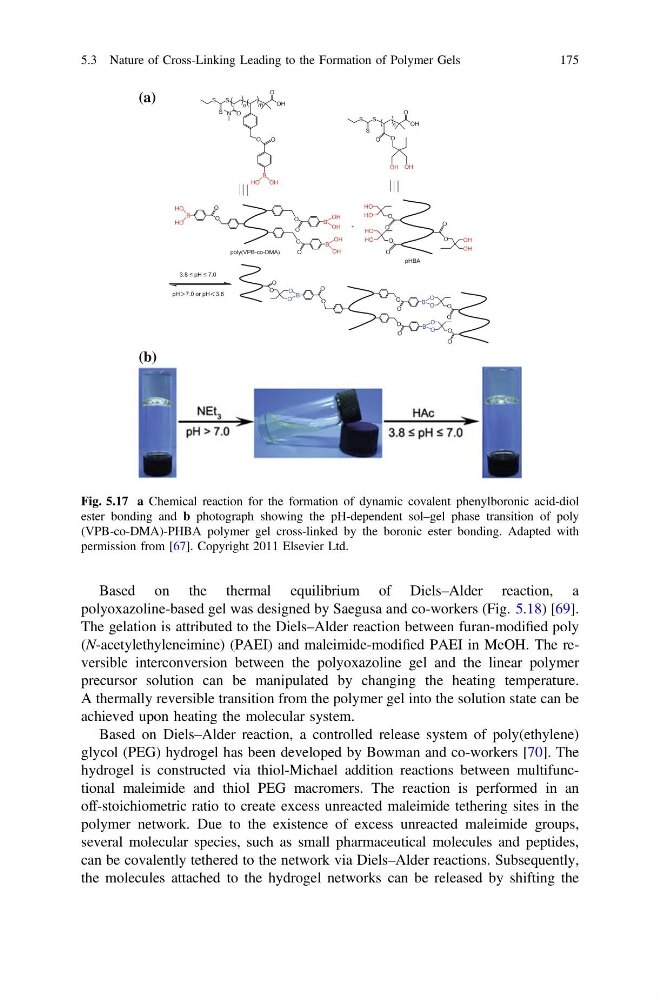
Fig. 5.17 a Chemical reaction for the formation of dynamic covalent phenylboronic acid-diol
ester bonding and b photograph showing the pH-dependent sol–gel phase transition of poly
(VPB-co-DMA)-PHBA polymer gel cross-linked by the boronic ester bonding. Adapted with
permission from [67]. Copyright 2011 Elsevier Ltd.
5.3 Nature of Cross-Linking Leading to the Formation of Polymer Gels
175
polyoxazoline-based gel was designed by Saegusa and co-workers (Fig. 5.18) [69].
The gelation is attributed to the Diels–Alder reaction between furan-modified poly
(N-acetylethyleneimine) (PAEI) and maleimide-modified PAEI in MeOH. The reversible interconversion between the polyoxazoline gel and the linear polymer
precursor solution can be manipulated by changing the heating temperature.
A thermally reversible transition from the polymer gel into the solution state can be
achieved upon heating the molecular system.
Based on Diels–Alder reaction, a controlled release system of poly(ethylene)
glycol (PEG) hydrogel has been developed by Bowman and co-workers [70]. The
hydrogel is constructed via thiol-Michael addition reactions between multifunctional maleimide and thiol PEG macromers. The reaction is performed in an
off-stoichiometric ratio to create excess unreacted maleimide tethering sites in the
polymer network. Due to the existence of excess unreacted maleimide groups,
several molecular species, such as small pharmaceutical molecules and peptides,
can be covalently tethered to the network via Diels–Alder reactions. Subsequently,
the molecules attached to the hydrogel networks can be released by shifting the
(a)
(b)
Fig. 5.17 a Chemical reaction for the formation of dynamic covalent phenylboronic acid-diol
ester bonding and b photograph showing the pH-dependent sol–gel phase transition of poly
(VPB-co-DMA)-PHBA polymer gel cross-linked by the boronic ester bonding. Adapted with
permission from [67]. Copyright 2011 Elsevier Ltd.
5.3 Nature of Cross-Linking Leading to the Formation of Polymer Gels
175