

with different 2-hydroxypropylmethacrylamide (HPMA) or acrylic acid
(AA) polymer backbones (two degrees of substitution for each polymer are x = 90
mol% or 95 mol%) [62]. The phenylboronic acid and salicylhydroxamic acid moieties react in aqueous solution at physiological pH to form boronic ester bonds and
generate a cross-linked polymer hydrogel. The viscoelastic behaviour of the gel shows
a dependence on the pH of the aqueous medium. Under neutral pH conditions, the
cross-linked polymer forms a brittle, elastic hydrogel because the boronic ester
equilibrium is shifted to the bound state. At mildly acidic pH conditions, however, a
deformable semisolid is formed because the equilibrium is shifted to an unbound state.
Reversible cross-links allow these boronic ester-based gels to restructure dynamically
and self-heal after undergoing mechanical disruption.
The use of thiol groups for reversible cross-linking of polymers to produce
polymeric networks has been reported by Chujo and co-workers [68]. A redoxreversible hydrogel based on thiol-modified poly(N-acetylethyleneimine) is formed
by exploiting the reversible interconversion between disulfide groups and thiols.
The linear poly(N-acetylethyleneimine) polymer with thiol pendant groups is soluble in water, and the resulting solution can be changed into a hydrogel upon
oxidation. The cleavage of the disulfide cross-linking by reduction causes an
increase in the degree of swelling.
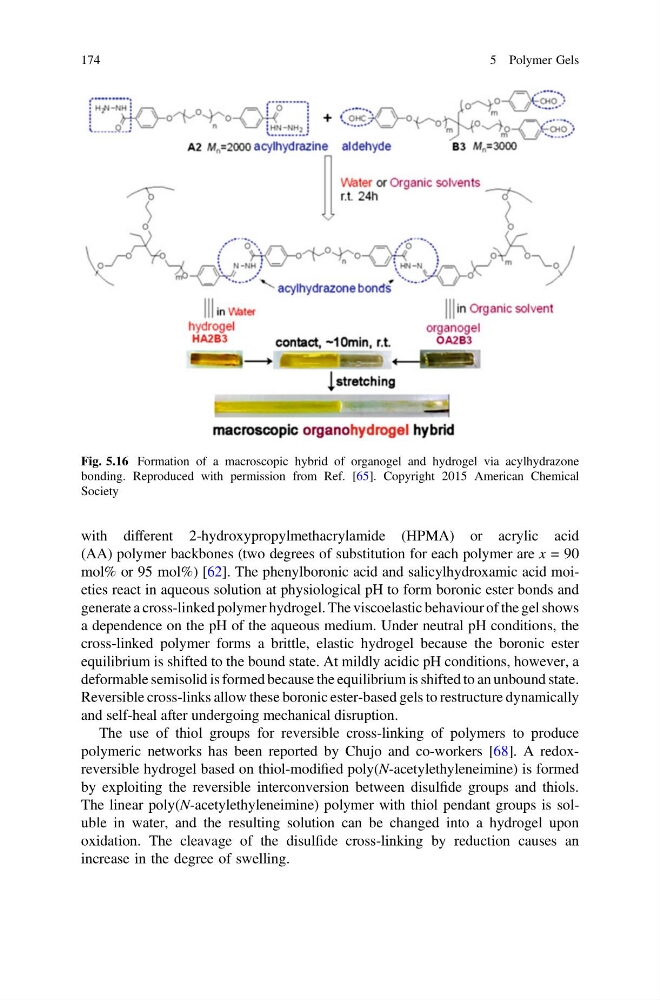
Fig. 5.16 Formation of a macroscopic hybrid of organogel and hydrogel via acylhydrazone
bonding. Reproduced with permission from Ref. [65]. Copyright 2015 American Chemical
Society
174
5 Polymer Gels
(AA) polymer backbones (two degrees of substitution for each polymer are x = 90
mol% or 95 mol%) [62]. The phenylboronic acid and salicylhydroxamic acid moieties react in aqueous solution at physiological pH to form boronic ester bonds and
generate a cross-linked polymer hydrogel. The viscoelastic behaviour of the gel shows
a dependence on the pH of the aqueous medium. Under neutral pH conditions, the
cross-linked polymer forms a brittle, elastic hydrogel because the boronic ester
equilibrium is shifted to the bound state. At mildly acidic pH conditions, however, a
deformable semisolid is formed because the equilibrium is shifted to an unbound state.
Reversible cross-links allow these boronic ester-based gels to restructure dynamically
and self-heal after undergoing mechanical disruption.
The use of thiol groups for reversible cross-linking of polymers to produce
polymeric networks has been reported by Chujo and co-workers [68]. A redoxreversible hydrogel based on thiol-modified poly(N-acetylethyleneimine) is formed
by exploiting the reversible interconversion between disulfide groups and thiols.
The linear poly(N-acetylethyleneimine) polymer with thiol pendant groups is soluble in water, and the resulting solution can be changed into a hydrogel upon
oxidation. The cleavage of the disulfide cross-linking by reduction causes an
increase in the degree of swelling.
Fig. 5.16 Formation of a macroscopic hybrid of organogel and hydrogel via acylhydrazone
bonding. Reproduced with permission from Ref. [65]. Copyright 2015 American Chemical
Society
174
5 Polymer Gels