

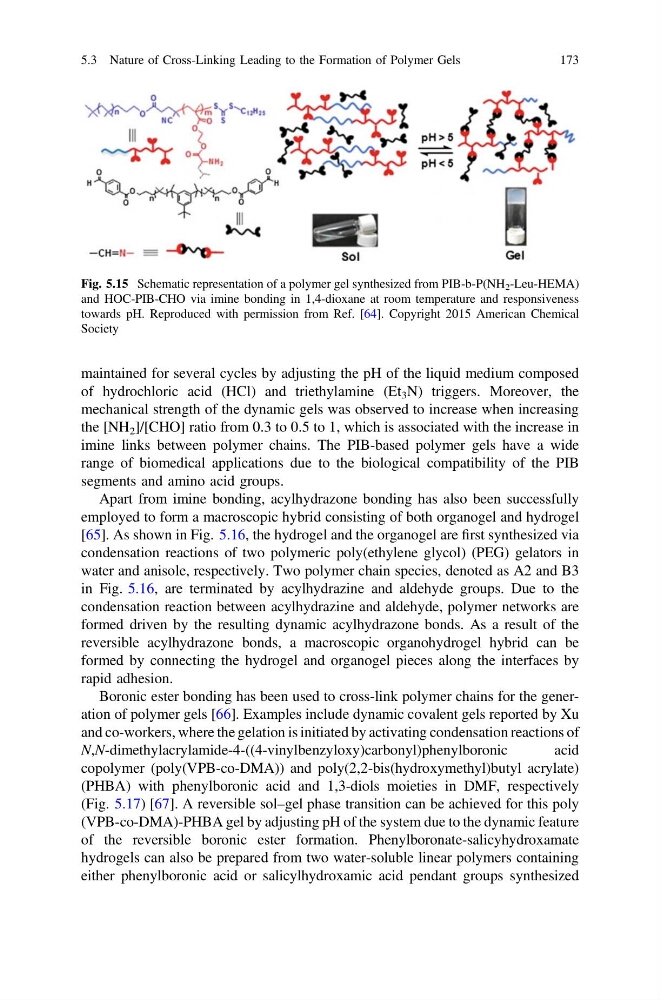
maintained for several cycles by adjusting the pH of the liquid medium composed
of hydrochloric acid (HCl) and triethylamine (Et 3 N) triggers. Moreover, the
mechanical strength of the dynamic gels was observed to increase when increasing
the [NH 2 ]/[CHO] ratio from 0.3 to 0.5 to 1, which is associated with the increase in
imine links between polymer chains. The PIB-based polymer gels have a wide
range of biomedical applications due to the biological compatibility of the PIB
segments and amino acid groups.
Apart from imine bonding, acylhydrazone bonding has also been successfully
employed to form a macroscopic hybrid consisting of both organogel and hydrogel
[65]. As shown in Fig. 5.16, the hydrogel and the organogel are first synthesized via
condensation reactions of two polymeric poly(ethylene glycol) (PEG) gelators in
water and anisole, respectively. Two polymer chain species, denoted as A2 and B3
in Fig. 5.16, are terminated by acylhydrazine and aldehyde groups. Due to the
condensation reaction between acylhydrazine and aldehyde, polymer networks are
formed driven by the resulting dynamic acylhydrazone bonds. As a result of the
reversible acylhydrazone bonds, a macroscopic organohydrogel hybrid can be
formed by connecting the hydrogel and organogel pieces along the interfaces by
rapid adhesion.
Boronic ester bonding has been used to cross-link polymer chains for the generation of polymer gels [66]. Examples include dynamic covalent gels reported by Xu
and co-workers, where the gelation is initiated by activating condensation reactions of
N,N-dimethylacrylamide-4-((4-vinylbenzyloxy)carbonyl)phenylboronic
acid
copolymer (poly(VPB-co-DMA)) and poly(2,2-bis(hydroxymethyl)butyl acrylate)
(PHBA) with phenylboronic acid and 1,3-diols moieties in DMF, respectively
(Fig. 5.17) [67]. A reversible sol–gel phase transition can be achieved for this poly
(VPB-co-DMA)-PHBA gel by adjusting pH of the system due to the dynamic feature
of the reversible boronic ester formation. Phenylboronate-salicyhydroxamate
hydrogels can also be prepared from two water-soluble linear polymers containing
either phenylboronic acid or salicylhydroxamic acid pendant groups synthesized
Fig. 5.15 Schematic representation of a polymer gel synthesized from PIB-b-P(NH 2 -Leu-HEMA)
and HOC-PIB-CHO via imine bonding in 1,4-dioxane at room temperature and responsiveness
towards pH. Reproduced with permission from Ref. [64]. Copyright 2015 American Chemical
Society
5.3 Nature of Cross-Linking Leading to the Formation of Polymer Gels
173
of hydrochloric acid (HCl) and triethylamine (Et 3 N) triggers. Moreover, the
mechanical strength of the dynamic gels was observed to increase when increasing
the [NH 2 ]/[CHO] ratio from 0.3 to 0.5 to 1, which is associated with the increase in
imine links between polymer chains. The PIB-based polymer gels have a wide
range of biomedical applications due to the biological compatibility of the PIB
segments and amino acid groups.
Apart from imine bonding, acylhydrazone bonding has also been successfully
employed to form a macroscopic hybrid consisting of both organogel and hydrogel
[65]. As shown in Fig. 5.16, the hydrogel and the organogel are first synthesized via
condensation reactions of two polymeric poly(ethylene glycol) (PEG) gelators in
water and anisole, respectively. Two polymer chain species, denoted as A2 and B3
in Fig. 5.16, are terminated by acylhydrazine and aldehyde groups. Due to the
condensation reaction between acylhydrazine and aldehyde, polymer networks are
formed driven by the resulting dynamic acylhydrazone bonds. As a result of the
reversible acylhydrazone bonds, a macroscopic organohydrogel hybrid can be
formed by connecting the hydrogel and organogel pieces along the interfaces by
rapid adhesion.
Boronic ester bonding has been used to cross-link polymer chains for the generation of polymer gels [66]. Examples include dynamic covalent gels reported by Xu
and co-workers, where the gelation is initiated by activating condensation reactions of
N,N-dimethylacrylamide-4-((4-vinylbenzyloxy)carbonyl)phenylboronic
acid
copolymer (poly(VPB-co-DMA)) and poly(2,2-bis(hydroxymethyl)butyl acrylate)
(PHBA) with phenylboronic acid and 1,3-diols moieties in DMF, respectively
(Fig. 5.17) [67]. A reversible sol–gel phase transition can be achieved for this poly
(VPB-co-DMA)-PHBA gel by adjusting pH of the system due to the dynamic feature
of the reversible boronic ester formation. Phenylboronate-salicyhydroxamate
hydrogels can also be prepared from two water-soluble linear polymers containing
either phenylboronic acid or salicylhydroxamic acid pendant groups synthesized
Fig. 5.15 Schematic representation of a polymer gel synthesized from PIB-b-P(NH 2 -Leu-HEMA)
and HOC-PIB-CHO via imine bonding in 1,4-dioxane at room temperature and responsiveness
towards pH. Reproduced with permission from Ref. [64]. Copyright 2015 American Chemical
Society
5.3 Nature of Cross-Linking Leading to the Formation of Polymer Gels
173