

dynamic covalent chemistry is their self-healing ability upon undergoing damage.
For the formation of dynamic covalent bonding, the target polymer chains are
commonly designed to bear specific functional groups as reactive sites for
cross-linking. To date, several dynamic covalent reaction schemes have been
applied in polymer gel fabrication including Schiff base condensation [57], acylhydrazone bond formation [58], Diels–Alder cycloadditions [59], disulfide
exchange [60], reversible radical reaction [61] and boronic acid condensation [62].
Imine bonding is an exemplary dynamic covalent linkage used for the
cross-linking of polymer networks. In this reaction scheme, the polymer gelators
should be functionalized with amine and aldehyde groups in order to construct
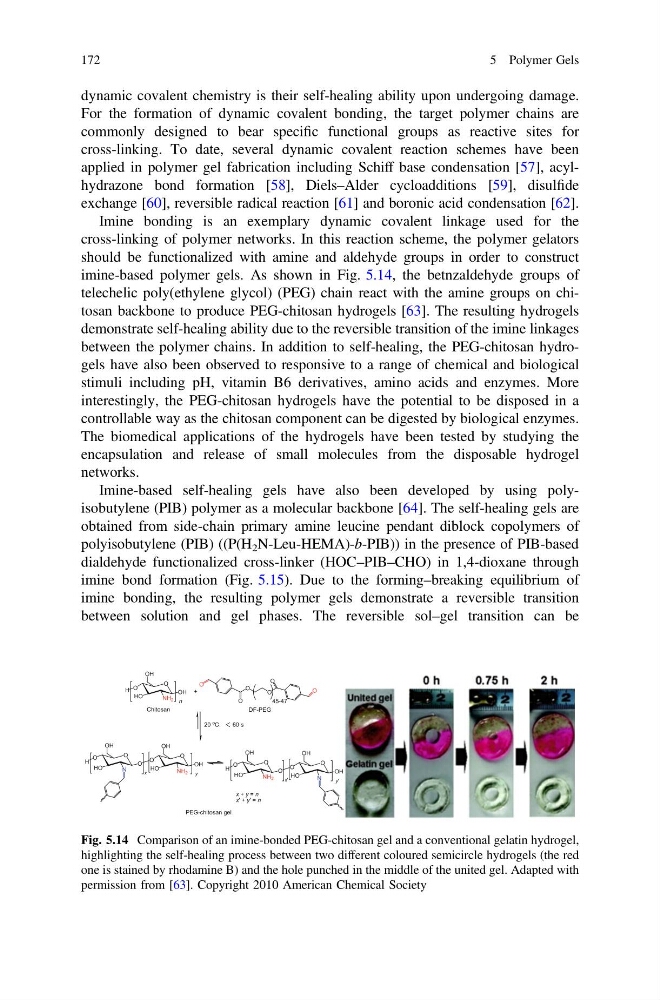
imine-based polymer gels. As shown in Fig. 5.14, the betnzaldehyde groups of
telechelic poly(ethylene glycol) (PEG) chain react with the amine groups on chitosan backbone to produce PEG-chitosan hydrogels [63]. The resulting hydrogels
demonstrate self-healing ability due to the reversible transition of the imine linkages
between the polymer chains. In addition to self-healing, the PEG-chitosan hydrogels have also been observed to responsive to a range of chemical and biological
stimuli including pH, vitamin B6 derivatives, amino acids and enzymes. More
interestingly, the PEG-chitosan hydrogels have the potential to be disposed in a
controllable way as the chitosan component can be digested by biological enzymes.
The biomedical applications of the hydrogels have been tested by studying the
encapsulation and release of small molecules from the disposable hydrogel
networks.
Imine-based self-healing gels have also been developed by using polyisobutylene (PIB) polymer as a molecular backbone [64]. The self-healing gels are
obtained from side-chain primary amine leucine pendant diblock copolymers of
polyisobutylene (PIB) ((P(H 2 N-Leu-HEMA)-b-PIB)) in the presence of PIB-based
dialdehyde functionalized cross-linker (HOC–PIB–CHO) in 1,4-dioxane through
imine bond formation (Fig. 5.15). Due to the forming–breaking equilibrium of
imine bonding, the resulting polymer gels demonstrate a reversible transition
between solution and gel phases. The reversible sol–gel transition can be
Fig. 5.14 Comparison of an imine-bonded PEG-chitosan gel and a conventional gelatin hydrogel,
highlighting the self-healing process between two different coloured semicircle hydrogels (the red
one is stained by rhodamine B) and the hole punched in the middle of the united gel. Adapted with
permission from [63]. Copyright 2010 American Chemical Society
172
5 Polymer Gels
For the formation of dynamic covalent bonding, the target polymer chains are
commonly designed to bear specific functional groups as reactive sites for
cross-linking. To date, several dynamic covalent reaction schemes have been
applied in polymer gel fabrication including Schiff base condensation [57], acylhydrazone bond formation [58], Diels–Alder cycloadditions [59], disulfide
exchange [60], reversible radical reaction [61] and boronic acid condensation [62].
Imine bonding is an exemplary dynamic covalent linkage used for the
cross-linking of polymer networks. In this reaction scheme, the polymer gelators
should be functionalized with amine and aldehyde groups in order to construct
imine-based polymer gels. As shown in Fig. 5.14, the betnzaldehyde groups of
telechelic poly(ethylene glycol) (PEG) chain react with the amine groups on chitosan backbone to produce PEG-chitosan hydrogels [63]. The resulting hydrogels
demonstrate self-healing ability due to the reversible transition of the imine linkages
between the polymer chains. In addition to self-healing, the PEG-chitosan hydrogels have also been observed to responsive to a range of chemical and biological
stimuli including pH, vitamin B6 derivatives, amino acids and enzymes. More
interestingly, the PEG-chitosan hydrogels have the potential to be disposed in a
controllable way as the chitosan component can be digested by biological enzymes.
The biomedical applications of the hydrogels have been tested by studying the
encapsulation and release of small molecules from the disposable hydrogel
networks.
Imine-based self-healing gels have also been developed by using polyisobutylene (PIB) polymer as a molecular backbone [64]. The self-healing gels are
obtained from side-chain primary amine leucine pendant diblock copolymers of
polyisobutylene (PIB) ((P(H 2 N-Leu-HEMA)-b-PIB)) in the presence of PIB-based
dialdehyde functionalized cross-linker (HOC–PIB–CHO) in 1,4-dioxane through
imine bond formation (Fig. 5.15). Due to the forming–breaking equilibrium of
imine bonding, the resulting polymer gels demonstrate a reversible transition
between solution and gel phases. The reversible sol–gel transition can be
Fig. 5.14 Comparison of an imine-bonded PEG-chitosan gel and a conventional gelatin hydrogel,
highlighting the self-healing process between two different coloured semicircle hydrogels (the red
one is stained by rhodamine B) and the hole punched in the middle of the united gel. Adapted with
permission from [63]. Copyright 2010 American Chemical Society
172
5 Polymer Gels