

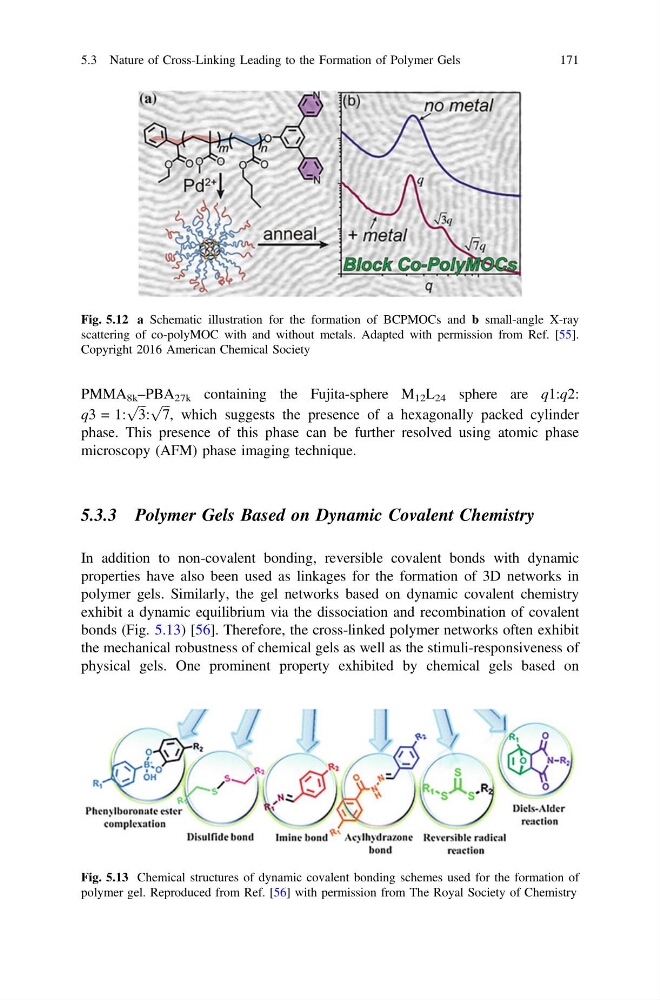
PMMA 8k –PBA 27k containing the Fujita-sphere M 12 L 24 sphere are q1:q2:
q3 = 1:
ffiffi ffi
3
p
:
ffiffi ffi
7
p
, which suggests the presence of a hexagonally packed cylinder
phase. This presence of this phase can be further resolved using atomic phase
microscopy (AFM) phase imaging technique.
5.3.3 Polymer Gels Based on Dynamic Covalent Chemistry
In addition to non-covalent bonding, reversible covalent bonds with dynamic
properties have also been used as linkages for the formation of 3D networks in
polymer gels. Similarly, the gel networks based on dynamic covalent chemistry
exhibit a dynamic equilibrium via the dissociation and recombination of covalent
bonds (Fig. 5.13) [56]. Therefore, the cross-linked polymer networks often exhibit
the mechanical robustness of chemical gels as well as the stimuli-responsiveness of
physical gels. One prominent property exhibited by chemical gels based on
Fig. 5.12 a Schematic illustration for the formation of BCPMOCs and b small-angle X-ray
scattering of co-polyMOC with and without metals. Adapted with permission from Ref. [55].
Copyright 2016 American Chemical Society
Fig. 5.13 Chemical structures of dynamic covalent bonding schemes used for the formation of
polymer gel. Reproduced from Ref. [56] with permission from The Royal Society of Chemistry
5.3 Nature of Cross-Linking Leading to the Formation of Polymer Gels
171
q3 = 1:
ffiffi ffi
3
p
:
ffiffi ffi
7
p
, which suggests the presence of a hexagonally packed cylinder
phase. This presence of this phase can be further resolved using atomic phase
microscopy (AFM) phase imaging technique.
5.3.3 Polymer Gels Based on Dynamic Covalent Chemistry
In addition to non-covalent bonding, reversible covalent bonds with dynamic
properties have also been used as linkages for the formation of 3D networks in
polymer gels. Similarly, the gel networks based on dynamic covalent chemistry
exhibit a dynamic equilibrium via the dissociation and recombination of covalent
bonds (Fig. 5.13) [56]. Therefore, the cross-linked polymer networks often exhibit
the mechanical robustness of chemical gels as well as the stimuli-responsiveness of
physical gels. One prominent property exhibited by chemical gels based on
Fig. 5.12 a Schematic illustration for the formation of BCPMOCs and b small-angle X-ray
scattering of co-polyMOC with and without metals. Adapted with permission from Ref. [55].
Copyright 2016 American Chemical Society
Fig. 5.13 Chemical structures of dynamic covalent bonding schemes used for the formation of
polymer gel. Reproduced from Ref. [56] with permission from The Royal Society of Chemistry
5.3 Nature of Cross-Linking Leading to the Formation of Polymer Gels
171