

[10], the number and positions of functional groups [11–13] and enantiomeric
excess [14, 15]. The differences result in the distinction of molecular characteristics
such as solubility, polarity, flexibility and further influence the nucleation and
growth process. Žinić and co-workers demonstrated that the enantiomeric assemblies by different diastereomeric aggregation show different morphologies and
stability of gel networks. This is reflected in sometimes dramatically different gelator effectiveness values (G eff ), for instant, racemic 1 can form a 70 times more
effective gelator of p-xylene than its (R)-enantiomer (Scheme 2.1) [11].
A gel-to-sol phase transition will occur associated with enthalpy changes upon
increasing the temperature. Complete reversal behaviour example was first reported
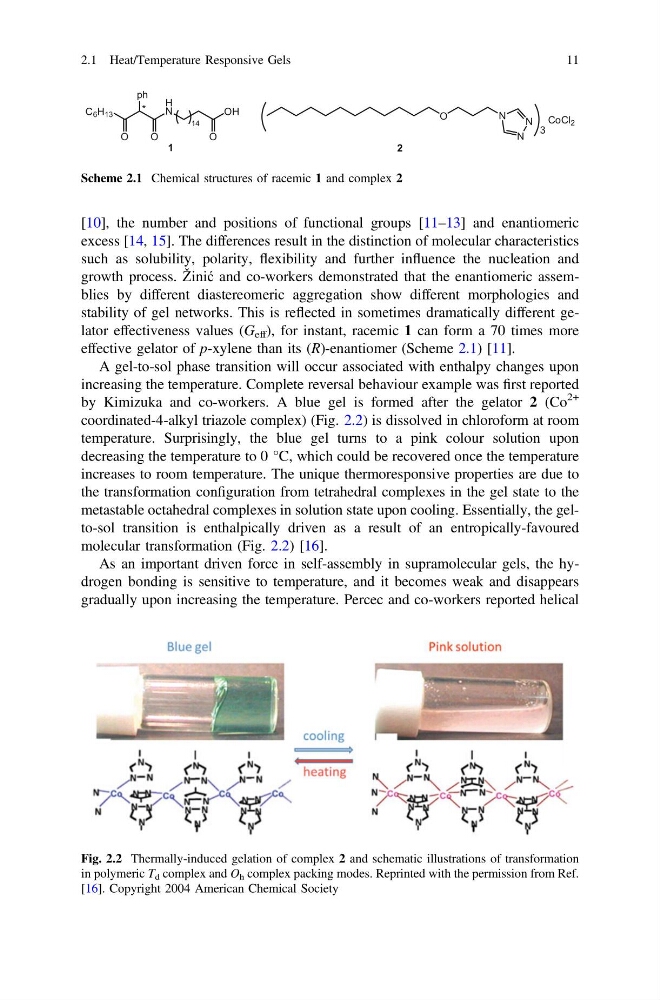
by Kimizuka and co-workers. A blue gel is formed after the gelator 2 (Co
2+
coordinated-4-alkyl triazole complex) (Fig. 2.2) is dissolved in chloroform at room
temperature. Surprisingly, the blue gel turns to a pink colour solution upon
decreasing the temperature to 0 °C, which could be recovered once the temperature
increases to room temperature. The unique thermoresponsive properties are due to
the transformation configuration from tetrahedral complexes in the gel state to the
metastable octahedral complexes in solution state upon cooling. Essentially, the gelto-sol transition is enthalpically driven as a result of an entropically-favoured
molecular transformation (Fig. 2.2) [16].
As an important driven force in self-assembly in supramolecular gels, the hydrogen bonding is sensitive to temperature, and it becomes weak and disappears
gradually upon increasing the temperature. Percec and co-workers reported helical
*
ph
H
N
O
C 6 H 13
O
OH
14
O
1
O
N
N
N 3
CoCl 2
2
Scheme 2.1 Chemical structures of racemic 1 and complex 2
Fig. 2.2 Thermally-induced gelation of complex 2 and schematic illustrations of transformation
in polymeric T d complex and O h complex packing modes. Reprinted with the permission from Ref.
[16]. Copyright 2004 American Chemical Society
2.1 Heat/Temperature Responsive Gels
11
excess [14, 15]. The differences result in the distinction of molecular characteristics
such as solubility, polarity, flexibility and further influence the nucleation and
growth process. Žinić and co-workers demonstrated that the enantiomeric assemblies by different diastereomeric aggregation show different morphologies and
stability of gel networks. This is reflected in sometimes dramatically different gelator effectiveness values (G eff ), for instant, racemic 1 can form a 70 times more
effective gelator of p-xylene than its (R)-enantiomer (Scheme 2.1) [11].
A gel-to-sol phase transition will occur associated with enthalpy changes upon
increasing the temperature. Complete reversal behaviour example was first reported
by Kimizuka and co-workers. A blue gel is formed after the gelator 2 (Co
2+
coordinated-4-alkyl triazole complex) (Fig. 2.2) is dissolved in chloroform at room
temperature. Surprisingly, the blue gel turns to a pink colour solution upon
decreasing the temperature to 0 °C, which could be recovered once the temperature
increases to room temperature. The unique thermoresponsive properties are due to
the transformation configuration from tetrahedral complexes in the gel state to the
metastable octahedral complexes in solution state upon cooling. Essentially, the gelto-sol transition is enthalpically driven as a result of an entropically-favoured
molecular transformation (Fig. 2.2) [16].
As an important driven force in self-assembly in supramolecular gels, the hydrogen bonding is sensitive to temperature, and it becomes weak and disappears
gradually upon increasing the temperature. Percec and co-workers reported helical
*
ph
H
N
O
C 6 H 13
O
OH
14
O
1
O
N
N
N 3
CoCl 2
2
Scheme 2.1 Chemical structures of racemic 1 and complex 2
Fig. 2.2 Thermally-induced gelation of complex 2 and schematic illustrations of transformation
in polymeric T d complex and O h complex packing modes. Reprinted with the permission from Ref.
[16]. Copyright 2004 American Chemical Society
2.1 Heat/Temperature Responsive Gels
11