

supramolecular columns constructed by C 3 -symmetric dendrimers via trisesters and
trisamides of 1,3,5-benzenetricarboxylic acid [17]. The thermal reversible inversion
of chirality was realized, negative chirality for 2D and 3D phases with triangular
symmetry and positive chirality for 2D and 3D phases with rectangular symmetry.
Kasha and co-workers proposed an explanation of aggregation effects for optical
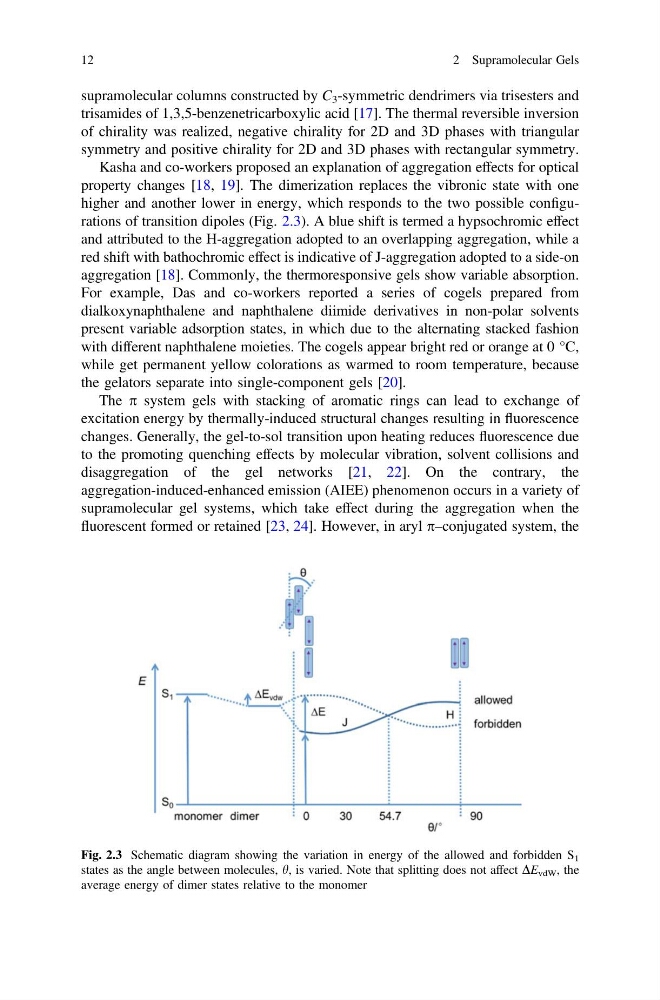
property changes [18, 19]. The dimerization replaces the vibronic state with one
higher and another lower in energy, which responds to the two possible configurations of transition dipoles (Fig. 2.3). A blue shift is termed a hypsochromic effect
and attributed to the H-aggregation adopted to an overlapping aggregation, while a
red shift with bathochromic effect is indicative of J-aggregation adopted to a side-on
aggregation [18]. Commonly, the thermoresponsive gels show variable absorption.
For example, Das and co-workers reported a series of cogels prepared from
dialkoxynaphthalene and naphthalene diimide derivatives in non-polar solvents
present variable adsorption states, in which due to the alternating stacked fashion
with different naphthalene moieties. The cogels appear bright red or orange at 0 °C,
while get permanent yellow colorations as warmed to room temperature, because
the gelators separate into single-component gels [20].
The p system gels with stacking of aromatic rings can lead to exchange of
excitation energy by thermally-induced structural changes resulting in fluorescence
changes. Generally, the gel-to-sol transition upon heating reduces fluorescence due
to the promoting quenching effects by molecular vibration, solvent collisions and
disaggregation of the gel networks [21, 22]. On the contrary, the
aggregation-induced-enhanced emission (AIEE) phenomenon occurs in a variety of
supramolecular gel systems, which take effect during the aggregation when the
fluorescent formed or retained [23, 24]. However, in aryl p–conjugated system, the
Fig. 2.3 Schematic diagram showing the variation in energy of the allowed and forbidden S 1
states as the angle between molecules, h, is varied. Note that splitting does not affect DE vdW , the
average energy of dimer states relative to the monomer
12
2 Supramolecular Gels
trisamides of 1,3,5-benzenetricarboxylic acid [17]. The thermal reversible inversion
of chirality was realized, negative chirality for 2D and 3D phases with triangular
symmetry and positive chirality for 2D and 3D phases with rectangular symmetry.
Kasha and co-workers proposed an explanation of aggregation effects for optical
property changes [18, 19]. The dimerization replaces the vibronic state with one
higher and another lower in energy, which responds to the two possible configurations of transition dipoles (Fig. 2.3). A blue shift is termed a hypsochromic effect
and attributed to the H-aggregation adopted to an overlapping aggregation, while a
red shift with bathochromic effect is indicative of J-aggregation adopted to a side-on
aggregation [18]. Commonly, the thermoresponsive gels show variable absorption.
For example, Das and co-workers reported a series of cogels prepared from
dialkoxynaphthalene and naphthalene diimide derivatives in non-polar solvents
present variable adsorption states, in which due to the alternating stacked fashion
with different naphthalene moieties. The cogels appear bright red or orange at 0 °C,
while get permanent yellow colorations as warmed to room temperature, because
the gelators separate into single-component gels [20].
The p system gels with stacking of aromatic rings can lead to exchange of
excitation energy by thermally-induced structural changes resulting in fluorescence
changes. Generally, the gel-to-sol transition upon heating reduces fluorescence due
to the promoting quenching effects by molecular vibration, solvent collisions and
disaggregation of the gel networks [21, 22]. On the contrary, the
aggregation-induced-enhanced emission (AIEE) phenomenon occurs in a variety of
supramolecular gel systems, which take effect during the aggregation when the
fluorescent formed or retained [23, 24]. However, in aryl p–conjugated system, the
Fig. 2.3 Schematic diagram showing the variation in energy of the allowed and forbidden S 1
states as the angle between molecules, h, is varied. Note that splitting does not affect DE vdW , the
average energy of dimer states relative to the monomer
12
2 Supramolecular Gels