

gent and potential applications in the fields of tissue engineering and wound
healing, drug delivery, templating or transcribing self-assembly morphology,
molecular electronics, sensing and so forth [4–7].
An obvious advantage of supramolecular gels compared with the chemically
cross-linked polymeric gels is that the gelation is usually reversible. This is due to
three-dimensional networks that are formed by self-assembly through non-covalent
interactions. The reversible gel-to-sol phase transition exhibits high sensitivity to
external stimuli that is an intrinsic behaviour of supramolecular gels. In addition to
the commonly thermo-responsive property, plenty of supramolecular gels are also
responsive to external stimuli such as light, sound, pH value, chemicals, ions and
mechanical stress which make the gels become “smart”. Based on this unique
characteristic, it is widely used in diverse fields of regenerative medicine, drug
delivery, sensors, logic gates, actuators, cosmetic, foods, environmental remediation and nanoelectronic, etc. [8].
2.1 Heat/Temperature Responsive Gels
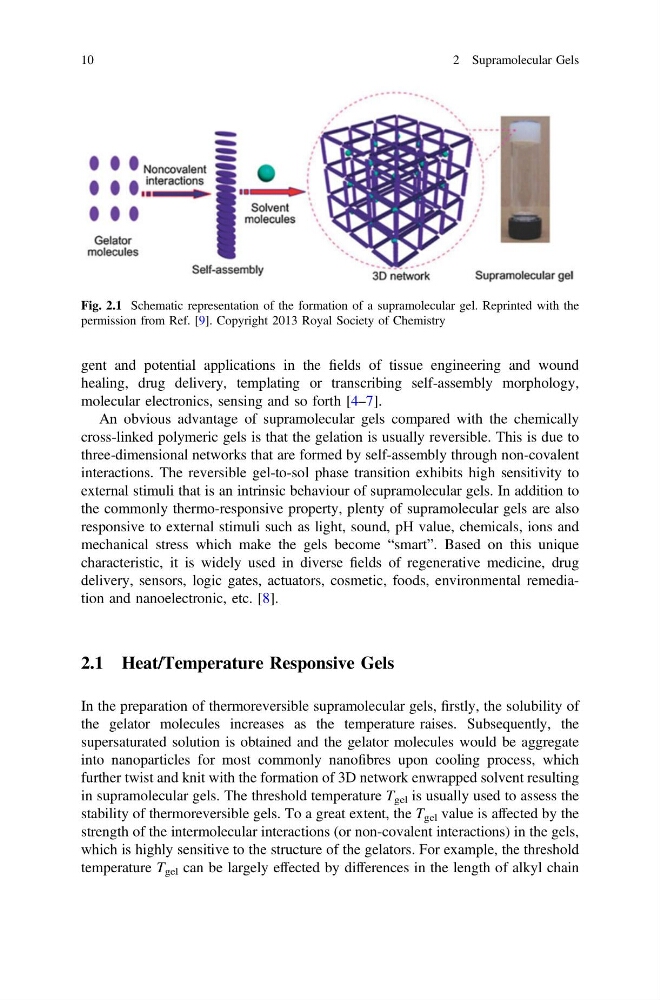
In the preparation of thermoreversible supramolecular gels, firstly, the solubility of
the gelator molecules increases as the temperature raises. Subsequently, the
supersaturated solution is obtained and the gelator molecules would be aggregate
into nanoparticles for most commonly nanofibres upon cooling process, which
further twist and knit with the formation of 3D network enwrapped solvent resulting
in supramolecular gels. The threshold temperature T gel is usually used to assess the
stability of thermoreversible gels. To a great extent, the T gel value is affected by the
strength of the intermolecular interactions (or non-covalent interactions) in the gels,
which is highly sensitive to the structure of the gelators. For example, the threshold
temperature T gel can be largely effected by differences in the length of alkyl chain
Fig. 2.1 Schematic representation of the formation of a supramolecular gel. Reprinted with the
permission from Ref. [9]. Copyright 2013 Royal Society of Chemistry
10
2 Supramolecular Gels
healing, drug delivery, templating or transcribing self-assembly morphology,
molecular electronics, sensing and so forth [4–7].
An obvious advantage of supramolecular gels compared with the chemically
cross-linked polymeric gels is that the gelation is usually reversible. This is due to
three-dimensional networks that are formed by self-assembly through non-covalent
interactions. The reversible gel-to-sol phase transition exhibits high sensitivity to
external stimuli that is an intrinsic behaviour of supramolecular gels. In addition to
the commonly thermo-responsive property, plenty of supramolecular gels are also
responsive to external stimuli such as light, sound, pH value, chemicals, ions and
mechanical stress which make the gels become “smart”. Based on this unique
characteristic, it is widely used in diverse fields of regenerative medicine, drug
delivery, sensors, logic gates, actuators, cosmetic, foods, environmental remediation and nanoelectronic, etc. [8].
2.1 Heat/Temperature Responsive Gels
In the preparation of thermoreversible supramolecular gels, firstly, the solubility of
the gelator molecules increases as the temperature raises. Subsequently, the
supersaturated solution is obtained and the gelator molecules would be aggregate
into nanoparticles for most commonly nanofibres upon cooling process, which
further twist and knit with the formation of 3D network enwrapped solvent resulting
in supramolecular gels. The threshold temperature T gel is usually used to assess the
stability of thermoreversible gels. To a great extent, the T gel value is affected by the
strength of the intermolecular interactions (or non-covalent interactions) in the gels,
which is highly sensitive to the structure of the gelators. For example, the threshold
temperature T gel can be largely effected by differences in the length of alkyl chain
Fig. 2.1 Schematic representation of the formation of a supramolecular gel. Reprinted with the
permission from Ref. [9]. Copyright 2013 Royal Society of Chemistry
10
2 Supramolecular Gels