

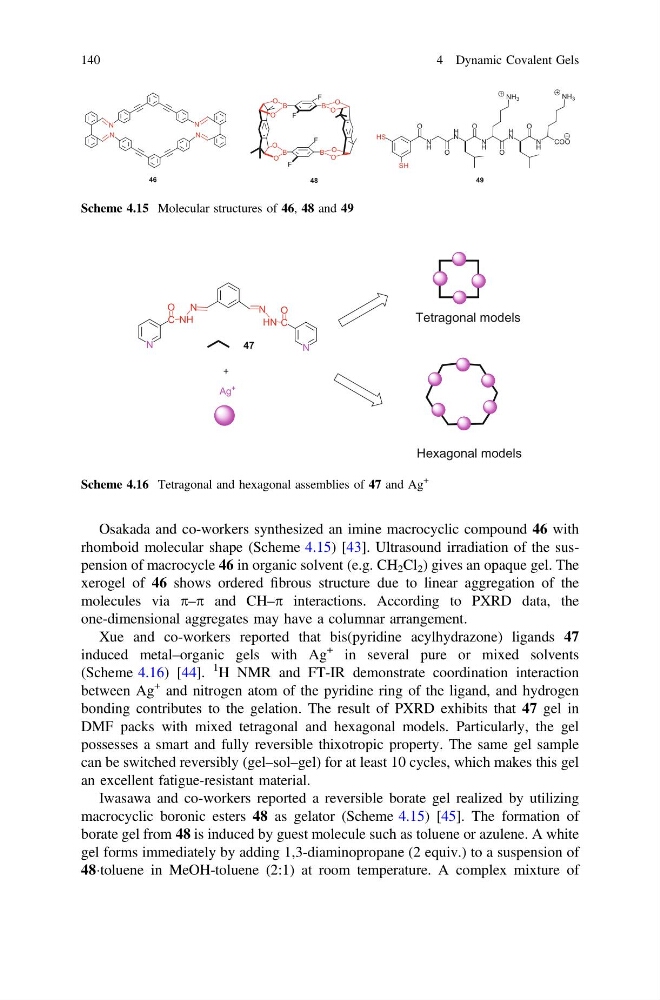
Osakada and co-workers synthesized an imine macrocyclic compound 46 with
rhomboid molecular shape (Scheme 4.15) [43]. Ultrasound irradiation of the suspension of macrocycle 46 in organic solvent (e.g. CH 2 Cl 2 ) gives an opaque gel. The
xerogel of 46 shows ordered fibrous structure due to linear aggregation of the
molecules via p–p and CH–p interactions. According to PXRD data, the
one-dimensional aggregates may have a columnar arrangement.
Xue and co-workers reported that bis(pyridine acylhydrazone) ligands 47
induced metal–organic gels with Ag
+ in several pure or mixed solvents
(Scheme 4.16) [44].
1 H NMR and FT-IR demonstrate coordination interaction
between Ag
+ and nitrogen atom of the pyridine ring of the ligand, and hydrogen
bonding contributes to the gelation. The result of PXRD exhibits that 47 gel in
DMF packs with mixed tetragonal and hexagonal models. Particularly, the gel
possesses a smart and fully reversible thixotropic property. The same gel sample
can be switched reversibly (gel–sol–gel) for at least 10 cycles, which makes this gel
an excellent fatigue-resistant material.
Iwasawa and co-workers reported a reversible borate gel realized by utilizing
macrocyclic boronic esters 48 as gelator (Scheme 4.15) [45]. The formation of
borate gel from 48 is induced by guest molecule such as toluene or azulene. A white
gel forms immediately by adding 1,3-diaminopropane (2 equiv.) to a suspension of
48Átoluene in MeOH-toluene (2:1) at room temperature. A complex mixture of
N
N
N
N
46
O
O
B
O
O
B
O
O
B
F
F
O
O
B
F
F
48
N
H
H
N
N
H
H
N
N
H
COO
O
O
O
O
O
49
NH 3
NH 3
SH
HS
Scheme 4.15 Molecular structures of 46, 48 and 49
Tetragonal models
Hexagonal models
N
N
NH
HN
C
O
C
O
N
N
Ag
+
+
47
Scheme 4.16 Tetragonal and hexagonal assemblies of 47 and Ag
+
140
4 Dynamic Covalent Gels
rhomboid molecular shape (Scheme 4.15) [43]. Ultrasound irradiation of the suspension of macrocycle 46 in organic solvent (e.g. CH 2 Cl 2 ) gives an opaque gel. The
xerogel of 46 shows ordered fibrous structure due to linear aggregation of the
molecules via p–p and CH–p interactions. According to PXRD data, the
one-dimensional aggregates may have a columnar arrangement.
Xue and co-workers reported that bis(pyridine acylhydrazone) ligands 47
induced metal–organic gels with Ag
+ in several pure or mixed solvents
(Scheme 4.16) [44].
1 H NMR and FT-IR demonstrate coordination interaction
between Ag
+ and nitrogen atom of the pyridine ring of the ligand, and hydrogen
bonding contributes to the gelation. The result of PXRD exhibits that 47 gel in
DMF packs with mixed tetragonal and hexagonal models. Particularly, the gel
possesses a smart and fully reversible thixotropic property. The same gel sample
can be switched reversibly (gel–sol–gel) for at least 10 cycles, which makes this gel
an excellent fatigue-resistant material.
Iwasawa and co-workers reported a reversible borate gel realized by utilizing
macrocyclic boronic esters 48 as gelator (Scheme 4.15) [45]. The formation of
borate gel from 48 is induced by guest molecule such as toluene or azulene. A white
gel forms immediately by adding 1,3-diaminopropane (2 equiv.) to a suspension of
48Átoluene in MeOH-toluene (2:1) at room temperature. A complex mixture of
N
N
N
N
46
O
O
B
O
O
B
O
O
B
F
F
O
O
B
F
F
48
N
H
H
N
N
H
H
N
N
H
COO
O
O
O
O
O
49
NH 3
NH 3
SH
HS
Scheme 4.15 Molecular structures of 46, 48 and 49
Tetragonal models
Hexagonal models
N
N
NH
HN
C
O
C
O
N
N
Ag
+
+
47
Scheme 4.16 Tetragonal and hexagonal assemblies of 47 and Ag
+
140
4 Dynamic Covalent Gels