

4.1.4 Conversions Between Anthracene and Its Dimer
Dynamic covalent bonds based on anthracene dimerization have been introduced
into supramolecular polymers built on host–guest interactions between pillar [5]
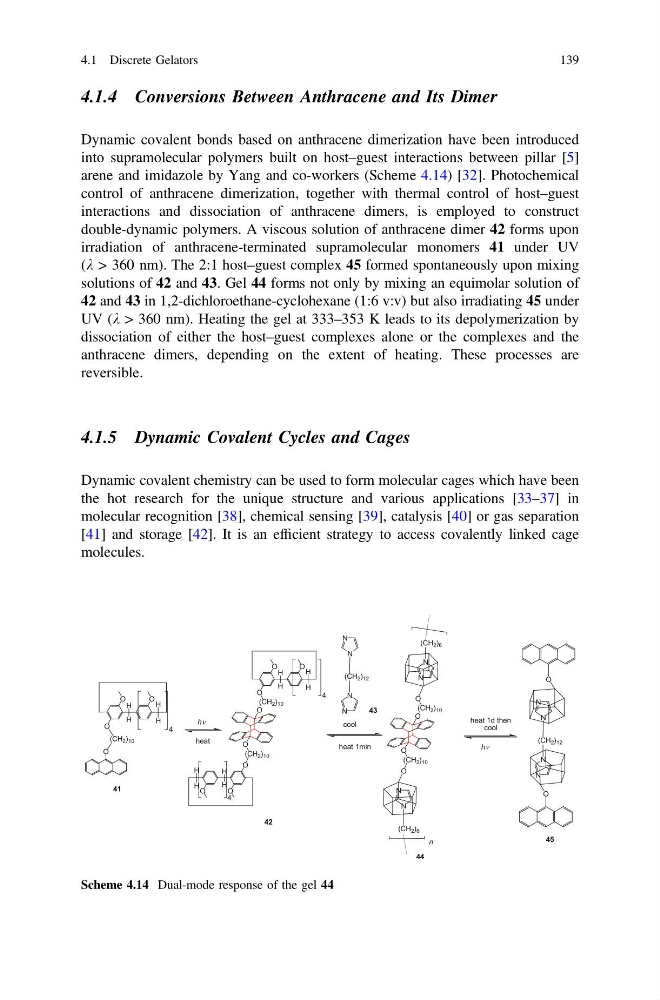
arene and imidazole by Yang and co-workers (Scheme 4.14) [32]. Photochemical
control of anthracene dimerization, together with thermal control of host–guest
interactions and dissociation of anthracene dimers, is employed to construct
double-dynamic polymers. A viscous solution of anthracene dimer 42 forms upon
irradiation of anthracene-terminated supramolecular monomers 41 under UV
(k > 360 nm). The 2:1 host–guest complex 45 formed spontaneously upon mixing
solutions of 42 and 43. Gel 44 forms not only by mixing an equimolar solution of
42 and 43 in 1,2-dichloroethane-cyclohexane (1:6 v:v) but also irradiating 45 under
UV (k > 360 nm). Heating the gel at 333–353 K leads to its depolymerization by
dissociation of either the host–guest complexes alone or the complexes and the
anthracene dimers, depending on the extent of heating. These processes are
reversible.
4.1.5 Dynamic Covalent Cycles and Cages
Dynamic covalent chemistry can be used to form molecular cages which have been
the hot research for the unique structure and various applications [33–37] in
molecular recognition [38], chemical sensing [39], catalysis [40] or gas separation
[41] and storage [42]. It is an efficient strategy to access covalently linked cage
molecules.
O
(CH 2 ) 10
O
H
H
O
H
H
O
4
hν
heat
O
(CH 2 ) 10
O
H
H
O
H
H
O
4
O
(CH 2 ) 10
O
H
H
O
H
H
O
4
N
(CH 2 ) 12
N
N
N
heat 1min
cool
O
(CH 2 ) 10
O
O
(CH 2 ) 10
O
(CH 2 ) 6
N
N
N
(CH 2 ) 6
N
n
N
(CH 2 ) 12
N
N
N
O
O
heat 1d then
cool
41
42
43
44
45
hν
Scheme 4.14 Dual-mode response of the gel 44
4.1 Discrete Gelators
139
Dynamic covalent bonds based on anthracene dimerization have been introduced
into supramolecular polymers built on host–guest interactions between pillar [5]
arene and imidazole by Yang and co-workers (Scheme 4.14) [32]. Photochemical
control of anthracene dimerization, together with thermal control of host–guest
interactions and dissociation of anthracene dimers, is employed to construct
double-dynamic polymers. A viscous solution of anthracene dimer 42 forms upon
irradiation of anthracene-terminated supramolecular monomers 41 under UV
(k > 360 nm). The 2:1 host–guest complex 45 formed spontaneously upon mixing
solutions of 42 and 43. Gel 44 forms not only by mixing an equimolar solution of
42 and 43 in 1,2-dichloroethane-cyclohexane (1:6 v:v) but also irradiating 45 under
UV (k > 360 nm). Heating the gel at 333–353 K leads to its depolymerization by
dissociation of either the host–guest complexes alone or the complexes and the
anthracene dimers, depending on the extent of heating. These processes are
reversible.
4.1.5 Dynamic Covalent Cycles and Cages
Dynamic covalent chemistry can be used to form molecular cages which have been
the hot research for the unique structure and various applications [33–37] in
molecular recognition [38], chemical sensing [39], catalysis [40] or gas separation
[41] and storage [42]. It is an efficient strategy to access covalently linked cage
molecules.
O
(CH 2 ) 10
O
H
H
O
H
H
O
4
hν
heat
O
(CH 2 ) 10
O
H
H
O
H
H
O
4
O
(CH 2 ) 10
O
H
H
O
H
H
O
4
N
(CH 2 ) 12
N
N
N
heat 1min
cool
O
(CH 2 ) 10
O
O
(CH 2 ) 10
O
(CH 2 ) 6
N
N
N
(CH 2 ) 6
N
n
N
(CH 2 ) 12
N
N
N
O
O
heat 1d then
cool
41
42
43
44
45
hν
Scheme 4.14 Dual-mode response of the gel 44
4.1 Discrete Gelators
139