

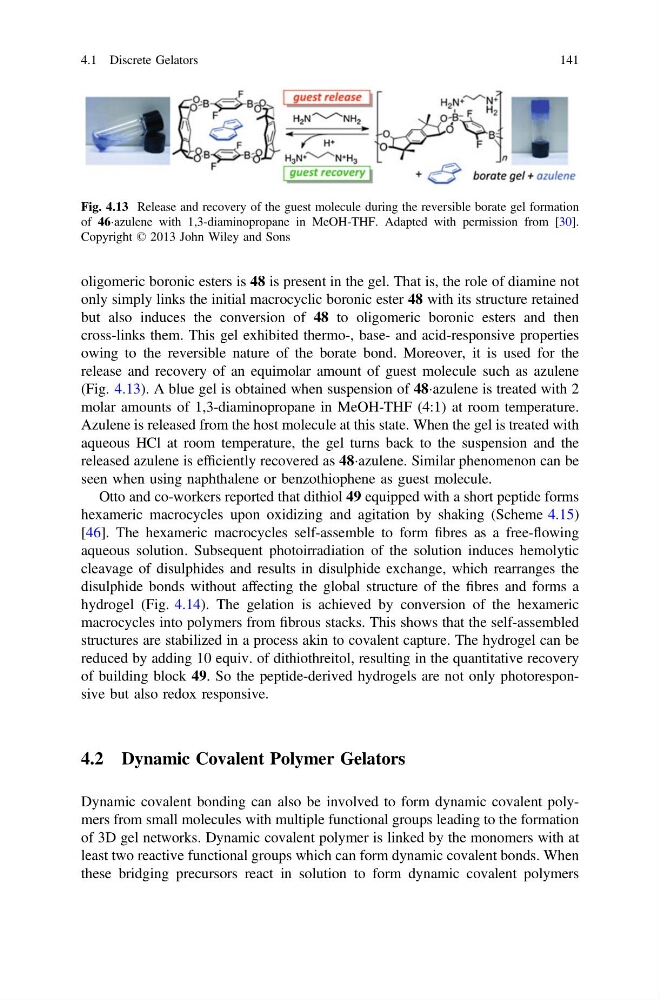
oligomeric boronic esters is 48 is present in the gel. That is, the role of diamine not
only simply links the initial macrocyclic boronic ester 48 with its structure retained
but also induces the conversion of 48 to oligomeric boronic esters and then
cross-links them. This gel exhibited thermo-, base- and acid-responsive properties
owing to the reversible nature of the borate bond. Moreover, it is used for the
release and recovery of an equimolar amount of guest molecule such as azulene
(Fig. 4.13). A blue gel is obtained when suspension of 48Áazulene is treated with 2
molar amounts of 1,3-diaminopropane in MeOH-THF (4:1) at room temperature.
Azulene is released from the host molecule at this state. When the gel is treated with
aqueous HCl at room temperature, the gel turns back to the suspension and the
released azulene is efficiently recovered as 48Áazulene. Similar phenomenon can be
seen when using naphthalene or benzothiophene as guest molecule.
Otto and co-workers reported that dithiol 49 equipped with a short peptide forms
hexameric macrocycles upon oxidizing and agitation by shaking (Scheme 4.15)
[46]. The hexameric macrocycles self-assemble to form fibres as a free-flowing
aqueous solution. Subsequent photoirradiation of the solution induces hemolytic
cleavage of disulphides and results in disulphide exchange, which rearranges the
disulphide bonds without affecting the global structure of the fibres and forms a
hydrogel (Fig. 4.14). The gelation is achieved by conversion of the hexameric
macrocycles into polymers from fibrous stacks. This shows that the self-assembled
structures are stabilized in a process akin to covalent capture. The hydrogel can be
reduced by adding 10 equiv. of dithiothreitol, resulting in the quantitative recovery
of building block 49. So the peptide-derived hydrogels are not only photoresponsive but also redox responsive.
4.2 Dynamic Covalent Polymer Gelators
Dynamic covalent bonding can also be involved to form dynamic covalent polymers from small molecules with multiple functional groups leading to the formation
of 3D gel networks. Dynamic covalent polymer is linked by the monomers with at
least two reactive functional groups which can form dynamic covalent bonds. When
these bridging precursors react in solution to form dynamic covalent polymers
Fig. 4.13 Release and recovery of the guest molecule during the reversible borate gel formation
of 46Áazulene with 1,3-diaminopropane in MeOH-THF. Adapted with permission from [30].
Copyright © 2013 John Wiley and Sons
4.1 Discrete Gelators
141
only simply links the initial macrocyclic boronic ester 48 with its structure retained
but also induces the conversion of 48 to oligomeric boronic esters and then
cross-links them. This gel exhibited thermo-, base- and acid-responsive properties
owing to the reversible nature of the borate bond. Moreover, it is used for the
release and recovery of an equimolar amount of guest molecule such as azulene
(Fig. 4.13). A blue gel is obtained when suspension of 48Áazulene is treated with 2
molar amounts of 1,3-diaminopropane in MeOH-THF (4:1) at room temperature.
Azulene is released from the host molecule at this state. When the gel is treated with
aqueous HCl at room temperature, the gel turns back to the suspension and the
released azulene is efficiently recovered as 48Áazulene. Similar phenomenon can be
seen when using naphthalene or benzothiophene as guest molecule.
Otto and co-workers reported that dithiol 49 equipped with a short peptide forms
hexameric macrocycles upon oxidizing and agitation by shaking (Scheme 4.15)
[46]. The hexameric macrocycles self-assemble to form fibres as a free-flowing
aqueous solution. Subsequent photoirradiation of the solution induces hemolytic
cleavage of disulphides and results in disulphide exchange, which rearranges the
disulphide bonds without affecting the global structure of the fibres and forms a
hydrogel (Fig. 4.14). The gelation is achieved by conversion of the hexameric
macrocycles into polymers from fibrous stacks. This shows that the self-assembled
structures are stabilized in a process akin to covalent capture. The hydrogel can be
reduced by adding 10 equiv. of dithiothreitol, resulting in the quantitative recovery
of building block 49. So the peptide-derived hydrogels are not only photoresponsive but also redox responsive.
4.2 Dynamic Covalent Polymer Gelators
Dynamic covalent bonding can also be involved to form dynamic covalent polymers from small molecules with multiple functional groups leading to the formation
of 3D gel networks. Dynamic covalent polymer is linked by the monomers with at
least two reactive functional groups which can form dynamic covalent bonds. When
these bridging precursors react in solution to form dynamic covalent polymers
Fig. 4.13 Release and recovery of the guest molecule during the reversible borate gel formation
of 46Áazulene with 1,3-diaminopropane in MeOH-THF. Adapted with permission from [30].
Copyright © 2013 John Wiley and Sons
4.1 Discrete Gelators
141