

4.1.3 Borate Gels
Borate formation has been used in dimerization of the guanosine gelators to form
hydrogels typically involving G 4 ÁM
+ quartets. Davis and co-workers studied the
formation of a hydrogel by adding 0.5 equiv of KB(OH) 4 into the guanosine (36)
(Scheme 4.12) [28]. The nucleoside’s 2′,3′-diol reacts with borate to form anionic
guanosine-borate (GB) diesters, and they further self-assemble to form a structure
containing stacked G 4 quartets. B(OH) 4
− , together with K
+ , is crucial for gelation.
K
+ stabilizes the G 4 quartets and allows the hydrogel to stay intact; B(OH) 4
−
cooperates with K
+ to template self-assembly of 36 to give a robust, non-covalent
hydrogel that remains intact indefinitely in salt water. The hydrogel is diagnostic of
G 4 quartets that are stacked in both head-to-tail and head-to-head orientations. GB
gel absorbs methylene blue with high selectivity due to electrostatic interactions of
the cationic dye with the anionic borates and stacking interactions with the G 4
quartets.
Among the gels of various metal borate salt (Li
+
, Na
+
, Rb
+
, Cs
+
) with KB(OH) 4 ,
G 4 K
+ hydrogel is the strongest, self-supporting hydrogel with elastic moduli
>10 kPa [29]. The structure involves the formation of borate dimers and G 4 K
+
quartets by 36 and KB(OH) 4 . Stacking of the G 4 K
+ quartets into nanowires via
hydrogen bonding and p–p stacking gives a hydrogel. Additionally when thioflavin
T (ThT 6) is incorporated, the fluorescent intensity of the G 4 M
+ gels is different.
ThT 6 has been used as a selective indicator for G-quadruplex DNA and displays a
strong enhancement in fluorescence upon binding to G-quadruplex DNA. The
fluorescence is cation dependent. The highest fluorescence is seen for the K
+ GB
hydrogel, suggesting it has the largest number of G 4 -quartets.
They further studied a G 4 -quartet-based hydrogel formed by 5′-deoxy-5′-iodoguanosine (37) (Scheme 4.12) [30]. 37 undergoes in situ cyclization to give 5′deoxy-N3,5′-cycloguanosine (38). The cyclization is temperature sensitive and
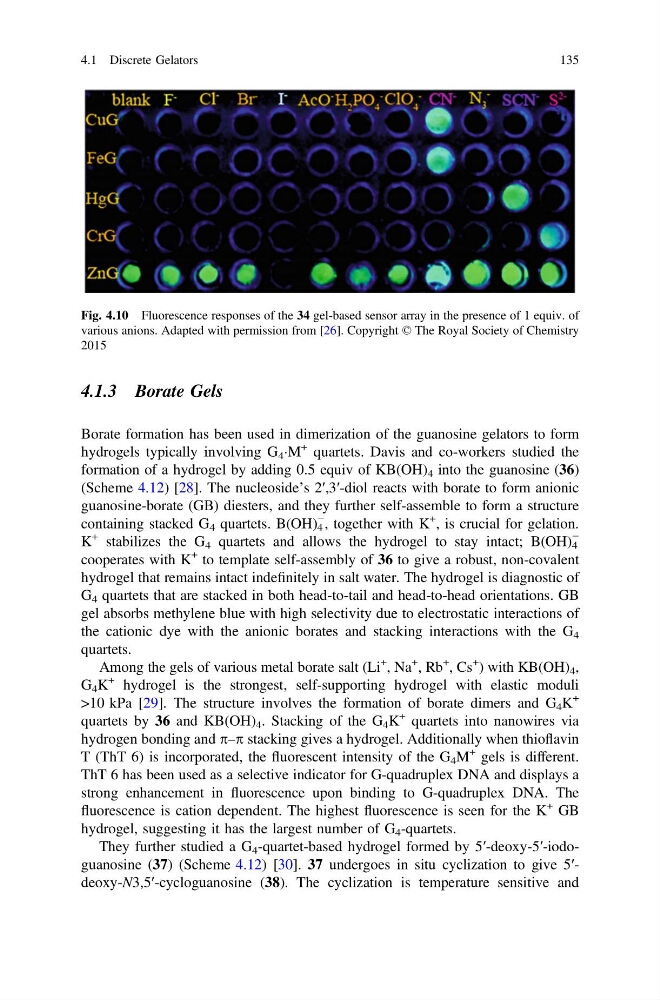
Fig. 4.10 Fluorescence responses of the 34 gel-based sensor array in the presence of 1 equiv. of
various anions. Adapted with permission from [26]. Copyright © The Royal Society of Chemistry
2015
4.1 Discrete Gelators
135
Borate formation has been used in dimerization of the guanosine gelators to form
hydrogels typically involving G 4 ÁM
+ quartets. Davis and co-workers studied the
formation of a hydrogel by adding 0.5 equiv of KB(OH) 4 into the guanosine (36)
(Scheme 4.12) [28]. The nucleoside’s 2′,3′-diol reacts with borate to form anionic
guanosine-borate (GB) diesters, and they further self-assemble to form a structure
containing stacked G 4 quartets. B(OH) 4
− , together with K
+ , is crucial for gelation.
K
+ stabilizes the G 4 quartets and allows the hydrogel to stay intact; B(OH) 4
−
cooperates with K
+ to template self-assembly of 36 to give a robust, non-covalent
hydrogel that remains intact indefinitely in salt water. The hydrogel is diagnostic of
G 4 quartets that are stacked in both head-to-tail and head-to-head orientations. GB
gel absorbs methylene blue with high selectivity due to electrostatic interactions of
the cationic dye with the anionic borates and stacking interactions with the G 4
quartets.
Among the gels of various metal borate salt (Li
+
, Na
+
, Rb
+
, Cs
+
) with KB(OH) 4 ,
G 4 K
+ hydrogel is the strongest, self-supporting hydrogel with elastic moduli
>10 kPa [29]. The structure involves the formation of borate dimers and G 4 K
+
quartets by 36 and KB(OH) 4 . Stacking of the G 4 K
+ quartets into nanowires via
hydrogen bonding and p–p stacking gives a hydrogel. Additionally when thioflavin
T (ThT 6) is incorporated, the fluorescent intensity of the G 4 M
+ gels is different.
ThT 6 has been used as a selective indicator for G-quadruplex DNA and displays a
strong enhancement in fluorescence upon binding to G-quadruplex DNA. The
fluorescence is cation dependent. The highest fluorescence is seen for the K
+ GB
hydrogel, suggesting it has the largest number of G 4 -quartets.
They further studied a G 4 -quartet-based hydrogel formed by 5′-deoxy-5′-iodoguanosine (37) (Scheme 4.12) [30]. 37 undergoes in situ cyclization to give 5′deoxy-N3,5′-cycloguanosine (38). The cyclization is temperature sensitive and
Fig. 4.10 Fluorescence responses of the 34 gel-based sensor array in the presence of 1 equiv. of
various anions. Adapted with permission from [26]. Copyright © The Royal Society of Chemistry
2015
4.1 Discrete Gelators
135