

continues to occur after gel formation. The hydrogel of 37 displays a
self-destruction because the content of the cyclization product (38) in the gel is
increasing when raising the temperature. 38 cannot form a stable G 4 -quartet due to
lacking of a N1 H-binding site, and the hydrogel is destroyed at 37 °C (Fig. 4.12).
So the hydrogel can release pre-incorporated antiviral drugs (acyclovir or ganciclovir (guanine analogues)) efficiently at 37 °C.
Sadler and co-workers incorporated a photoactivatable dopamine-conjugated
platinum(IV) anticancer complex into G-quadruplex G 4 K
+ borate hydrogels by
using borate ester linkages (40) (Scheme 4.13) [31]. The molar ratio of 39 relative
to guanosine hydrate is crucial for gel formation. When 1 mol equiv. of 39 was
used, there is no gelation, because the presence of 39 functional group on the four
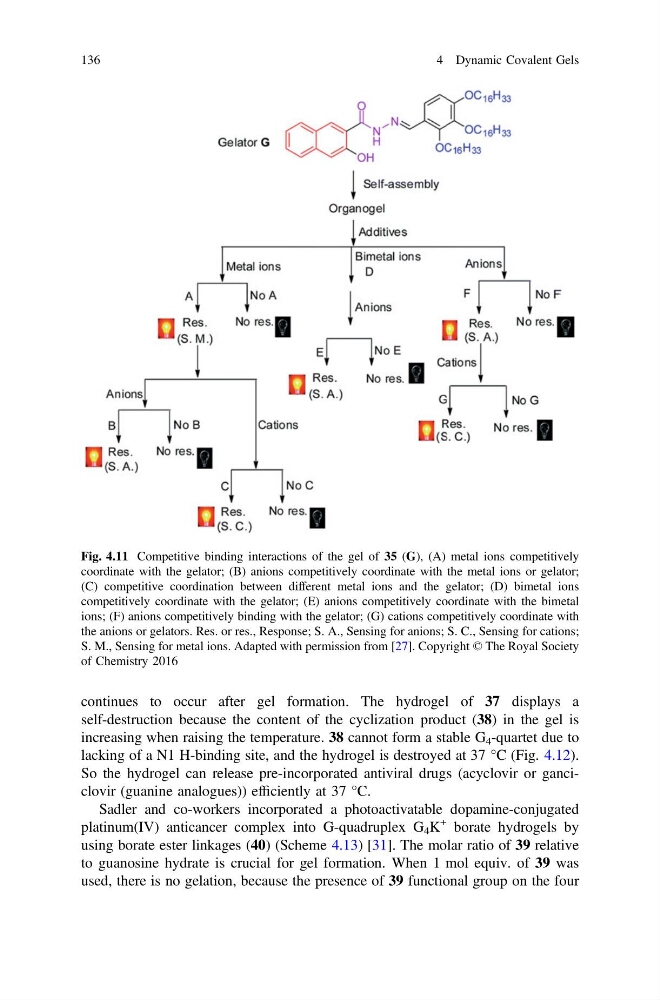
Fig. 4.11 Competitive binding interactions of the gel of 35 (G), (A) metal ions competitively
coordinate with the gelator; (B) anions competitively coordinate with the metal ions or gelator;
(C) competitive coordination between different metal ions and the gelator; (D) bimetal ions
competitively coordinate with the gelator; (E) anions competitively coordinate with the bimetal
ions; (F) anions competitively binding with the gelator; (G) cations competitively coordinate with
the anions or gelators. Res. or res., Response; S. A., Sensing for anions; S. C., Sensing for cations;
S. M., Sensing for metal ions. Adapted with permission from [27]. Copyright © The Royal Society
of Chemistry 2016
136
4 Dynamic Covalent Gels
self-destruction because the content of the cyclization product (38) in the gel is
increasing when raising the temperature. 38 cannot form a stable G 4 -quartet due to
lacking of a N1 H-binding site, and the hydrogel is destroyed at 37 °C (Fig. 4.12).
So the hydrogel can release pre-incorporated antiviral drugs (acyclovir or ganciclovir (guanine analogues)) efficiently at 37 °C.
Sadler and co-workers incorporated a photoactivatable dopamine-conjugated
platinum(IV) anticancer complex into G-quadruplex G 4 K
+ borate hydrogels by
using borate ester linkages (40) (Scheme 4.13) [31]. The molar ratio of 39 relative
to guanosine hydrate is crucial for gel formation. When 1 mol equiv. of 39 was
used, there is no gelation, because the presence of 39 functional group on the four
Fig. 4.11 Competitive binding interactions of the gel of 35 (G), (A) metal ions competitively
coordinate with the gelator; (B) anions competitively coordinate with the metal ions or gelator;
(C) competitive coordination between different metal ions and the gelator; (D) bimetal ions
competitively coordinate with the gelator; (E) anions competitively coordinate with the bimetal
ions; (F) anions competitively binding with the gelator; (G) cations competitively coordinate with
the anions or gelators. Res. or res., Response; S. A., Sensing for anions; S. C., Sensing for cations;
S. M., Sensing for metal ions. Adapted with permission from [27]. Copyright © The Royal Society
of Chemistry 2016
136
4 Dynamic Covalent Gels