

aqueous solution (Fig. 4.11). According to their test, upon the addition of 0.5 equiv.
of Cu
2+ , Ba
2+ , Fe
3+ , Cr
3+ , Ru
3+ , Eu
3+ or Tb
3+ to 35 gel, the AIE of 35 was
quenched and the corresponding no fluorescence metallogel (MG2) formed; while
addition of 0.5 equiv. of Ca
2+ , Al
3+ , La
3+ , Y
3+ and so on induces the AIE of G2
with obvious shifts. What’s more, the MG2 metallogels sense various anions.
CuG2, CrG2, BaG2, EuG2, TbG2 and CuG2 show selective fluorescence
“turn-on” towards SCN
− , S
2− , F
− and OH
− , respectively, while FeG2, AlG2 and
LaG2 selectively sense HSO 4
− and OH
− , respectively. This gel system, a
twenty-two member sensor array, is based on only one synthesized receptor and
accurately controlled by various competitive binding interactions.
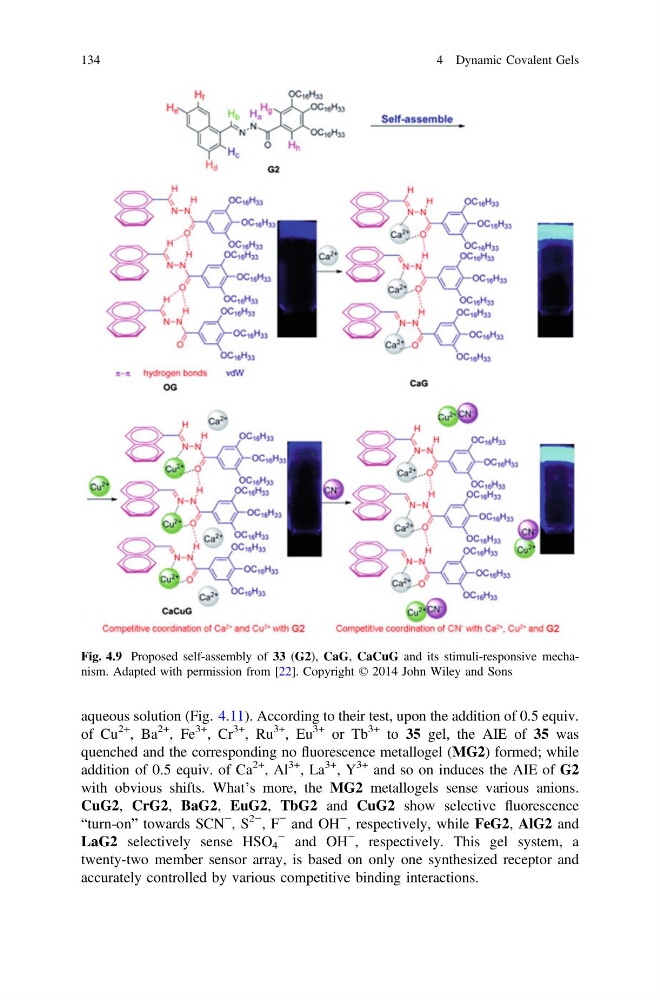
Fig. 4.9 Proposed self-assembly of 33 (G2), CaG, CaCuG and its stimuli-responsive mechanism. Adapted with permission from [22]. Copyright © 2014 John Wiley and Sons
134
4 Dynamic Covalent Gels
of Cu
2+ , Ba
2+ , Fe
3+ , Cr
3+ , Ru
3+ , Eu
3+ or Tb
3+ to 35 gel, the AIE of 35 was
quenched and the corresponding no fluorescence metallogel (MG2) formed; while
addition of 0.5 equiv. of Ca
2+ , Al
3+ , La
3+ , Y
3+ and so on induces the AIE of G2
with obvious shifts. What’s more, the MG2 metallogels sense various anions.
CuG2, CrG2, BaG2, EuG2, TbG2 and CuG2 show selective fluorescence
“turn-on” towards SCN
− , S
2− , F
− and OH
− , respectively, while FeG2, AlG2 and
LaG2 selectively sense HSO 4
− and OH
− , respectively. This gel system, a
twenty-two member sensor array, is based on only one synthesized receptor and
accurately controlled by various competitive binding interactions.
Fig. 4.9 Proposed self-assembly of 33 (G2), CaG, CaCuG and its stimuli-responsive mechanism. Adapted with permission from [22]. Copyright © 2014 John Wiley and Sons
134
4 Dynamic Covalent Gels