

Chen, Yin and co-workers reported another example of metal-assisted gelation
[18]. Metal–organic gels (26-ZnG and CuG) were prepared from 25 and Zn
2+ /Cu
2+
in DMSO (Scheme 4.7). For ZnG and CuG, metal coordination results in the
destruction of intramolecular hydrogen bonding in 25 and the formation of naphtholate, these metal ions coordinated with nitrogen and oxygen atoms in the
hydroxy and imine group, respectively, with 1:1 stoichiometry. In addition, Cu
2+
can competitively coordinate with 25 in ZnG and release Zn
2+ , which result in the
fluorescence quenching and colour change of ZnG. The resulting Zn–CuG can
fluorescently detect CN
− with specific selectivity over S
2− and Cys. This property
enables Zn–CuG to act as a Cu
2+ and CN
− controlled “OFF–ON–OFF” fluorescent
switch. The mechanism is that CN
− could competitively bound to Cu
2+ to form
stable [Cu(CN) x ]
n− species after the addition of CN
− into Zn–CuG, while Zn
2+
again coordinated with 25 (Fig. 4.7). Then upon addition of Cu
2+ into the above
mixture containing ZnG and [Cu(CN) x ]
− species, the fluorescence of the system is
quenched, which is attributed to recoordination of Cu
2+ with 25.
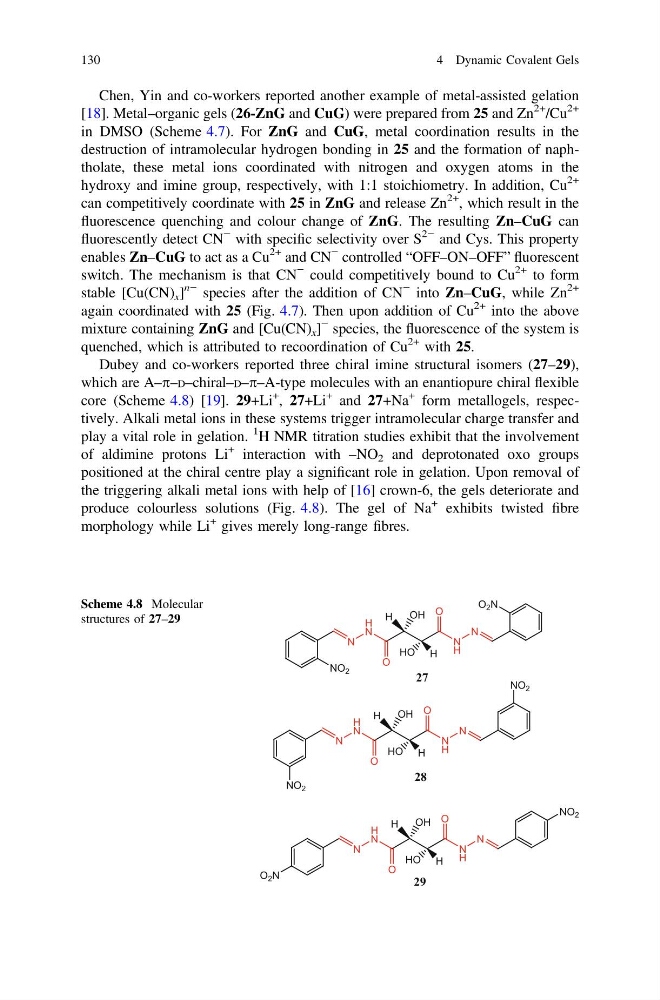
Dubey and co-workers reported three chiral imine structural isomers (27–29),
which are A–p–D–chiral–D–p–A-type molecules with an enantiopure chiral flexible
core (Scheme 4.8) [19]. 29+Li
+
, 27+Li
+ and 27+Na
+ form metallogels, respectively. Alkali metal ions in these systems trigger intramolecular charge transfer and
play a vital role in gelation.
1 H NMR titration studies exhibit that the involvement
of aldimine protons Li
+ interaction with –NO 2 and deprotonated oxo groups
positioned at the chiral centre play a significant role in gelation. Upon removal of
the triggering alkali metal ions with help of [16] crown-6, the gels deteriorate and
produce colourless solutions (Fig. 4.8). The gel of Na
+ exhibits twisted fibre
morphology while Li
+ gives merely long-range fibres.
NO 2
N
H
N
O
N
H
O
N
O 2 N
H
OH
HO H
27
28
29
N
H
N
O
N
H
O
N
H
OH
HO H
NO 2
NO 2
N
H
N
O
N
H
O
N
H
OH
HO H
O 2 N
NO 2
Scheme 4.8 Molecular
structures of 27–29
130
4 Dynamic Covalent Gels
[18]. Metal–organic gels (26-ZnG and CuG) were prepared from 25 and Zn
2+ /Cu
2+
in DMSO (Scheme 4.7). For ZnG and CuG, metal coordination results in the
destruction of intramolecular hydrogen bonding in 25 and the formation of naphtholate, these metal ions coordinated with nitrogen and oxygen atoms in the
hydroxy and imine group, respectively, with 1:1 stoichiometry. In addition, Cu
2+
can competitively coordinate with 25 in ZnG and release Zn
2+ , which result in the
fluorescence quenching and colour change of ZnG. The resulting Zn–CuG can
fluorescently detect CN
− with specific selectivity over S
2− and Cys. This property
enables Zn–CuG to act as a Cu
2+ and CN
− controlled “OFF–ON–OFF” fluorescent
switch. The mechanism is that CN
− could competitively bound to Cu
2+ to form
stable [Cu(CN) x ]
n− species after the addition of CN
− into Zn–CuG, while Zn
2+
again coordinated with 25 (Fig. 4.7). Then upon addition of Cu
2+ into the above
mixture containing ZnG and [Cu(CN) x ]
− species, the fluorescence of the system is
quenched, which is attributed to recoordination of Cu
2+ with 25.
Dubey and co-workers reported three chiral imine structural isomers (27–29),
which are A–p–D–chiral–D–p–A-type molecules with an enantiopure chiral flexible
core (Scheme 4.8) [19]. 29+Li
+
, 27+Li
+ and 27+Na
+ form metallogels, respectively. Alkali metal ions in these systems trigger intramolecular charge transfer and
play a vital role in gelation.
1 H NMR titration studies exhibit that the involvement
of aldimine protons Li
+ interaction with –NO 2 and deprotonated oxo groups
positioned at the chiral centre play a significant role in gelation. Upon removal of
the triggering alkali metal ions with help of [16] crown-6, the gels deteriorate and
produce colourless solutions (Fig. 4.8). The gel of Na
+ exhibits twisted fibre
morphology while Li
+ gives merely long-range fibres.
NO 2
N
H
N
O
N
H
O
N
O 2 N
H
OH
HO H
27
28
29
N
H
N
O
N
H
O
N
H
OH
HO H
NO 2
NO 2
N
H
N
O
N
H
O
N
H
OH
HO H
O 2 N
NO 2
Scheme 4.8 Molecular
structures of 27–29
130
4 Dynamic Covalent Gels