

Another example of incorporating imine bonding into metal-assisted gelation
was investigated by Jiang and co-workers [17]. An ALS-type imine gelator 23
(ALS gelators are comprised of an aromatic functional group coupled with a
steroidal moiety through a flexible linker) is synthesized beforehand from cholesterol 2-aminoacetate (22) and 3,5-di-tert-butyl-2-hydroxybenzaldehyde (21)
(Scheme 4.7). Imine compound 23 efficiently gelate various organic solvents.
Nanofibres with 30–100 nm width are responsible for the gelation. The gel shows
thermochromism due to the enol–keto tautomerism. Metal ions binding affects the
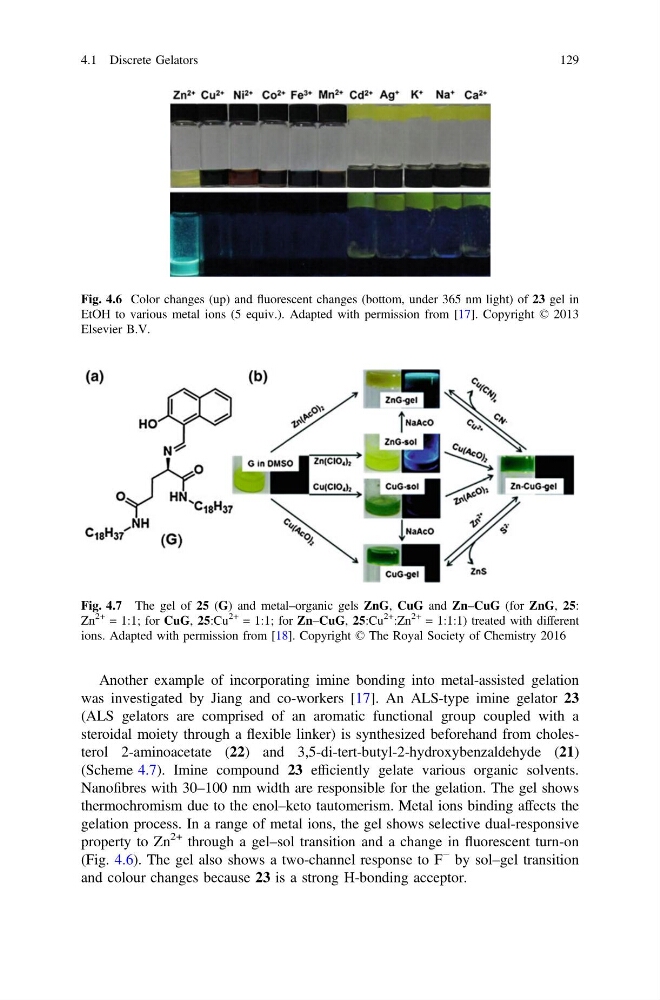
gelation process. In a range of metal ions, the gel shows selective dual-responsive
property to Zn
2+ through a gel–sol transition and a change in fluorescent turn-on
(Fig. 4.6). The gel also shows a two-channel response to F
− by sol–gel transition
and colour changes because 23 is a strong H-bonding acceptor.
Fig. 4.6 Color changes (up) and fluorescent changes (bottom, under 365 nm light) of 23 gel in
EtOH to various metal ions (5 equiv.). Adapted with permission from [17]. Copyright © 2013
Elsevier B.V.
Fig. 4.7 The gel of 25 (G) and metal–organic gels ZnG, CuG and Zn–CuG (for ZnG, 25:
Zn
2+ = 1:1; for CuG, 25:Cu
2+ = 1:1; for Zn–CuG, 25:Cu
2+ :Zn
2+ = 1:1:1) treated with different
ions. Adapted with permission from [18]. Copyright © The Royal Society of Chemistry 2016
4.1 Discrete Gelators
129
was investigated by Jiang and co-workers [17]. An ALS-type imine gelator 23
(ALS gelators are comprised of an aromatic functional group coupled with a
steroidal moiety through a flexible linker) is synthesized beforehand from cholesterol 2-aminoacetate (22) and 3,5-di-tert-butyl-2-hydroxybenzaldehyde (21)
(Scheme 4.7). Imine compound 23 efficiently gelate various organic solvents.
Nanofibres with 30–100 nm width are responsible for the gelation. The gel shows
thermochromism due to the enol–keto tautomerism. Metal ions binding affects the
gelation process. In a range of metal ions, the gel shows selective dual-responsive
property to Zn
2+ through a gel–sol transition and a change in fluorescent turn-on
(Fig. 4.6). The gel also shows a two-channel response to F
− by sol–gel transition
and colour changes because 23 is a strong H-bonding acceptor.
Fig. 4.6 Color changes (up) and fluorescent changes (bottom, under 365 nm light) of 23 gel in
EtOH to various metal ions (5 equiv.). Adapted with permission from [17]. Copyright © 2013
Elsevier B.V.
Fig. 4.7 The gel of 25 (G) and metal–organic gels ZnG, CuG and Zn–CuG (for ZnG, 25:
Zn
2+ = 1:1; for CuG, 25:Cu
2+ = 1:1; for Zn–CuG, 25:Cu
2+ :Zn
2+ = 1:1:1) treated with different
ions. Adapted with permission from [18]. Copyright © The Royal Society of Chemistry 2016
4.1 Discrete Gelators
129