

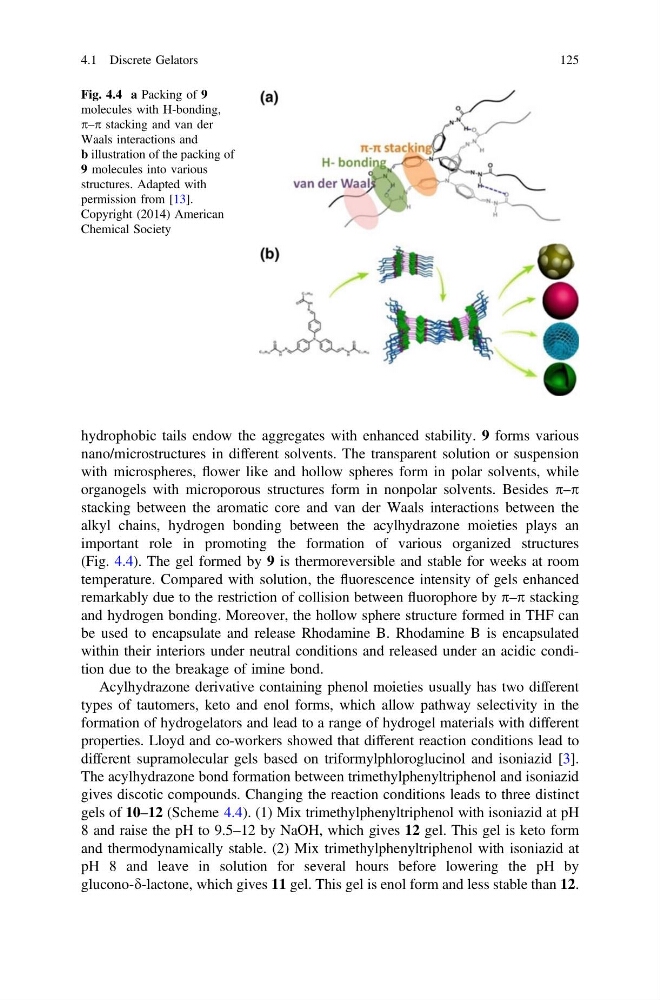
hydrophobic tails endow the aggregates with enhanced stability. 9 forms various
nano/microstructures in different solvents. The transparent solution or suspension
with microspheres, flower like and hollow spheres form in polar solvents, while
organogels with microporous structures form in nonpolar solvents. Besides p–p
stacking between the aromatic core and van der Waals interactions between the
alkyl chains, hydrogen bonding between the acylhydrazone moieties plays an
important role in promoting the formation of various organized structures
(Fig. 4.4). The gel formed by 9 is thermoreversible and stable for weeks at room
temperature. Compared with solution, the fluorescence intensity of gels enhanced
remarkably due to the restriction of collision between fluorophore by p–p stacking
and hydrogen bonding. Moreover, the hollow sphere structure formed in THF can
be used to encapsulate and release Rhodamine B. Rhodamine B is encapsulated
within their interiors under neutral conditions and released under an acidic condition due to the breakage of imine bond.
Acylhydrazone derivative containing phenol moieties usually has two different
types of tautomers, keto and enol forms, which allow pathway selectivity in the
formation of hydrogelators and lead to a range of hydrogel materials with different
properties. Lloyd and co-workers showed that different reaction conditions lead to
different supramolecular gels based on triformylphloroglucinol and isoniazid [3].
The acylhydrazone bond formation between trimethylphenyltriphenol and isoniazid
gives discotic compounds. Changing the reaction conditions leads to three distinct
gels of 10–12 (Scheme 4.4). (1) Mix trimethylphenyltriphenol with isoniazid at pH
8 and raise the pH to 9.5–12 by NaOH, which gives 12 gel. This gel is keto form
and thermodynamically stable. (2) Mix trimethylphenyltriphenol with isoniazid at
pH 8 and leave in solution for several hours before lowering the pH by
glucono-d-lactone, which gives 11 gel. This gel is enol form and less stable than 12.
Fig. 4.4 a Packing of 9
molecules with H-bonding,
p–p stacking and van der
Waals interactions and
b illustration of the packing of
9 molecules into various
structures. Adapted with
permission from [13].
Copyright (2014) American
Chemical Society
4.1 Discrete Gelators
125
nano/microstructures in different solvents. The transparent solution or suspension
with microspheres, flower like and hollow spheres form in polar solvents, while
organogels with microporous structures form in nonpolar solvents. Besides p–p
stacking between the aromatic core and van der Waals interactions between the
alkyl chains, hydrogen bonding between the acylhydrazone moieties plays an
important role in promoting the formation of various organized structures
(Fig. 4.4). The gel formed by 9 is thermoreversible and stable for weeks at room
temperature. Compared with solution, the fluorescence intensity of gels enhanced
remarkably due to the restriction of collision between fluorophore by p–p stacking
and hydrogen bonding. Moreover, the hollow sphere structure formed in THF can
be used to encapsulate and release Rhodamine B. Rhodamine B is encapsulated
within their interiors under neutral conditions and released under an acidic condition due to the breakage of imine bond.
Acylhydrazone derivative containing phenol moieties usually has two different
types of tautomers, keto and enol forms, which allow pathway selectivity in the
formation of hydrogelators and lead to a range of hydrogel materials with different
properties. Lloyd and co-workers showed that different reaction conditions lead to
different supramolecular gels based on triformylphloroglucinol and isoniazid [3].
The acylhydrazone bond formation between trimethylphenyltriphenol and isoniazid
gives discotic compounds. Changing the reaction conditions leads to three distinct
gels of 10–12 (Scheme 4.4). (1) Mix trimethylphenyltriphenol with isoniazid at pH
8 and raise the pH to 9.5–12 by NaOH, which gives 12 gel. This gel is keto form
and thermodynamically stable. (2) Mix trimethylphenyltriphenol with isoniazid at
pH 8 and leave in solution for several hours before lowering the pH by
glucono-d-lactone, which gives 11 gel. This gel is enol form and less stable than 12.
Fig. 4.4 a Packing of 9
molecules with H-bonding,
p–p stacking and van der
Waals interactions and
b illustration of the packing of
9 molecules into various
structures. Adapted with
permission from [13].
Copyright (2014) American
Chemical Society
4.1 Discrete Gelators
125