

yellow to red and reform after addition of water. Importantly, the gel system
exhibits quite unconventional solvent effects on emission wavelength, which is
attributed to the controlled formation of “excimer” and “exciplex” from the pyrene
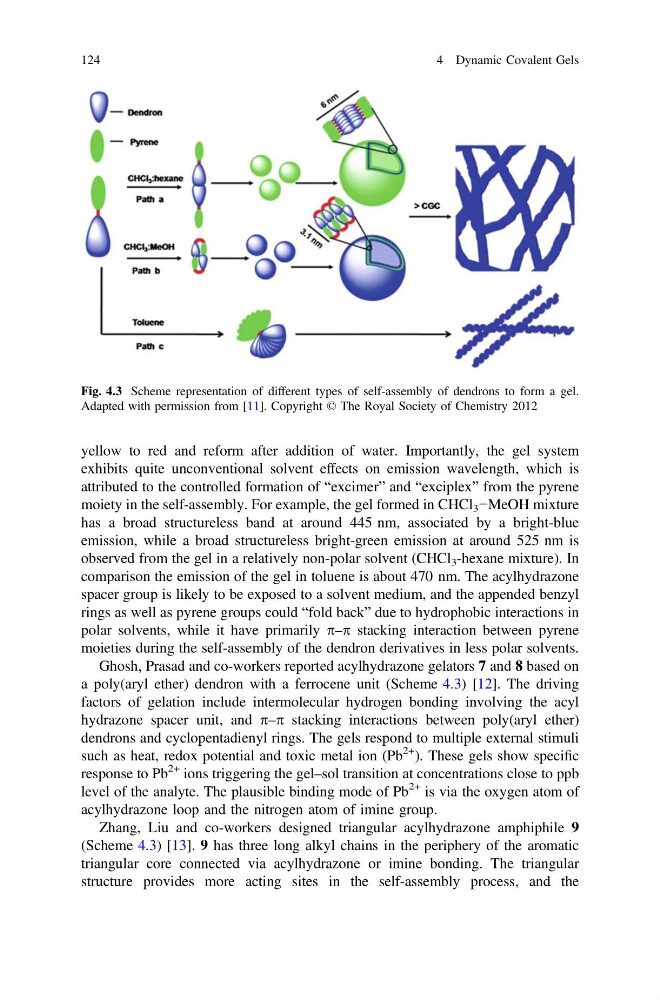
moiety in the self-assembly. For example, the gel formed in CHCl 3 −MeOH mixture
has a broad structureless band at around 445 nm, associated by a bright-blue
emission, while a broad structureless bright-green emission at around 525 nm is
observed from the gel in a relatively non-polar solvent (CHCl 3 -hexane mixture). In
comparison the emission of the gel in toluene is about 470 nm. The acylhydrazone
spacer group is likely to be exposed to a solvent medium, and the appended benzyl
rings as well as pyrene groups could “fold back” due to hydrophobic interactions in
polar solvents, while it have primarily p–p stacking interaction between pyrene
moieties during the self-assembly of the dendron derivatives in less polar solvents.
Ghosh, Prasad and co-workers reported acylhydrazone gelators 7 and 8 based on
a poly(aryl ether) dendron with a ferrocene unit (Scheme 4.3) [12]. The driving
factors of gelation include intermolecular hydrogen bonding involving the acyl
hydrazone spacer unit, and p–p stacking interactions between poly(aryl ether)
dendrons and cyclopentadienyl rings. The gels respond to multiple external stimuli
such as heat, redox potential and toxic metal ion (Pb
2+ ). These gels show specific
response to Pb
2+ ions triggering the gel–sol transition at concentrations close to ppb
level of the analyte. The plausible binding mode of Pb
2+ is via the oxygen atom of
acylhydrazone loop and the nitrogen atom of imine group.
Zhang, Liu and co-workers designed triangular acylhydrazone amphiphile 9
(Scheme 4.3) [13]. 9 has three long alkyl chains in the periphery of the aromatic
triangular core connected via acylhydrazone or imine bonding. The triangular
structure provides more acting sites in the self-assembly process, and the
Fig. 4.3 Scheme representation of different types of self-assembly of dendrons to form a gel.
Adapted with permission from [11]. Copyright © The Royal Society of Chemistry 2012
124
4 Dynamic Covalent Gels
exhibits quite unconventional solvent effects on emission wavelength, which is
attributed to the controlled formation of “excimer” and “exciplex” from the pyrene
moiety in the self-assembly. For example, the gel formed in CHCl 3 −MeOH mixture
has a broad structureless band at around 445 nm, associated by a bright-blue
emission, while a broad structureless bright-green emission at around 525 nm is
observed from the gel in a relatively non-polar solvent (CHCl 3 -hexane mixture). In
comparison the emission of the gel in toluene is about 470 nm. The acylhydrazone
spacer group is likely to be exposed to a solvent medium, and the appended benzyl
rings as well as pyrene groups could “fold back” due to hydrophobic interactions in
polar solvents, while it have primarily p–p stacking interaction between pyrene
moieties during the self-assembly of the dendron derivatives in less polar solvents.
Ghosh, Prasad and co-workers reported acylhydrazone gelators 7 and 8 based on
a poly(aryl ether) dendron with a ferrocene unit (Scheme 4.3) [12]. The driving
factors of gelation include intermolecular hydrogen bonding involving the acyl
hydrazone spacer unit, and p–p stacking interactions between poly(aryl ether)
dendrons and cyclopentadienyl rings. The gels respond to multiple external stimuli
such as heat, redox potential and toxic metal ion (Pb
2+ ). These gels show specific
response to Pb
2+ ions triggering the gel–sol transition at concentrations close to ppb
level of the analyte. The plausible binding mode of Pb
2+ is via the oxygen atom of
acylhydrazone loop and the nitrogen atom of imine group.
Zhang, Liu and co-workers designed triangular acylhydrazone amphiphile 9
(Scheme 4.3) [13]. 9 has three long alkyl chains in the periphery of the aromatic
triangular core connected via acylhydrazone or imine bonding. The triangular
structure provides more acting sites in the self-assembly process, and the
Fig. 4.3 Scheme representation of different types of self-assembly of dendrons to form a gel.
Adapted with permission from [11]. Copyright © The Royal Society of Chemistry 2012
124
4 Dynamic Covalent Gels