

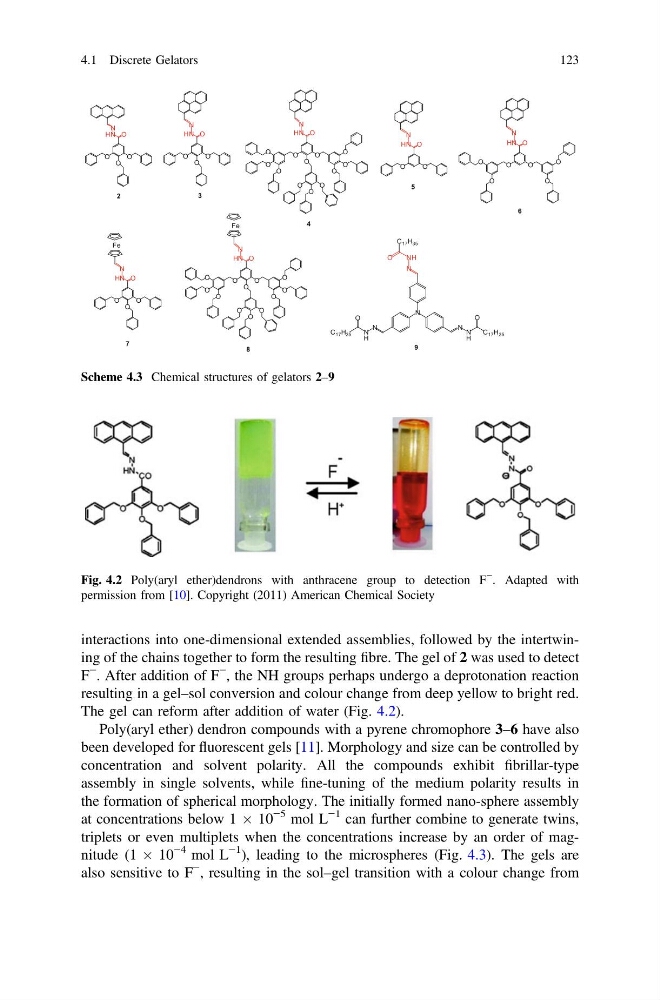
interactions into one-dimensional extended assemblies, followed by the intertwining of the chains together to form the resulting fibre. The gel of 2 was used to detect
F
− . After addition of F
−
, the NH groups perhaps undergo a deprotonation reaction
resulting in a gel–sol conversion and colour change from deep yellow to bright red.
The gel can reform after addition of water (Fig. 4.2).
Poly(aryl ether) dendron compounds with a pyrene chromophore 3–6 have also
been developed for fluorescent gels [11]. Morphology and size can be controlled by
concentration and solvent polarity. All the compounds exhibit fibrillar-type
assembly in single solvents, while fine-tuning of the medium polarity results in
the formation of spherical morphology. The initially formed nano-sphere assembly
at concentrations below 1 Â 10
−5 mol L
−1 can further combine to generate twins,
triplets or even multiplets when the concentrations increase by an order of magnitude (1 Â 10
−4 mol L
−1 ), leading to the microspheres (Fig. 4.3). The gels are
also sensitive to F
− , resulting in the sol–gel transition with a colour change from
N
HN O
O
O
O
N
HN O
O
O
O
N
HN O
O
O
N
HN O
O
O
O
O
O
O
O
O
O
O
O
O
N
HN O
O
O
O
O
O
O
2
3
4
5
6
N
N N
H
C 17 H 35
O
N
N
H
C 17 H 35
O
N
NH
C 17 H 35
O
9
7
N
HN O
O
O
O
N
HN O
O
O
O
O
O
O
O
O
O
O
O
O
8
Fe
Fe
Scheme 4.3 Chemical structures of gelators 2–9
Fig. 4.2 Poly(aryl ether)dendrons with anthracene group to detection F
−
. Adapted with
permission from [10]. Copyright (2011) American Chemical Society
4.1 Discrete Gelators
123
F
− . After addition of F
−
, the NH groups perhaps undergo a deprotonation reaction
resulting in a gel–sol conversion and colour change from deep yellow to bright red.
The gel can reform after addition of water (Fig. 4.2).
Poly(aryl ether) dendron compounds with a pyrene chromophore 3–6 have also
been developed for fluorescent gels [11]. Morphology and size can be controlled by
concentration and solvent polarity. All the compounds exhibit fibrillar-type
assembly in single solvents, while fine-tuning of the medium polarity results in
the formation of spherical morphology. The initially formed nano-sphere assembly
at concentrations below 1 Â 10
−5 mol L
−1 can further combine to generate twins,
triplets or even multiplets when the concentrations increase by an order of magnitude (1 Â 10
−4 mol L
−1 ), leading to the microspheres (Fig. 4.3). The gels are
also sensitive to F
− , resulting in the sol–gel transition with a colour change from
N
HN O
O
O
O
N
HN O
O
O
O
N
HN O
O
O
N
HN O
O
O
O
O
O
O
O
O
O
O
O
O
N
HN O
O
O
O
O
O
O
2
3
4
5
6
N
N N
H
C 17 H 35
O
N
N
H
C 17 H 35
O
N
NH
C 17 H 35
O
9
7
N
HN O
O
O
O
N
HN O
O
O
O
O
O
O
O
O
O
O
O
O
8
Fe
Fe
Scheme 4.3 Chemical structures of gelators 2–9
Fig. 4.2 Poly(aryl ether)dendrons with anthracene group to detection F
−
. Adapted with
permission from [10]. Copyright (2011) American Chemical Society
4.1 Discrete Gelators
123