

hydrolyzed, leading to the dissociation of fibres and appearance of spherical
aggregates. The transformation is reversible as fibres appeared again when pH is
changed back to alkaline value. In addition, a gel forms from the fiber solution at
pH 12.8 after NaCl is added which is capable of greatly enhancing the nanofibre
density and cross-linking. The gel collapses after pH is changed to 7.4 due to the
breakage of imine bond and reforms when the pH changed back to 12.8.
Introduction of functional groups via formation of imine bonding expands the
functionality of the resultant gel materials. For example, Yu, Pang and co-workers
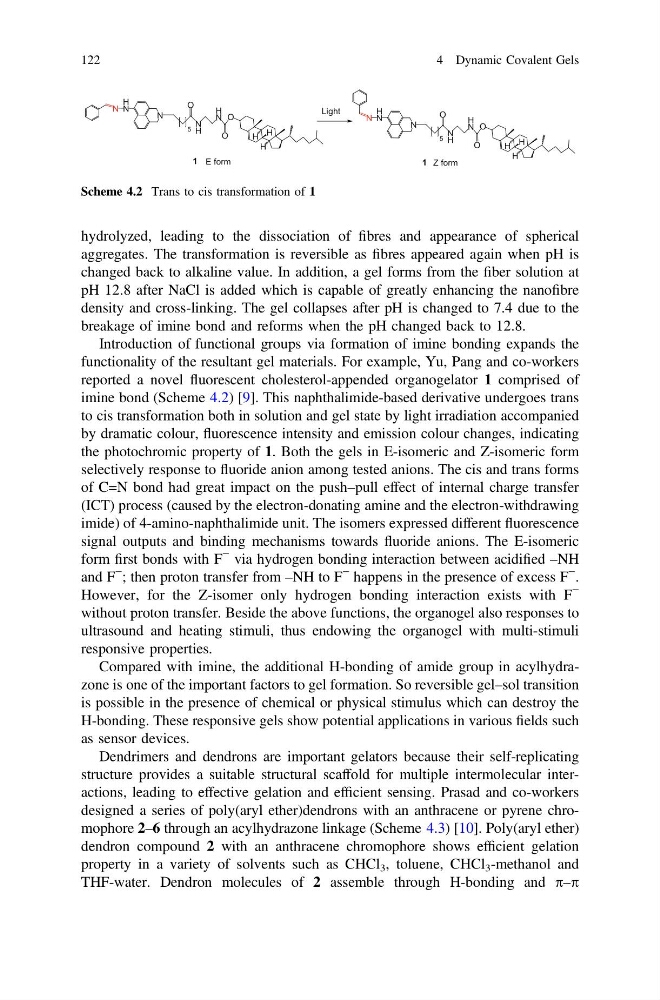
reported a novel fluorescent cholesterol-appended organogelator 1 comprised of
imine bond (Scheme 4.2) [9]. This naphthalimide-based derivative undergoes trans
to cis transformation both in solution and gel state by light irradiation accompanied
by dramatic colour, fluorescence intensity and emission colour changes, indicating
the photochromic property of 1. Both the gels in E-isomeric and Z-isomeric form
selectively response to fluoride anion among tested anions. The cis and trans forms
of C=N bond had great impact on the push–pull effect of internal charge transfer
(ICT) process (caused by the electron-donating amine and the electron-withdrawing
imide) of 4-amino-naphthalimide unit. The isomers expressed different fluorescence
signal outputs and binding mechanisms towards fluoride anions. The E-isomeric
form first bonds with F
− via hydrogen bonding interaction between acidified –NH
and F
− ; then proton transfer from –NH to F
− happens in the presence of excess F
− .
However, for the Z-isomer only hydrogen bonding interaction exists with F
−
without proton transfer. Beside the above functions, the organogel also responses to
ultrasound and heating stimuli, thus endowing the organogel with multi-stimuli
responsive properties.
Compared with imine, the additional H-bonding of amide group in acylhydrazone is one of the important factors to gel formation. So reversible gel–sol transition
is possible in the presence of chemical or physical stimulus which can destroy the
H-bonding. These responsive gels show potential applications in various fields such
as sensor devices.
Dendrimers and dendrons are important gelators because their self-replicating
structure provides a suitable structural scaffold for multiple intermolecular interactions, leading to effective gelation and efficient sensing. Prasad and co-workers
designed a series of poly(aryl ether)dendrons with an anthracene or pyrene chromophore 2–6 through an acylhydrazone linkage (Scheme 4.3) [10]. Poly(aryl ether)
dendron compound 2 with an anthracene chromophore shows efficient gelation
property in a variety of solvents such as CHCl 3 , toluene, CHCl 3 -methanol and
THF-water. Dendron molecules of 2 assemble through H-bonding and p–p
N
H
N
N
N
H
N
N
Light
E form
Z form
5
N
H
O
H
N O
O
H
H
H
1
1
5
N
H
O
H
N O
O
H
H
H
Scheme 4.2 Trans to cis transformation of 1
122
4 Dynamic Covalent Gels
aggregates. The transformation is reversible as fibres appeared again when pH is
changed back to alkaline value. In addition, a gel forms from the fiber solution at
pH 12.8 after NaCl is added which is capable of greatly enhancing the nanofibre
density and cross-linking. The gel collapses after pH is changed to 7.4 due to the
breakage of imine bond and reforms when the pH changed back to 12.8.
Introduction of functional groups via formation of imine bonding expands the
functionality of the resultant gel materials. For example, Yu, Pang and co-workers
reported a novel fluorescent cholesterol-appended organogelator 1 comprised of
imine bond (Scheme 4.2) [9]. This naphthalimide-based derivative undergoes trans
to cis transformation both in solution and gel state by light irradiation accompanied
by dramatic colour, fluorescence intensity and emission colour changes, indicating
the photochromic property of 1. Both the gels in E-isomeric and Z-isomeric form
selectively response to fluoride anion among tested anions. The cis and trans forms
of C=N bond had great impact on the push–pull effect of internal charge transfer
(ICT) process (caused by the electron-donating amine and the electron-withdrawing
imide) of 4-amino-naphthalimide unit. The isomers expressed different fluorescence
signal outputs and binding mechanisms towards fluoride anions. The E-isomeric
form first bonds with F
− via hydrogen bonding interaction between acidified –NH
and F
− ; then proton transfer from –NH to F
− happens in the presence of excess F
− .
However, for the Z-isomer only hydrogen bonding interaction exists with F
−
without proton transfer. Beside the above functions, the organogel also responses to
ultrasound and heating stimuli, thus endowing the organogel with multi-stimuli
responsive properties.
Compared with imine, the additional H-bonding of amide group in acylhydrazone is one of the important factors to gel formation. So reversible gel–sol transition
is possible in the presence of chemical or physical stimulus which can destroy the
H-bonding. These responsive gels show potential applications in various fields such
as sensor devices.
Dendrimers and dendrons are important gelators because their self-replicating
structure provides a suitable structural scaffold for multiple intermolecular interactions, leading to effective gelation and efficient sensing. Prasad and co-workers
designed a series of poly(aryl ether)dendrons with an anthracene or pyrene chromophore 2–6 through an acylhydrazone linkage (Scheme 4.3) [10]. Poly(aryl ether)
dendron compound 2 with an anthracene chromophore shows efficient gelation
property in a variety of solvents such as CHCl 3 , toluene, CHCl 3 -methanol and
THF-water. Dendron molecules of 2 assemble through H-bonding and p–p
N
H
N
N
N
H
N
N
Light
E form
Z form
5
N
H
O
H
N O
O
H
H
H
1
1
5
N
H
O
H
N O
O
H
H
H
Scheme 4.2 Trans to cis transformation of 1
122
4 Dynamic Covalent Gels